Facts
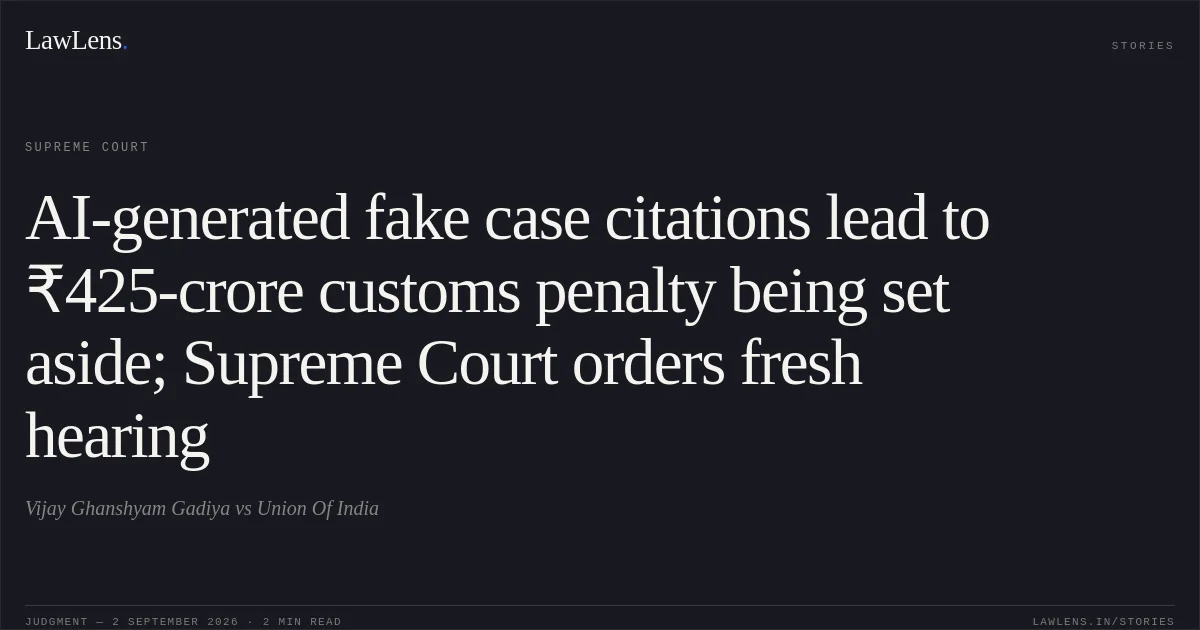
The Additional Commissioner of Customs, Surat, imposed a penalty of ₹425,27,99,100 on the appellant under Section 114 of the Customs Act, 1962, for allegedly mis-declaring natural diamonds as lab-grown diamonds to obtain a lower tariff, by Order-in-Original dated 8 October 2025.
Source reference: para. 2The appellant’s challenge before the Gujarat High Court was dismissed on 20 January 2026.
Source reference: para. 2Before the Supreme Court, the appellant contended that several judgments and articles relied upon by the adjudicating authority had been generated through Artificial Intelligence (“AI”).
Source reference: para. 3Upon verification, the Supreme Court found that some cited authorities were non-existent or bore fake citations, while others did not support the propositions attributed to them and appeared to be AI-generated hallucinations.
Source reference: para. 4Issues
Whether an adjudicatory order relying on non-existent, falsely cited, or inaccurately represented AI-generated judgments and articles is legally sustainable
Source reference: paras. 3–5Whether the High Court’s order and the Order-in-Original imposing the customs penalty should be set aside and the proceedings remanded for fresh adjudication
Source reference: paras. 7–8Law Applied
The Court applied Section 114 of the Customs Act, 1962, under which the penalty had been imposed for the alleged mis-declaration.
Source reference: para. 2It relied on Pooja Ramesh Singh v. Jammu & Kashmir Bank Ltd., 2026 SCC OnLine SC 1258, which established a zero-tolerance principle against producing, citing, or relying upon unverified AI-generated or hallucinated precedents; reliance on such material by counsel or a judge constitutes serious misconduct or a grave adjudicatory lapse, and a decision affected by such material is liable to be set aside as contrary to the integrity and sanctity of adjudication.
Source reference: para. 5The Court further recognised that AI may be used as an assistive tool in adjudication, but it cannot substitute for judicial or adjudicatory decision-making, and its output must be independently verified.
Source reference: para. 6Reasoning
The Supreme Court verified the authorities relied upon by the adjudicating authority and found that some were non-existent or supported by fake citations, while other genuine authorities had been inaccurately represented.
Source reference: paras. 4–5Applying the principle in Pooja Ramesh Singh, the Court held that reliance on dubious AI-generated material was not a mere technical irregularity but compromised the integrity of the adjudicatory process.
Source reference: paras. 4–5Although the Court did not examine the merits of the alleged customs mis-declaration, the tainted reliance on unverified AI-generated material rendered the penalty order unsustainable.
Source reference: para. 7Since the penalty order itself was affected, the High Court’s order confirming it could not stand.
Source reference: para. 7Holding
The Supreme Court allowed the appeal and set aside both the Gujarat High Court’s order and the Order-in-Original dated 8 October 2025.
The proceedings against the appellant were revived for fresh adjudication by an officer of the same rank, but not by the officer who had passed the impugned order.
Source reference: para. 8The Court left it to the appointing authority to consider, in accordance with law, whether action was warranted against the author of the original order.
Source reference: para. 11Acts & Sections Cited
1 provisions across 1 statute referred to in this judgment. Each provision opens on LawLens.
Customs Act,19621
Original Court PDF
Vijay Ghanshyam GadiyavsUnion Of India
Click to open original judgment
Original judgment, available to read, download and summarize on LawLens.in