Facts
The petitioner challenged an Air India disciplinary order dated 31 May 2013/1 July 2013 and, in a connected petition, sought disposal of a grievance petition dated 22 May 2015 and payment of ₹1,54,67,262, with interest
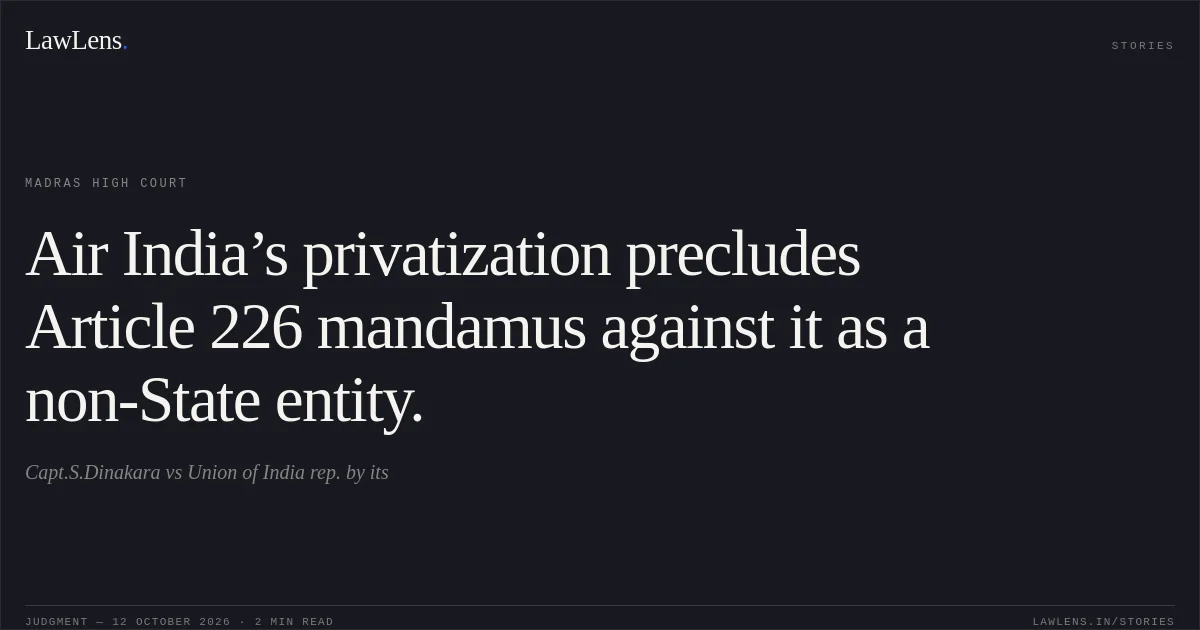
Source reference: pp. 2–3During the proceedings, the Court was informed that it had previously considered the maintainability of writ petitions against the respondents and, by order dated 16 September 2025, held that Air India’s change from a public-sector to a private-sector airline meant it could not be treated as “State” under Article 12
Source reference: para. 3, p. 4The Court dismissed both petitions, while preserving the petitioner’s right to pursue appropriate proceedings
Source reference: paras. 5–7, pp. 4–5Issues
Whether the writ petitions could be maintained against the respondents after Air India’s change in status from a public-sector to a private-sector airline
Source reference: paras. 3–4, p. 4Whether the Court could grant the requested relief under Article 226 in light of that change in status
Source reference: paras. 4–5, p. 4Law Applied
Article 12 determines whether an entity is “State” for the purposes of the Constitution. The Court relied on the Supreme Court’s decision in R.S. Madireddy and others v. Union of India and others, 2024 SCC OnLine SC 965, and its own order dated 16 September 2025, under which Air India’s changed status meant it could not be considered “State” under Article 12 for maintaining these writ petitions
Source reference: para. 3, p. 4The Court also referred to Section 14 of the Limitation Act, 1963, providing for exclusion of time spent bona fide pursuing a proceeding before a forum unable to entertain it, subject to sufficient cause
Source reference: para. 6, p. 4Reasoning
Applying its prior maintainability determination to the petitions before it, the Court held that Air India’s changed status prevented it from being treated as “State” under Article 12 and concluded that mandamus could not issue in the circumstances
Source reference: paras. 3–4, p. 4It did not decide the merits of the disciplinary challenge or the payment claim; instead, it preserved the petitioner’s ability to pursue those claims before an appropriate forum and provided for exclusion of the time spent in the writ proceedings, subject to sufficient cause
Source reference: paras. 5–6, p. 4Holding
The Court dismissed both writ petitions without costs and closed the connected miscellaneous petitions.
It preserved the petitioner’s right to initiate appropriate proceedings and directed that, if sufficient cause is shown, the period spent pursuing the writ petitions—from the filing date recorded by the Court, 23 April 2021, until receipt of the order—be excluded under Section 14 of the Limitation Act, 1963
Source reference: paras. 5–7, pp. 4–5Acts & Sections Cited
1 provisions across 1 statute referred to in this judgment. Each provision opens on LawLens.
Limitation Act, 19631
Original Court PDF
Capt.S.DinakaravsUnion of India rep. by its
Click to open original judgment
Original judgment, available to read, download and summarize on LawLens.in