Facts
The petitioner, a minor Muslim student, had studied in Tagore Public School, Attarsuiya, Prayagraj, from Classes VI to X while wearing a headscarf.
Source reference: paras. 1–5After passing Class X, she sought admission to Class XI but alleged that the School refused admission because she insisted on wearing the headscarf.
Source reference: paras. 1–5The School maintained that it was a co-educational, private unaided CBSE-affiliated institution with a uniform dress code applicable equally to all students, and that permitting the petitioner to add a headscarf would violate that code and affect institutional discipline.
Source reference: paras. 1–5The petitioner invoked Articles 14, 19(1)(a), 21 and 25 of the Constitution, claiming that wearing the headscarf was an expression of identity, protected her dignity and bodily integrity, and constituted an essential religious practice of Islam.
Source reference: para. 6Issues
Whether a student can claim an enforceable right to add a headscarf to the uniform prescribed by a private unaided school, contrary to its uniform dress code.
Source reference: para. 10Whether refusal to permit the petitioner to wear a headscarf with the prescribed uniform violated her rights under Articles 14, 19(1)(a), 21 or 25 of the Constitution.
Source reference: paras. 6, 10–11, 22Whether the petitioner’s previous wearing of a headscarf in Classes VI to X created an estoppel or vested right requiring the School to permit its continued use in Class XI.
Source reference: para. 10Whether the School’s uniform policy was bona fide, non-discriminatory and within its institutional power to regulate discipline and dress.
Source reference: paras. 10–11, 23Law Applied
The Court applied Articles 14, 19(1)(a), 21 and 25 of the Constitution, holding that fundamental rights must be assessed in their institutional context and are not absolute where their exercise conflicts with a bona fide, uniform and non-discriminatory dress code.
Source reference: paras. 14, 16, 22Article 25 protects freedom of conscience and religious practice, but a claim that a practice is an “essential religious practice” must be supported by appropriate pleadings and material.
Source reference: paras. 14, 16, 22The Court relied on Fathima Thasneem (Minor) v. State of Kerala , which recognized competing rights of students and private educational institutions and held that institutional management may determine whether departures from the uniform are permissible.
Source reference: para. 12Fathema Hussain Sayed v. Bharat Education Society , which held that requiring adherence to a school dress code does not, without more, violate Article 25.
Source reference: paras. 13–14The Karnataka Full Bench decision in Resham v. State of Karnataka , which held that hijab had not been established as an essential religious practice and that permitting it as an addition to a uniform could undermine uniformity and create social separation.
Source reference: paras. 15–19The Court also referred to T.M.A. Pai Foundation v. State of Karnataka and P.A. Inamdar v. State of Maharashtra regarding the institutional right to manage educational institutions, and to Pradeep Kumar Srivastava v. Ministry of Human Resource Development on judicial restraint in matters of school dress policy.
Source reference: paras. 11–12The interim order in Zainab Abdul Qayyum Choudhary v. Chembur Trombay Education Society was treated as non-binding because it contained no reasons and was provisional.
Source reference: para. 21Reasoning
The Court found that the School’s dress code was uniformly applicable to students of all communities and that the petitioner was not objecting to the prescribed uniform itself, but sought to add a headscarf to it.
Source reference: para. 10Such an addition would, in the School’s view, create an exception and undermine the concept of uniformity, discipline and institutional identity.
Source reference: para. 10The Court held that the petitioner’s earlier use of a headscarf, though apparently tolerated by the School, could have resulted from non-enforcement, inaction or courtesy and did not create a vested right or estoppel against subsequent enforcement of the uniform policy.
Source reference: para. 10Although the School was private and unaided, the Court held that it could be subject to writ jurisdiction because education is a public function, but clarified that the School was regulating institutional discipline rather than suppressing the petitioner’s faith.
Source reference: para. 23The petitioner’s assertion that wearing the headscarf was religiously obligatory was unsupported by authoritative religious material or sufficient pleadings; the record merely established that she had worn it since childhood and during her earlier schooling.
Source reference: para. 22In the absence of proof that non-wearing would fundamentally alter or jeopardize her faith, and in view of the consistent persuasive authority upholding uniform dress codes, the Court declined to interfere with the School’s policy.
Source reference: paras. 20–24Holding
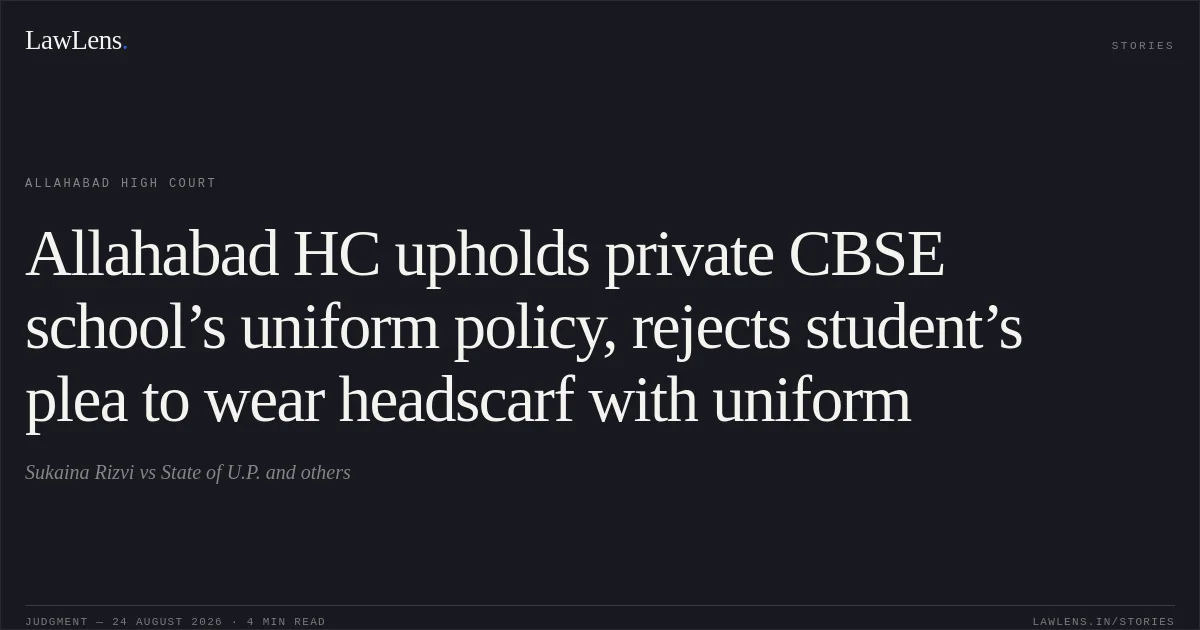
The Court held that a student has no enforceable right to compel a private unaided school to permit an additional item of attire contrary to a uniform dress code that is uniform, bona fide, non-discriminatory and intended to maintain discipline and institutional identity.
The petitioner failed to establish that wearing a headscarf in the classroom was an essential religious practice protected by Article 25 or that the School’s policy violated Articles 14, 19(1)(a) or 21.
Source reference: paras. 22–24The writ petition was dismissed, with no order as to costs.
Source reference: paras. 25–26Original Court PDF
Sukaina RizvivsState of U.P. and others
Click to open original judgment
Original judgment, available to read, download and summarize on LawLens.in
![Courts will not interfere with transfers absent mala fides or violation of statutory rules.. M Ramya vs EMPLOYEES STATE INSURANCE CORPORATION (ESIC). CAT - ['Chennai']. LawLens](/stories/thumbnails/courts-will-not-interfere-with-transfers-absent-mala-fides-or-violation-of-statutory-rules-a6845e9ca6f548fca284c51c8351957f.webp)
![Courts cannot direct one-time recruitment age relaxation absent authority in the governing rules or advertisement.. UT OF PUDUCHERRY vs M ANDAL. CAT - ['Chennai']. LawLens](/stories/thumbnails/courts-cannot-direct-one-time-recruitment-age-relaxation-absent-authority-in-the-governing-895d78fde47143e2a8ed0207c4b6a44f.webp)
![A review cannot correct an allegedly erroneous decision absent an error apparent on the record.. Ajit Kumar Jha vs RAILWAY BOARD. CAT - ['Delhi']. LawLens](/stories/thumbnails/a-review-cannot-correct-an-allegedly-erroneous-decision-absent-an-error-apparent-on-the-re-8ac952fd4eba470c92f7da20af72a220.webp)