Facts
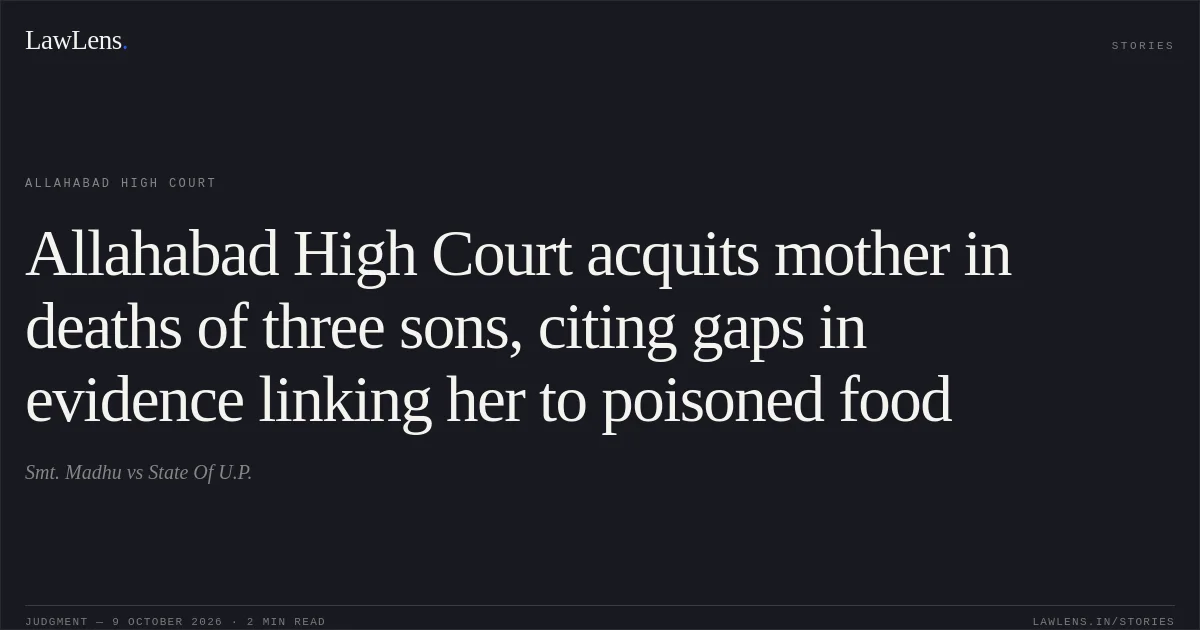
The appellant was convicted by the Additional Sessions Judge, Moradabad, under Sections 302 and 328 IPC for allegedly poisoning her three minor sons, who were found dead in a room in her parental home on 18 September 2012.
Source reference: para. 1–7, 15–27The prosecution relied on circumstantial evidence, including food samples in which the FSL detected poison, an empty plastic box recovered after the appellant’s arrest, and evidence alleging a motive connected with her proposed remarriage.
Source reference: para. 1–7, 15–27The High Court noted gaps in the evidence concerning the recovery and chain of custody of the food samples, proof that the children consumed the poisoned food, and the reliability of the alleged motive.
Source reference: para. 1–7, 15–27The trial court’s conviction and sentence were challenged in appeal
Source reference: para. 1–7, 15–27Issues
1. Whether the circumstantial evidence established beyond reasonable doubt that the appellant administered poison to her children and caused their deaths
Source reference: para. 19–27, 32–332. Whether Section 106 of the Indian Evidence Act could support an inference of guilt where the prosecution had not first established a prima facie case linking the appellant to the crime
Source reference: para. 28–31Law Applied
The charges were under Sections 302 and 328 IPC.
Source reference: no citationIn a circumstantial-evidence case, the prosecution must prove cogent and credible circumstances forming a complete chain consistent with guilt and inconsistent with the accused’s innocence
Source reference: para. 32Section 106 of the Indian Evidence Act, 1872, does not relieve the prosecution of its burden to prove guilt; it applies where proved facts permit a reasonable inference and the relevant matter is especially within the accused’s knowledge.
Source reference: para. 28Section 114 permits courts to draw appropriate factual presumptions, having regard to the ordinary course of events and human conduct
Source reference: para. 28The Court relied on Tulsiram Sahadu Suryawanshi v. State of Maharashtra, (2012) 10 SCC 373, and Anees v. State Govt. of NCT, 2024 INSC 368, for these principles
Source reference: para. 28–29Reasoning
The prosecution did not establish where or from whom the food samples were recovered; no recovery memo documented their seizure, and the investigating officer’s evidence did not identify the recovery place.
Source reference: para. 20–23The samples were sent for analysis six days later, and the evidence did not prove that the poisoned roti and sabzi were served to or consumed by the children.
Source reference: para. 20–23The postmortem reports recorded no food in the children’s stomachs, while the milk sample tested negative for poison; the recovered plastic box was empty and was not forensically examined
Source reference: para. 20–23The alleged motive and the testimony concerning the appellant’s relationship with P.W.-5 were not sufficiently corroborated
Source reference: para. 24–26Because the house was shared with other family members and the prosecution had not established the necessary foundational facts, Section 106 could not be used to shift the burden to the appellant
Source reference: para. 28–31Holding
The Court held that the prosecution had failed to prove the appellant’s guilt beyond reasonable doubt and that the circumstantial evidence did not form a complete chain
It allowed the appeal, set aside the conviction and sentence under Sections 302 and 328 IPC, and acquitted the appellant.
Source reference: para. 34–35It directed that she be released immediately unless required in another case
Source reference: para. 34–35Acts & Sections Cited
5 provisions across 2 statutes referred to in this judgment. Each provision opens on LawLens.
Indian Penal Code, 18602
Code of Criminal Procedure, 19733
Original Court PDF
Smt. MadhuvsState Of U.P.
Click to open original judgment
Original judgment, available to read, download and summarize on LawLens.in