Facts
The dispute concerned agricultural plots recorded as the bhumidhari holdings of Badlu.
Source reference: paras. 2–8Ram Kesh claimed to be Badlu’s biological son, born during the subsistence of his mother’s marriage with Budh Ram, and further claimed that Badlu had adopted him on 8 November 1970.
Source reference: paras. 2–8He alleged that the appellants had taken advantage of Badlu’s condition and fraudulently procured sale deeds dated 18/19 June 1973 in respect of the disputed land.
Source reference: paras. 2–8He therefore sued for cancellation of the sale deeds.
Source reference: paras. 2–8The Trial Court decreed the suit on 16 August 1979, holding that Ram Kesh was Badlu’s adopted son and that the sale transaction was invalid; the First Appellate Court affirmed the decree on 2 February 1980.
Source reference: paras. 2–8The appellants challenged the concurrent judgments in a second appeal under Section 100 CPC.
Source reference: para. 9Issues
1. Whether a Hindu male could validly adopt his own illegitimate biological son under the Hindu Adoptions and Maintenance Act, 1956?
Source reference: para. 9(i)2. Whether the concurrent finding that the impugned sale deed was not duly executed for consideration, and was fraudulently obtained, was vitiated by an error of law warranting interference in second appeal?
Source reference: para. 9(ii)Law Applied
The Court applied the Hindu Adoptions and Maintenance Act, 1956, particularly Sections 2, 6, 7, 9, 10, 11 and 12.
Source reference: paras. 15–17, 25–26The Act does not disqualify an illegitimate child from being adopted, and it contains no express prohibition against a Hindu male adopting his own biological but illegitimate son.
Source reference: paras. 15–17, 25–26Section 9 concerns the capacity to give a child in adoption, while Sections 6 and 7 concern the capacity and right to take a child in adoption; Section 9(4) applies only to exceptional cases involving a guardian and prior court permission.
Source reference: paras. 18–20, 27–28Section 11(vi) requires actual giving and taking of the child with the intention of transferring him to the adoptive family.
Source reference: para. 30In Lakshman Singh Kothari v. Smt. Rup Kanwar, AIR 1961 SC 1378, the Supreme Court held that giving and taking is the operative part of adoption.
Source reference: para. 30Under Kishori Lal v. Mst. Chaltibai, AIR 1959 SC 504, adoption must be proved by evidence free from suspicion and consistent with probability.
Source reference: para. 31The Court also applied the principles governing registered documents: registration and the registering officer’s endorsement are relevant evidence but do not immunise a transaction from challenge on grounds of fraud, want of free consent or undue influence.
Source reference: paras. 42–43Under Section 100 CPC, concurrent findings of fact cannot ordinarily be disturbed unless perverse, unsupported by evidence, based on misreading of material evidence or founded on an erroneous legal principle.
Source reference: paras. 51–52Reasoning
The Court held that Badlu’s status as the plaintiff’s biological father did not, by itself, invalidate the adoption.
Source reference: paras. 15–17, 25–26Illegitimacy was not a statutory disqualification under the Act, and Section 12 merely prescribed the effects of a valid adoption rather than prohibiting a biological father from adopting his illegitimate child.
Source reference: paras. 15–17, 25–26Although the First Appellate Court had incorrectly relied on Section 9(4), that error did not undermine its ultimate conclusion because the evidence showed that the plaintiff’s biological mother gave him in adoption and that the requisite ceremony of giving and taking was performed in 1970.
Source reference: paras. 27–38The testimony of the witnesses, supported by entries in revenue, school and other records, was concurrently accepted by both courts; the post-1976 documentary requirement under Section 16 did not apply retrospectively to an adoption made in 1970.
Source reference: paras. 27–38On the sale deeds, the Court found that registration and Badlu’s appearance before the Sub-Registrar were not conclusive of a voluntary and genuine transaction.
Source reference: paras. 44–50The courts below had considered the surrounding circumstances, Badlu’s condition, the manner in which he was taken to the registry office, and material inconsistencies in the defendants’ witnesses’ accounts regarding the alleged consideration of Rs. 6,000/-, Rs. 18,000/- and Rs. 3,000/-.
Source reference: paras. 44–50These findings were based on a cumulative appreciation of evidence and were neither perverse nor unsupported by evidence; therefore, reassessment of the facts was impermissible in second appeal.
Source reference: paras. 51–61Holding
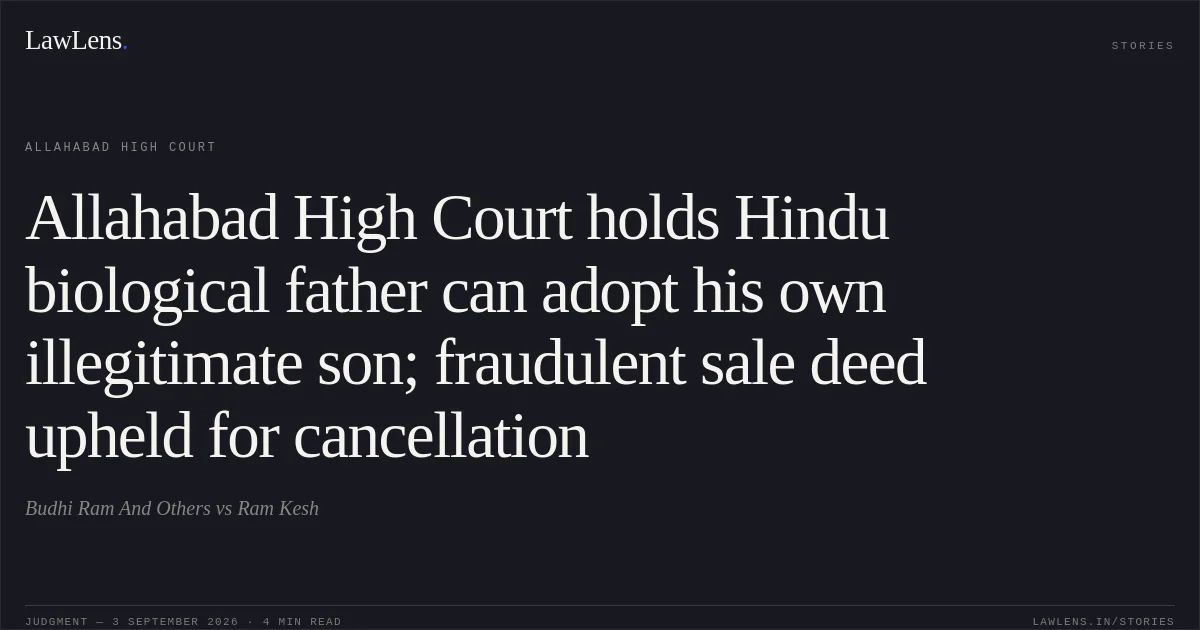
The Court answered the first issue in the affirmative: a Hindu male was not prohibited under the Hindu Adoptions and Maintenance Act, 1956, merely because he was the biological father of an illegitimate child, from taking that child in adoption, provided the statutory requirements were satisfied.
The plaintiff’s adoption was therefore sustainable on the evidence, notwithstanding the First Appellate Court’s erroneous reference to Section 9(4).
Source reference: para. 63The second issue was answered in the negative: the finding that the sale deeds were not genuine, voluntary transactions and had been fraudulently obtained was not vitiated by any error of law or perversity.
Source reference: para. 64The second appeal was dismissed, the judgments and decrees of the Trial Court and First Appellate Court were affirmed, and the appellants were directed to bear the costs.
Source reference: paras. 66–69Acts & Sections Cited
13 provisions across 4 statutes referred to in this judgment. Each provision opens on LawLens.
Code of Civil Procedure, 19081
Hindu Adoptions and Maintenance Act, 19568
Registration Act, 19083
Hindu Minority and Guardianship Act, 19561
Original Court PDF
Budhi Ram And OthersvsRam Kesh
Click to open original judgment
Original judgment, available to read, download and summarize on LawLens.in