01Facts
The applicant-informant lodged an FIR alleging sexual assault of a minor by opposite parties nos. 2 and 3.
After the police submitted a final report, the informant’s protest petition was allowed and the matter proceeded as a complaint case.
The Special Judge (POCSO Act) summoned the accused for offences under the B.N.S. and Sections 7/8 of the POCSO Act.
¶ 4The accused obtained anticipatory bail on 17 January 2026.
The informant sought cancellation, contending that the bail application had been decided without notice or an opportunity to be heard.
¶ 3–5On the High Court’s direction, the Special Judge confirmed that no court notice had been issued; the police notice relied upon did not establish how or to whom information had been given.
¶ 17–1802Issues
i.1. Whether anticipatory bail granted in a POCSO case without notice to, or an opportunity of hearing for, the victim or guardian is sustainable or liable to be set aside
¶ 9(i)ii.2. Whether such an order may be set aside for procedural illegality without proof that the accused misused the liberty granted
¶ 19–2003Law Applied
Rule 4(13)–(15) of the POCSO Rules, 2020 places responsibility on the SJPU or local police to inform the child and the child’s parent, guardian or trusted person about developments, court proceedings and the bail, release or detention status of the accused.
¶ 10, 12Section 40 of the POCSO Act entitles the child’s family or guardian to legal assistance, including assistance through the Legal Services Authority where necessary.
¶ 13In Jagjeet Singh v. Ashish Mishra @ Monu, the Supreme Court recognised a victim’s right to a fair and effective hearing in criminal proceedings, including bail proceedings.
¶ 15Mahipal v. Rajesh Kumar alias Polia establishes that a bail order may be set aside where it suffers from non-application of mind or other material infirmity.
¶ 21The Court distinguished setting aside an unlawful bail order from cancellation for supervening misconduct: procedural illegality may justify setting aside the order independently of any post-release misuse of liberty.
¶ 20Provisions in the judgment · 13 · Linked ones open on LawLens
Bharatiya Nyaya Sanhita, 2023 Section 74Section 115Section 351Section 352
Protection of Children from Sexual Offences Act, 2012 Section 7Section 8Section 40Section 45
Code of Criminal Procedure, 1973 Section 200Section 202Section 301
Bharatiya Nagarik Suraksha Sanhita, 2023 Section 223Section 225
04Reasoning
The Special Judge admitted that no notice was issued to the victim or informant before deciding the anticipatory bail application.
¶ 18The police notice did not reliably demonstrate service or effective communication of the application’s pendency.
¶ 18The Court held that the victim was thereby denied a fair opportunity to present relevant facts and concerns, contrary to the applicable statutory provisions and principles of natural justice.
¶ 20, 22–23Because the challenge concerned the legality of the order when made—not subsequent misconduct by the accused—the absence of evidence of bail misuse did not prevent the Court from setting it aside.
¶ 2005Holding
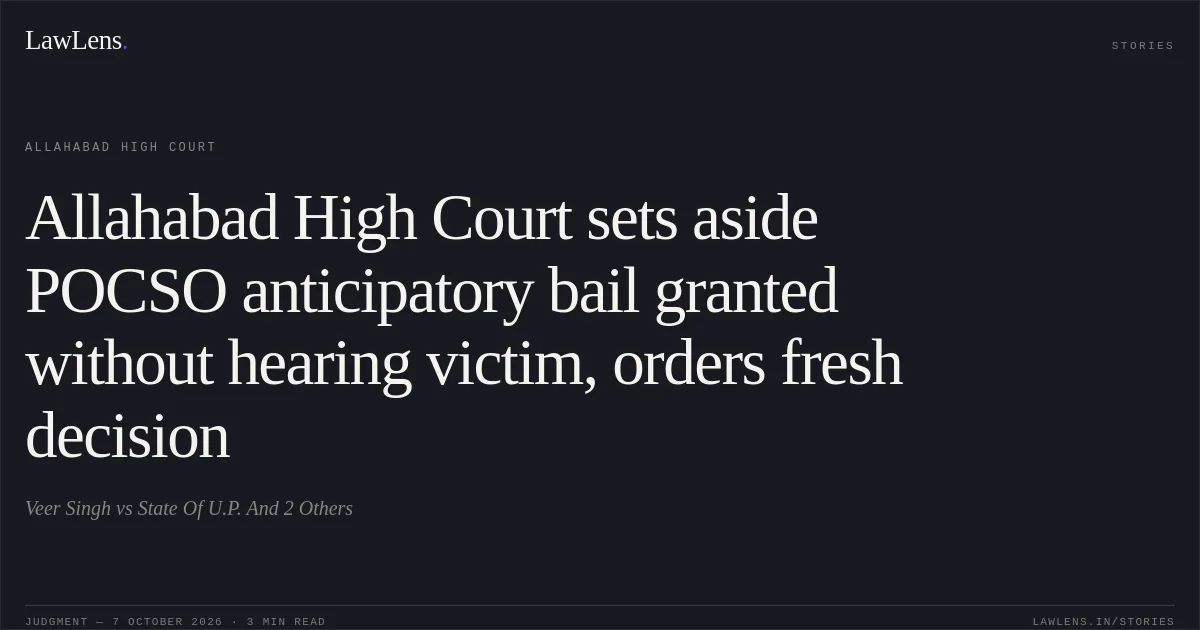
The Court answered the principal issue in the affirmative and held that the anticipatory bail order was unsustainable because it had been passed without affording the victim or guardian an opportunity of hearing.
¶ 23It allowed the application, set aside the order dated 17 January 2026 and remanded the anticipatory bail application for fresh determination after proper notice and a fair hearing to the victim and the State.
¶ 24The accused were protected from coercive action for six weeks to allow the Special Judge to hear and decide the restored application.
¶ 24(d)Original Court PDF
Veer SinghvsState Of U.P. And 2 Others
Click to open original judgment
Original judgment, available to read, download and summarize on LawLens.in