Facts
The prosecution alleged that, at approximately 2:00 a.m. on 16 October 1980, four armed persons forcibly entered the house of the victim, overpowered her husband and family members, and successively raped the victim. The informant, Bhagwan Das (her father-in-law), identified Roshan and Har Kishan, while two other assailants remained unidentified.
Source reference: para. 7The FIR was lodged promptly on the date of the occurrence, and the victim was medically examined the same day. The medical examination confirmed recent sexual intercourse, presence of spermatozoa, and that the victim was approximately 22 weeks pregnant, although no external injuries were initially detected.
Source reference: paras. 8–11, 45–48The victim’s statement was recorded under Section 161 Cr.P.C. on the date of the incident. She specifically named Roshan and Har Kishan and described their participation in the occurrence.
Source reference: paras. 31–33She died eleven days later, on 27 October 1980. The post-mortem examination found old lacerations and injuries to the internal and external genital organs, septicemia and toxemia, and a foetus of approximately six months’ gestation.
Source reference: paras. 12, 53–56The case was subsequently converted to one involving Section 304 IPC, and charges were framed under Sections 452, 376 and 304/34 IPC; however, the trial court convicted both accused only under Sections 452 and 376 IPC and sentenced each to three years’ rigorous imprisonment under Section 452 IPC and seven years’ rigorous imprisonment and fine under Section 376 IPC.
Source reference: paras. 4, 70–71During the pendency of the appeal, Roshan died and the appeal against him abated. The appeal therefore survived only in respect of Har Kishan.
Source reference: para. 3Issues
Whether the victim’s statement recorded under Section 161 Cr.P.C., after her subsequent death, could be treated as a dying declaration and relied upon under Section 32(1) of the Evidence Act?
Source reference: paras. 31–36, 51, 57–64Whether the oral, medical and documentary evidence established beyond reasonable doubt that Har Kishan committed house-trespass and rape punishable under Sections 452 and 376 IPC, despite the victim not being examined at trial and the absence of external injuries at her initial medical examination?
Source reference: paras. 45–59, 65–69Whether the appellant was entitled to have his sentence reduced to the period already undergone on account of the passage of more than forty years since the occurrence?
Source reference: paras. 5–6, 72–73Law Applied
The Court applied Sections 452 and 376 IPC concerning house-trespass and rape, and considered the effect of the subsequent death of the victim under Section 32(1) of the Evidence Act.
Source reference: no citationIt relied on Sri Bhagwan v. State of U.P., (2013) 12 SCC 137, for the principle that a statement originally recorded under Section 161 Cr.P.C. may, upon the maker’s death and where its contents satisfy Section 32(1), assume the character of a dying declaration.
Source reference: para. 63It relied on Ravi v. State of Tamil Nadu, (2006) 9 SCC 240, for the rule that a truthful and voluntary dying declaration may by itself support conviction, corroboration being only a rule of prudence.
Source reference: para. 64The Court further applied the principles in Mohd. Imran Khan v. State (NCT of Delhi), (2011) 10 SCC 192, that a sexual-assault victim is not an accomplice, that her testimony does not require corroboration as a matter of law, and that reliable testimony may form the sole basis of conviction.
Source reference: paras. 60–61It also relied on Surendra Kumar v. State of Punjab, (2012) 12 SCC 120, for the proposition that a dying declaration has no prescribed form and need not necessarily be recorded by a Magistrate.
Source reference: para. 62Reasoning
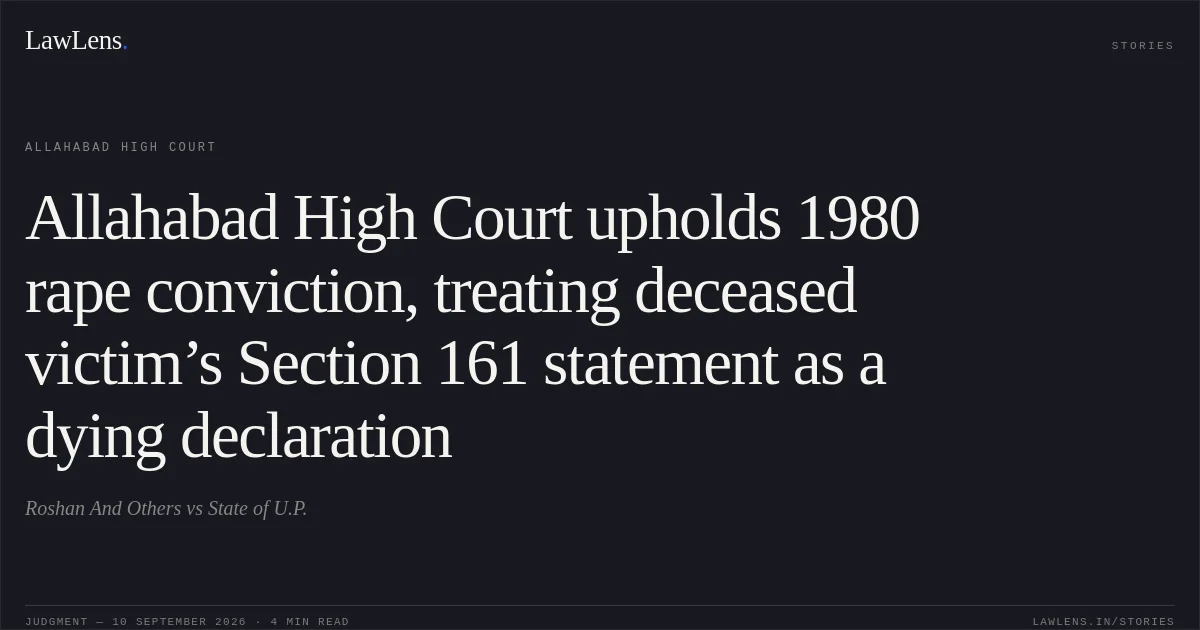
The Court held that the victim’s statement was recorded promptly on the date of the occurrence, consistently named Roshan and Har Kishan, and was later proved by the Investigating Officer. Since the victim died from injuries allegedly arising out of the occurrence, the statement could be considered under Section 32(1) of the Evidence Act despite having been recorded under Section 161 Cr.P.C.
Source reference: paras. 51, 57–64The statement was materially corroborated by Bhagwan Das and the victim’s husband, both of whom claimed to have witnessed the occurrence, as well as by the prompt FIR and identification of the accused from the outset.
Source reference: paras. 7, 16–17, 26–30, 65–67The absence of external injuries at the initial examination did not, in the Court’s view, discredit the prosecution because the later post-mortem examination recorded healed lacerations, genital injuries and septicemia caused by infection of the internal and external genital organs.
Source reference: paras. 45–48, 53–59The Court treated the medical evidence as corroborative rather than determinative and found that the doctor’s concessions in cross-examination did not negate the core medical opinion.
Source reference: paras. 45–48, 53–59Considering the evidence cumulatively, the Court found no reasonable basis for false implication or for disturbing the trial court’s findings.
Source reference: paras. 65–70The Court also declined to extend sentencing leniency merely because the incident was several decades old, given the seriousness of the offences and the sentence imposed by the trial court.
Source reference: paras. 5–6, 71–73Holding
The High Court dismissed Har Kishan’s appeal and affirmed his conviction and sentences under Sections 452 and 376 IPC.
It held that the victim’s Section 161 Cr.P.C. statement was admissible and capable of being treated as a dying declaration under Section 32(1) of the Evidence Act, and that the prosecution evidence proved the charges beyond reasonable doubt.
Source reference: paras. 68–71The appeal against Roshan had already abated due to his death.
Source reference: paras. 3, 71Har Kishan, being on bail, was directed to surrender before the trial court within fifteen days; his bail bonds were to be cancelled and the sureties discharged upon surrender. He was directed to undergo the remaining sentence, with any period already undergone to be set off in accordance with law.
Source reference: paras. 72–73Acts & Sections Cited
10 provisions across 2 statutes referred to in this judgment. Each provision opens on LawLens.
Indian Penal Code, 18607
Code of Criminal Procedure, 19733
Original Court PDF
Roshan And OthersvsState of U.P.
Click to open original judgment
Original judgment, available to read, download and summarize on LawLens.in