Facts
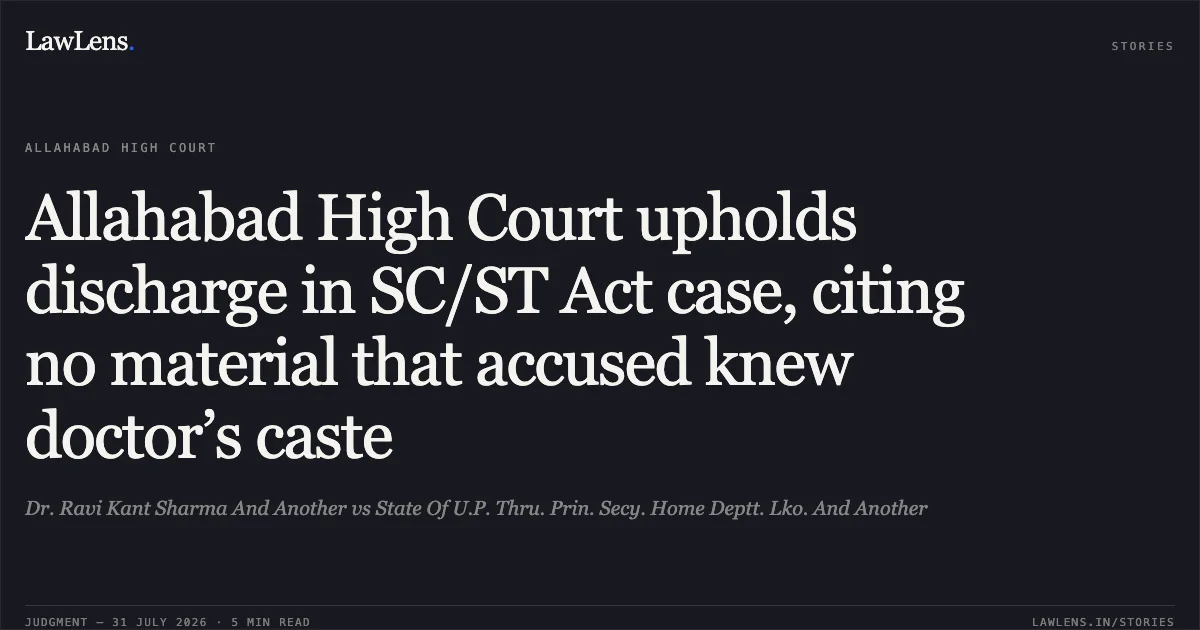
The appellants challenged, under Section 14-A(1) of the Scheduled Castes and Scheduled Tribes (Prevention of Atrocities) Act, 1989 (“SC/ST Act”), the order dated 9 June 2026 by which the Special Judge, SC/ST Act, Hardoi discharged Opposite Party No. 2, Umesh Chand Trivedi, in Sessions Case No. 1416 of 2024 arising from Case Crime No. 368 of 2024.
Source reference: paras. 1–2The FIR was lodged by Appellant No. 1, Dr. Ravi Kant Sharma, a Medical Officer at the Community Health Centre, Bilgram, alleging that Opposite Party No. 2 quarrelled with Appellant No. 2, Dr. Liyaqat Ali, and, when Dr. Sharma intervened, abused him by using a casteist expression, threatened him and assaulted him with fists and kicks.
Source reference: para. 3Dr. Sharma stated that he belonged to the Chamar caste and that the accused had addressed him as “sale chamatte”.
Source reference: para. 4Statements of other CHC employees supported the prosecution version, while the medical examination recorded abrasions, swelling and pain on Dr. Sharma’s face and body.
Source reference: paras. 5–6After investigation, a charge-sheet was filed for offences under Sections 121, 115(2), 352, 351(3), 132 and 221 of the Bharatiya Nyaya Sanhita, 2023 (“BNS”), and Sections 3(2)(va), 3(1)(r) and 3(1)(s) of the SC/ST Act; cognizance was taken on 9 December 2024.
Source reference: para. 7The accused sought discharge, asserting that he had visited the CHC for a tetanus injection after injuring his thumb, that the medical staff were intoxicated and refused treatment, and that he had been falsely implicated.
Source reference: para. 8The appellants filed no objection to the discharge application.
Source reference: para. 9The trial court held that the FIR and investigation material did not establish that the accused knew Dr. Sharma or his caste, questioned the reliability of the medical examination conducted by Dr. Liyaqat Ali, and found the prosecution version improbable.
Source reference: paras. 10–11Issues
1. Whether the allegations and investigation material disclosed a prima facie offence under Sections 3(1)(r), 3(1)(s) and 3(2)(va) of the SC/ST Act, particularly where there was no material showing that the accused knew the complainant’s caste or acted against him because of that caste?
Source reference: paras. 20–242. Whether the trial court was justified in discharging the accused by assessing the alleged improbability of the prosecution case, the circumstances of the altercation and the reliability of the medical examination at the discharge stage?
Source reference: paras. 10–11, 25–273. Whether the impugned discharge order suffered from any illegality warranting interference in an appeal under Section 14-A(1) of the SC/ST Act?
Source reference: paras. 1–2, 30–31Law Applied
The Court applied Section 14-A(1) of the SC/ST Act concerning appeals against orders of Special Courts, Section 250 of the BNSS concerning discharge, and Sections 3(1)(r), 3(1)(s) and 3(2)(va) of the SC/ST Act.
Source reference: no citationIt relied on Subhash Kashinath Mahajan v. State of Maharashtra, (2018) 6 SCC 454, and the review decision in Union of India v. State of Maharashtra, (2018) 6 SCC 450, for the proposition that the protective scheme of the SC/ST Act does not prevent judicial scrutiny where no prima facie case is made out or the complaint appears patently false or mala fide.
Source reference: paras. 14–18Prathvi Raj Chauhan v. Union of India, (2020) 4 SCC 727, was relied upon for the Court’s power to prevent abuse of the process of law in exceptional cases.
Source reference: para. 19Under Hitesh Verma v. State of Uttarakhand, (2020) 10 SCC 710, mere proof that the victim belongs to a Scheduled Caste or Scheduled Tribe is insufficient; the prosecution must show an intention to humiliate the victim because of that status.
Source reference: para. 22Masumsha Hasanasha Musalman v. State of Maharashtra, (2000) 3 SCC 557, was cited for the requirement that the underlying offence must have been committed against the victim on the basis of his or her Scheduled Caste or Scheduled Tribe identity.
Source reference: para. 23The Court also invoked the general principle that vague, false or vexatious criminal proceedings may be terminated at the threshold to prevent abuse of the criminal justice system.
Source reference: paras. 28–29Reasoning
The Court held that the material did not establish that Opposite Party No. 2 knew Dr. Sharma beforehand or knew that he belonged to a Scheduled Caste.
Source reference: paras. 20–24In the Court’s view, the use of the surname “Sharma” did not disclose Scheduled Caste identity, and there was no other material showing caste-based knowledge or intent.
Source reference: paras. 20–24Consequently, the essential requirement that the alleged humiliation or assault be committed because of the victim’s caste was found absent.
Source reference: paras. 20–24The Court further endorsed the trial court’s view that the altercation had initially arisen between the accused and Dr. Liyaqat Ali, while Dr. Sharma intervened later; it considered the medical examination suspect because Dr. Liyaqat Ali, allegedly involved in the incident, conducted it himself.
Source reference: para. 25The absence of any explanation in the FIR or witness statements for the altercation, coupled with the accused’s account that he had gone to obtain a tetanus injection, was treated as undermining the prosecution version and making the defence version appear more natural.
Source reference: para. 26The Court also relied on the investigating officer’s note regarding agitation among doctors and possible protests to infer that the investigation may have been influenced by that apprehension.
Source reference: para. 27On this basis, it concluded that the prosecution was an apparent abuse of the SC/ST Act and that no prima facie case required the accused to face trial.
Source reference: paras. 29–30Holding
The High Court answered the principal issues against the appellants.
It held that the alleged casteist abuse and assault did not prima facie satisfy the requirement of caste-based intent or knowledge under the SC/ST Act, and that the trial court had committed no error in discharging Opposite Party No. 2.
Source reference: paras. 24, 30The criminal appeal was dismissed for lack of merit, and the discharge order dated 9 June 2026 was upheld.
Source reference: para. 31The Court directed that a copy of the judgment be communicated to the Director General, Medical Health, and the Additional Chief Secretary, Medical Health, State of Uttar Pradesh.
Source reference: para. 38Acts & Sections Cited
14 provisions across 5 statutes referred to in this judgment. Each provision opens on LawLens.
Scheduled Castes and the Scheduled Tribes (Prevention of Atrocities) Act, 19892
Bharatiya Nyaya Sanhita, 20237
Bharatiya Nagarik Suraksha Sanhita, 20232
Code of Criminal Procedure, 19732
Indian Penal Code, 18601
Original Court PDF
Dr. Ravi Kant Sharma And AnothervsState Of U.P. Thru. Prin. Secy. Home Deptt. Lko. And Another
Click to open original judgment
Original judgment, available to read, download and summarize on LawLens.in


![Subsequent exoneration does not retrospectively invalidate a finalized promotion select list.. UNNIKRISHNAN M vs M/o Environment And Forests. CAT - ['Ernakulam']. LawLens](/stories/thumbnails/subsequent-exoneration-does-not-retrospectively-invalidate-a-finalized-promotion-select-li-ce80a0e84f2f4887857271e8b4341c42.webp)