Facts
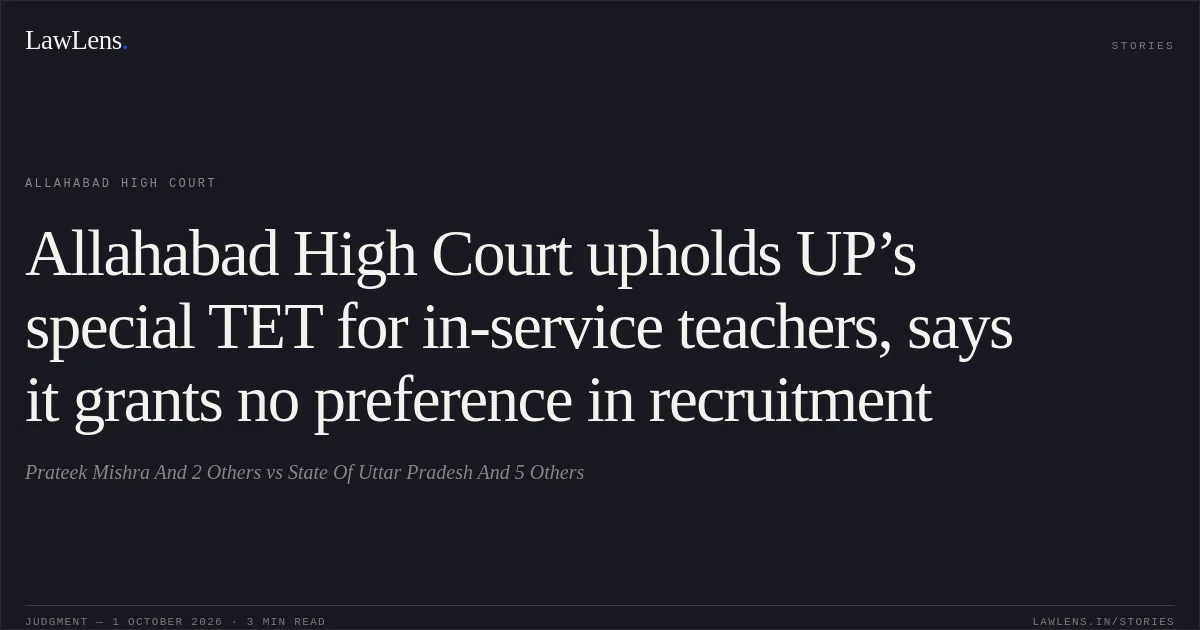
The petitioners, who had qualified the regular Teacher Eligibility Test (TET) and were awaiting teacher recruitment, challenged the State Government Order dated 2 September 2026 and consequential memorandum/advertisement dated 3 September 2026.
Source reference: para. 2–3, 20–21, 27Those measures provided for a Special TET for certain in-service teachers appointed before 23 August 2010; the petitioners did not challenge the provision concerning candidates with special needs.
Source reference: para. 2–3, 20–21, 27They sought to quash the measures, alleging that a separate test could dilute NCTE-prescribed standards and adversely affect their opportunity for public employment.
Source reference: para. 9–15, 20–21The State maintained that the Special TET would enable in-service teachers to acquire the qualification required under the statutory scheme and Supreme Court directions.
Source reference: para. 22–29The High Court dismissed the petition.
Source reference: para. 50Issues
1. Whether the State Government’s decision to conduct a Special TET for the concerned in-service teachers was contrary to the RTE Act and NCTE-prescribed standards, or otherwise arbitrary under Articles 14 and 16.
Source reference: para. 20–21, 31, 482. Whether providing those teachers an opportunity to qualify TET, without more, caused legally cognizable prejudice to the petitioners or conferred an unconstitutional preference in recruitment.
Source reference: para. 32–34, 39–47Law Applied
Section 23(1) of the Right of Children to Free and Compulsory Education Act, 2009 (RTE Act) empowers the designated academic authority, NCTE, to prescribe minimum teacher qualifications; the NCTE notifications make passing TET a mandatory qualification for covered teachers.
Source reference: para. 10–11, 23Section 23(2), as amended, provides a framework for existing teachers to acquire prescribed minimum qualifications.
Source reference: para. 4–5In Anjuman Ishaat-e-Taleem Trust v. State of Maharashtra, 2025 SCC OnLine SC 1912, the Supreme Court held TET mandatory for teachers covered by the statutory scheme and allowed the relevant in-service teachers time to qualify; the subsequent review extended the deadline to 31 August 2028 and called for periodic opportunities to take TET.
Source reference: para. 35–36Articles 14 and 16 prohibit arbitrary discrimination and guarantee equality of opportunity in public employment, but do not prevent a class of candidates from acquiring a prescribed minimum qualification; any recruitment preference must have lawful authority.
Source reference: para. 39–40, 45–46The Full Bench decision in Anand Kumar Yadav v. Union of India, 2015 (8) ADJ 338, recognizes the importance of TET to teaching standards and NCTE’s authority to prescribe qualifications.
Source reference: para. 8, 10Reasoning
The Court treated the Special TET as a means of enabling the concerned in-service teachers to obtain—not avoid—the mandatory TET qualification within the period allowed by the Supreme Court.
Source reference: para. 37, 41, 47The order did not reserve vacancies, award additional marks or weightage, or otherwise grant a preference in recruitment; passing the Special TET would only satisfy a threshold qualification.
Source reference: para. 38–40The petitioners’ existing TET qualifications remained valid, and they retained the opportunity to compete under the applicable recruitment rules.
Source reference: para. 42–43Their qualification and expectation of consideration did not amount to a vested right to appointment or prevent others from acquiring the same minimum qualification.
Source reference: para. 42–43Any future preference unsupported by the rules or Supreme Court directions could be challenged when a recruitment process occurred, but that possibility did not justify invalidating the present order.
Source reference: para. 45–47Holding
The Court held that the Special TET order, on its face, neither diluted the mandatory TET requirement nor created a preferential right to appointment or promotion, and therefore did not establish a present violation of Articles 14 or 16.
The writ petition was dismissed.
Source reference: para. 50The petitioners were left at liberty to challenge any subsequent recruitment action that grants an unauthorised preference or advantage.
Source reference: para. 50Acts & Sections Cited
2 provisions across 1 statute referred to in this judgment. Each provision opens on LawLens.
Right of Children to Free and Compulsory Education Act, 20092
Original Court PDF
Prateek Mishra And 2 OthersvsState Of Uttar Pradesh And 5 Others
Click to open original judgment
Original judgment, available to read, download and summarize on LawLens.in