Facts
The Petitioners filed a suit for declaration and injunction in 1997 regarding property in Village Tikri Kalan
Source reference: p. 1The suit was dismissed for non-prosecution on 25.09.2008
Source reference: p. 2An application for restoration under Order IX Rule 9 CPC was dismissed on 22.09.2014 due to non-payment of costs
Source reference: p. 5A second application to restore the restoration application was dismissed on 08.08.2016 as time-barred
Source reference: p. 6After withdrawing a petition under Article 227 and a subsequent application in 2017, the Petitioners filed an appeal under Order XLIII Rule 1(c) CPC along with a Section 5 Limitation Act application
Source reference: p. 2The Appellate Court dismissed the appeal and the condonation application on 28.11.2025, leading to the present challenge
Source reference: p. 3Issues
1. Whether the Petitioners established "sufficient cause" under Section 5 of the Limitation Act to condone a delay of approximately 32 months
Source reference: p. 10 / para. 7.262. Whether a litigant can seek exclusion of time under the Limitation Act for periods spent pursuing successive, non-statutory restoration applications instead of the prescribed appellate remedy
Source reference: p. 13-14 / para. 13Law Applied
The court applied Section 5 of the Limitation Act, 1963, which requires the applicant to show "sufficient cause" for delay, noting that while the term should be construed pragmatically per State (NCT of Delhi) v. Ahmed Jaan, it does not permit a total lack of due diligence
Source reference: p. 15The court considered Section 35B of the CPC regarding the effect of non-payment of costs and Order XLIII Rule 1(c) regarding appealable orders
Source reference: p. 5, p. 10The court distinguished Jaswant Singh v. Parkash Kaur, clarifying that the maintainability of an appeal does not automatically entitle a party to condonation of delay
Source reference: p. 14-15Reasoning
The Court reasoned that the Petitioners were negligent by failing to pursue the statutory appellate remedy against the 2014 order for nearly two years, choosing instead to file successive restoration applications
Source reference: p. 13It held that a party cannot keep limitation in abeyance by pursuing different proceedings and then seeking condonation after failing therein, as this would encourage dilatory tactics
Source reference: p. 14The Court rejected the argument that "liberty to avail appropriate remedy" granted in earlier Article 227 proceedings operated to condone prior delays or entitle them to automatic exclusion of time
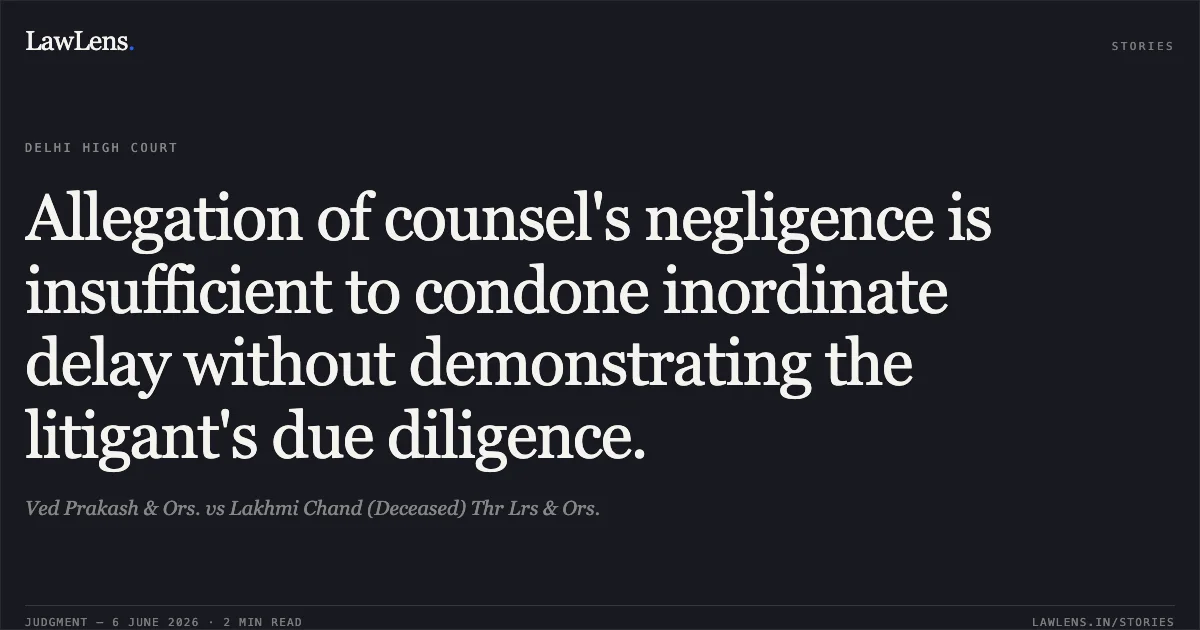
Source reference: p. 14The Court found the "negligent counsel" plea insufficient, stating that litigants have a duty to remain vigilant and cannot pindown entire blame on advocates to excuse inordinate delays
Source reference: p. 16Holding
The Court held that the Petitioners failed to demonstrate "sufficient cause" or due diligence
The Court dismissed the petition and affirmed the Appellate Court’s findings that the delay was substantial and unexplained, and that mere maintainability of an appeal under Order XLIII Rule 1(c) does not dispense with the requirement to satisfy Section 5 of the Limitation Act
Source reference: p. 15-17Acts & Sections Cited
2 provisions across 2 statutes referred to in this judgment. Linked provisions open on LawLens.
Code of Civil Procedure, 19081
Limitation Act, 19631
Original Court PDF
Ved Prakash & Ors.vsLakhmi Chand (Deceased) Thr Lrs & Ors.
Click to open original judgment
Original judgment, available to read, download and summarize on LawLens.in


