01Facts
The complainant married Dr. Rishi Raj in July 2019
¶ 3.1In March 2021, the husband filed for divorce
¶ 3.2A year later, in March 2022, the complainant filed an FIR alleging dowry demands (specifically a BMW car), physical assault, and an attempt at strangulation by her husband, father-in-law, mother-in-law, and sister-in-law
¶ 3.3, 3.4Police filed a chargesheet, and the Judicial Magistrate took cognizance in September 2022
¶ 3.7, 3.8The accused family members moved the High Court under Section 482 CrPC to quash the proceedings.
¶ 3.10The High Court quashed the case against the sister-in-law, citing "general and omnibus" allegations, but refused relief to the father-in-law and mother-in-law (the appellants), finding a prima facie case against them
¶ 3.1002Issues
i.1. Whether the High Court was justified in refusing to quash the criminal proceedings against the parents-in-law while quashing them for the sister-in-law on the same set of general allegations
¶ 7ii.2. Whether the criminal proceedings against the appellants were liable to be quashed as a "counter-blast" to the previously instituted divorce petition
¶ 803Law Applied
The Court applied the principles governing the quashing of criminal proceedings under Section 482 of the Code of Criminal Procedure, 1973
¶ 3.9It emphasized the legal standard that criminal proceedings cannot be sustained when allegations against relatives of the husband are "general and omnibus" in nature, lacking specific overt acts, dates, or individual roles
¶ 7, 10The Court also took into account the principle that proceedings initiated as a "counter-blast" to matrimonial litigation (such as a divorce petition) with significant delay and lack of specificity may be quashed to prevent the abuse of the process of law
¶ 5, 8Provisions in the judgment · 7 · Linked ones open on LawLens
Hindu Marriage Act, 1955 Section 13
Indian Penal Code, 1860 Section 341Section 323Section 34
Dowry Prohibition Act, 1961 Section 3Section 4
Code of Criminal Procedure, 1973 Section 482
04Reasoning
The Supreme Court observed that the allegations against the appellants were materially identical to those levelled against the sister-in-law
¶ 7No specific or overt acts, dates, or places were attributed to the parents-in-law, other than a vague assertion that they "would quarrel," which does not constitute a criminal offence under IPC Sections 341, 323, or 498A
¶ 7The Court highlighted that the High Court erred by applying a "different standard" to persons standing on an identical footing
¶ 10Furthermore, the FIR was lodged nearly a year after the husband filed for divorce, and while delay alone is not always fatal, in this case, it supported the submission that the complaint was an afterthought or counter-blast to the matrimonial dispute
¶ 805Holding
The Supreme Court allowed the appeal and set aside the High Court’s order
¶ 11It held that since the allegations against the appellants were general and omnibus, they could not be distinguished from the sister-in-law who was granted relief
¶ 10The Court quashed all proceedings arising out of L.N.M.U. P.S. Case No. 81 of 2022 specifically against the father-in-law and mother-in-law
¶ 11It clarified that the criminal trial against the husband would proceed as he had not sought quashing and the allegations against him were not the subject of this appeal
¶ 9Original Court PDF
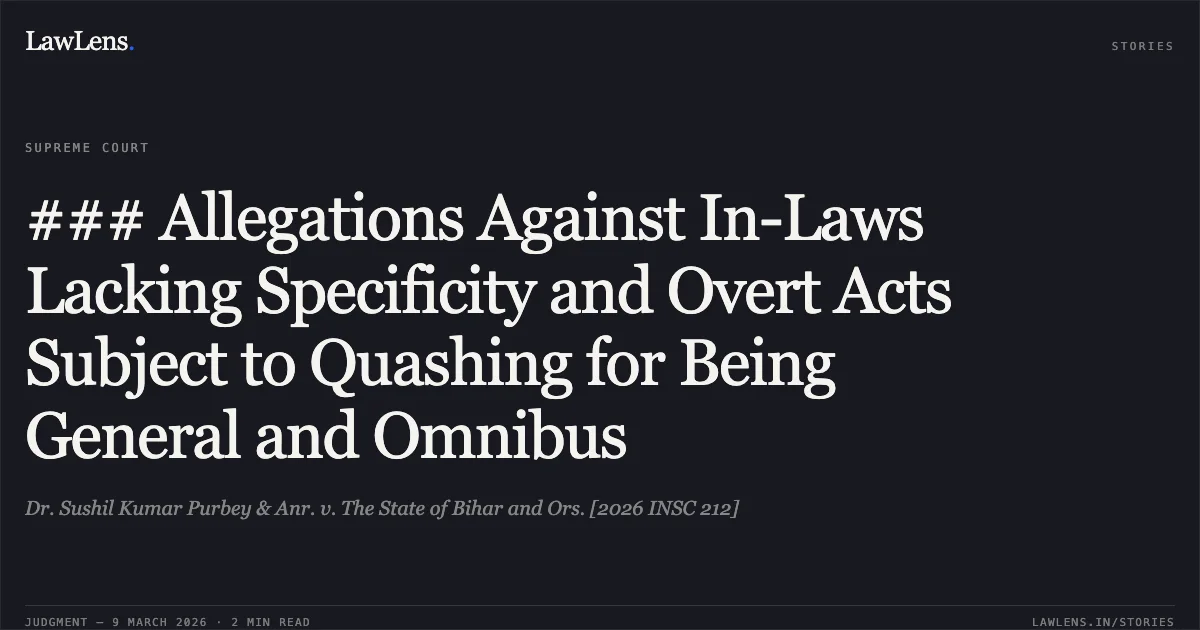
Dr. Sushil Kumar Purbey & Anr. v. The State of Bihar and Ors. [2026 INSC 212]
Click to open original judgment
Original judgment, available to read, download and summarize on LawLens.in