Facts
The complainant alleged that he entered into a registered agreement to purchase land from petitioner No. 1 on 23 March 2015, made payments said to total ₹3.75 crore, and that a general power of attorney was subsequently executed.
Source reference: p. 3–4, 7–8He further alleged that, after the land was converted, petitioner No. 1 gifted portions to family members and executed sale deeds for plots in favour of others, despite the agreement.
Source reference: p. 3–4, 7–8The police registered Crime No. 284/2019 for offences under Sections 406 and 420 IPC.
Source reference: p. 2–3, 5The petitioners sought to quash the FIR under Section 482 Cr.P.C., contending that the dispute was civil in nature; petitioner No. 1 had died, and the Court recorded that the petition had abated against him.
Source reference: p. 2–3, 5The State opposed quashing, submitting that investigation remained incomplete.
Source reference: p. 6Issues
1. Whether the allegations in the complaint disclosed offences under Sections 406 and 420 IPC so as to warrant continuation of the investigation.
Source reference: p. 6–82. Whether the Court should exercise its inherent jurisdiction under Section 482 Cr.P.C. to quash the FIR on the ground that the dispute was civil in nature.
Source reference: p. 4–6, 8–9Law Applied
Section 482 Cr.P.C. empowers the High Court to prevent abuse of process and secure the ends of justice.
Source reference: p. 6–7In considering a request to quash an FIR, the Court must examine the complaint’s contents and determine whether they disclose the commission of an offence; where the allegations attract the ingredients of an offence, the Court should not undertake to quash the FIR, and investigation remains within the Investigating Officer’s domain.
Source reference: p. 6–7The Court relied on Dineshbhai Chandubhai Patel v. State of Gujarat, (2018) 3 SCC 104.
Source reference: p. 6–7The alleged offences were under Sections 406 and 420 IPC.
Source reference: p. 2Reasoning
The Court considered the allegations that an agreement and general power of attorney had been executed, that payments had been made, and that the land was later gifted to family members and sold in plots to others.
Source reference: p. 7–8Whether the petitioners acted with an intention to cheat, including whether such intention existed when the agreement was made, required investigation and could not be determined at the FIR-quashing stage.
Source reference: p. 8The Court distinguished the earlier quashing order relied on by the petitioners because that case involved different alleged offences and allegations concerning creation of documents.
Source reference: p. 8–9It therefore declined to treat the matter as merely civil for purposes of quashing the FIR.
Source reference: p. 8–9Holding
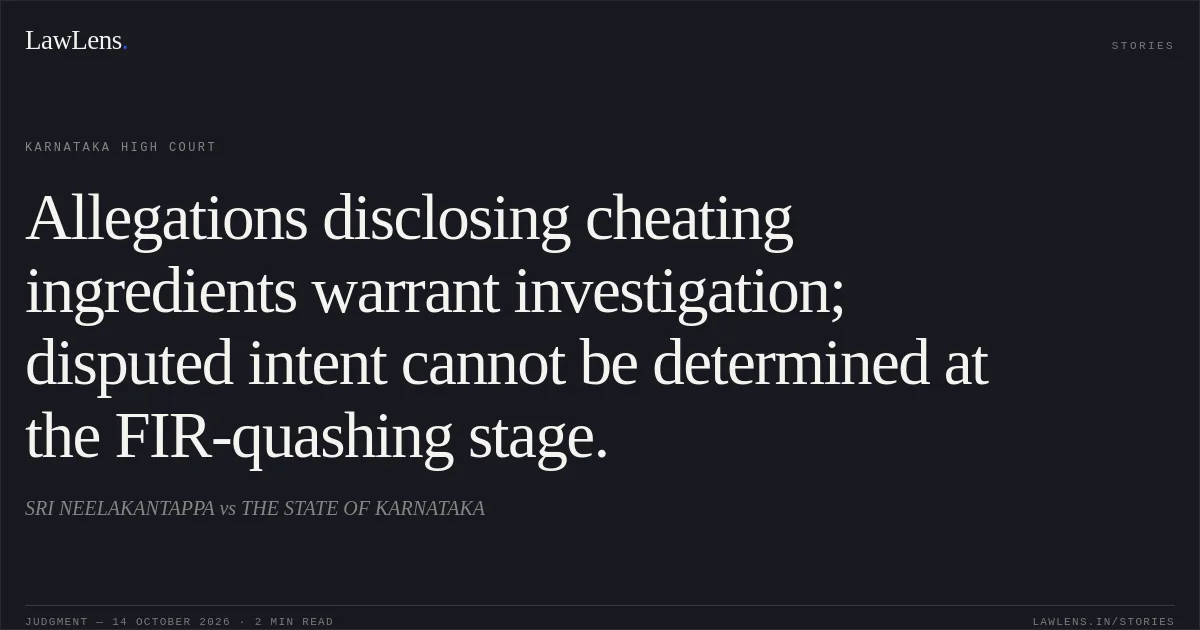
The Court held that the complaint contained specific allegations requiring investigation and that this was not a fit case for exercising jurisdiction under Section 482 Cr.P.C.
The criminal petition was dismissed; the petition had abated against petitioner No. 1 following his death.
Source reference: p. 3, 9Acts & Sections Cited
7 provisions across 2 statutes referred to in this judgment. Each provision opens on LawLens.
Code of Criminal Procedure, 19731
Indian Penal Code, 18606
Original Court PDF
SRI NEELAKANTAPPAvsTHE STATE OF KARNATAKA
Click to open original judgment
Original judgment, available to read, download and summarize on LawLens.in


