Facts
The Respondent No. 2 filed a complaint under Section 138 of the Negotiable Instruments (NI) Act against the Petitioner regarding the dishonour of a cheque for Rs. 50,00,000 dated 21.08.2010
Source reference: p. 2The Respondent alleged that the Petitioner received earnest money for a property sale but failed to execute the documents, subsequently entering into an MOU on 21.08.2010 to settle the matter by issuing the subject cheque
Source reference: p. 2The Petitioner moved for quashing, contending that the cheque and supporting documents were forged by a "crime syndicate" (including the Respondent's brother) who had trapped her husband in a predatory loan scheme in 2007
Source reference: p. 3-4The Petitioner relied on an FSL report and EOW investigations in FIR No. 0236/2013 and FIR No. 0831/2014, which suggested certain sale documents were forged
Source reference: p. 5-7Notably, the Petitioner had previously filed two quashing petitions and a revision petition for discharge, all of which were dismissed
Source reference: p. 7, 11Issues
Whether a complaint under Section 138 of the NI Act can be quashed under Section 482 Cr.P.C. on the grounds of alleged forgery and lack of legal liability when the signatures on the cheque are admitted.
Source reference: p. 14 / para. 44-46Whether the findings of a police investigation/cancellation report in a related FIR are sufficient to quash a private complaint under the NI Act without a trial.
Source reference: p. 10 / para. 29, 31Law Applied
The court applied Section 482 of the Cr.P.C., which grants inherent powers to prevent abuse of the process of any court but must be exercised sparingly only when no offense is disclosed on the face of the complaint
Source reference: p. 14It referred to the principle in *Subramanium Sethuraman v. State of Maharashtra* regarding the remedy for seeking discharge in summons cases
Source reference: p. 8It further noted the restricted scope of interference at the pre-trial stage as established in *Pepsi Foods Ltd. v. Judicial Magistrate*, emphasizing that courts should not conduct "mini-trials" or evaluate disputed defense evidence under Section 482
Source reference: p. 8, 14Reasoning
The Court observed that the Petitioner did not dispute her signatures on the cheque
Source reference: p. 14While the Petitioner argued that the underlying transaction was fraudulent and supported by forged documents, the Court noted that the Respondent claimed the cheque was issued pursuant to a specific MOU dated 21.08.2010, which the Respondent asserted was valid and distinct from the documents under investigation in the FIRs
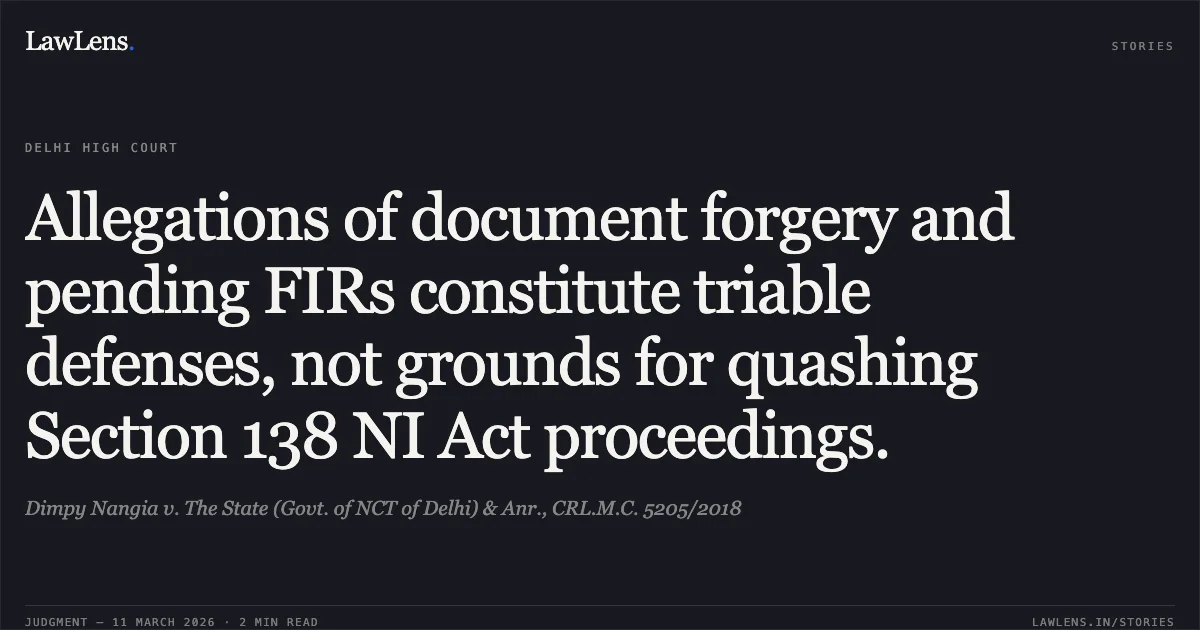
Source reference: p. 12, 15The Court found that the allegations of forgery, the absence of a debt, and the impact of the FSL reports are secondary defenses that must be proved through evidence during a trial
Source reference: p. 15Furthermore, the court highlighted that the Petitioner’s repeated attempts to seek quashing and discharge had already been rejected by coordinate benches and lower courts, indicating an attempt to stall proceedings
Source reference: p. 11, 15Holding
The Court dismissed the petition, holding that there was no merit in the prayer for quashing
It ruled that since the signatures on the cheque were not questioned, the Petitioner's claims regarding the manipulation of the MOU and lack of liability are matters of defense to be adjudicated at trial
Source reference: p. 15-16The court concluded that the continuation of the proceedings did not amount to an abuse of process
Source reference: p. 14, 16Original Court PDF
Dimpy Nangia v. The State (Govt. of NCT of Delhi) & Anr., CRL.M.C. 5205/2018
Click to open original judgment
Original judgment, available to read, download and summarize on LawLens.in