Facts
The Petitioners, acting as promotional agents for a cryptocurrency venture, were accused of orchestrating a digital assets fraud. A complaint was lodged alleging that the Petitioners induced the informant to invest ₹13,540 in a scheme named "MVC (My Victory Club)" and a fake entity called "Digi Mudra Pvt. Ltd."
Source reference: p.2It was alleged that over ₹5 crores were collected from multiple districts under the false promise of high returns and the listing of a fake digital coin called ‘SIITO’ on major exchanges like Binance
Source reference: p.7-8Following the investigation, a charge-sheet was filed for offences under Sections 419, 420, 465, 467, 471, 120-B, and 34 of the IPC, alongside Sections 66C and 66D of the IT Act
Source reference: p.2The Petitioners moved the High Court seeking to quash the proceedings, contending the dispute was purely commercial and that cryptocurrency trading is a legal activity
Source reference: p.3-4Issues
1. Whether the inherent powers of the High Court under Section 528 of the BNSS (erstwhile Section 482 of the Cr.P.C) should be exercised to quash a criminal proceeding where a charge-sheet has been filed and prima facie allegations of fraud exist
Source reference: p.10 / para. 62. Whether the dissemination and promotion of cryptocurrency, when used as a façade for fraudulent inducement and misappropriation, constitutes a purely commercial loss or a criminal offence under the IPC
Source reference: p.11-13 / para. 9-11Law Applied
The Court applied Section 528 of the Bharatiya Nagarik Suraksha Sanhita (BNSS), which preserves the inherent power of the High Court to prevent abuse of the process of law
Source reference: p.1It relied on the foundational principles of Section 420 of the IPC (cheating), emphasizing that mens rea must exist at the inception of the transaction for a breach of promise to become a criminal offence
Source reference: p.12 / para. 12The Court referred to Internet Mobile Association of India v. RBI regarding the status of virtual currency
Source reference: p.3prioritized the "sparing use" doctrine for quashing proceedings as established in Neeharika Infrastructure Pvt. Ltd. v. State of Maharashtra and Central Bureau of Investigation v. Aryan Singh, which mandate that Courts should not conduct a "mini-trial" at the quashing stage
Source reference: p.9, 15Reasoning
The Court reasoned that while cryptocurrency is a recognized virtual digital asset, its legal status does not grant immunity if it is used as a "cloak for fraudulent conduct"
Source reference: p.13-14The Court distinguished between a mere commercial failure and criminal cheating, noting that the allegations—including the creation of fictitious entities like "Digi Mudra" and the promotion of a non-existent coin ‘SIITO’—suggested a dishonest intention from the very inception
Source reference: p.11-12It rejected the Petitioners' defense that they were mere subordinate agents, holding that such factual determinations regarding the extent of their participation and knowledge require a full-fledged trial and meticulous appreciation of evidence, which is outside the scope of Section 528 of the BNSS
Source reference: p.14-15the Court highlighted that economic offences involving systematic fraud against multiple victims must be viewed with higher seriousness as they impact public confidence in financial systems
Source reference: p.14Holding
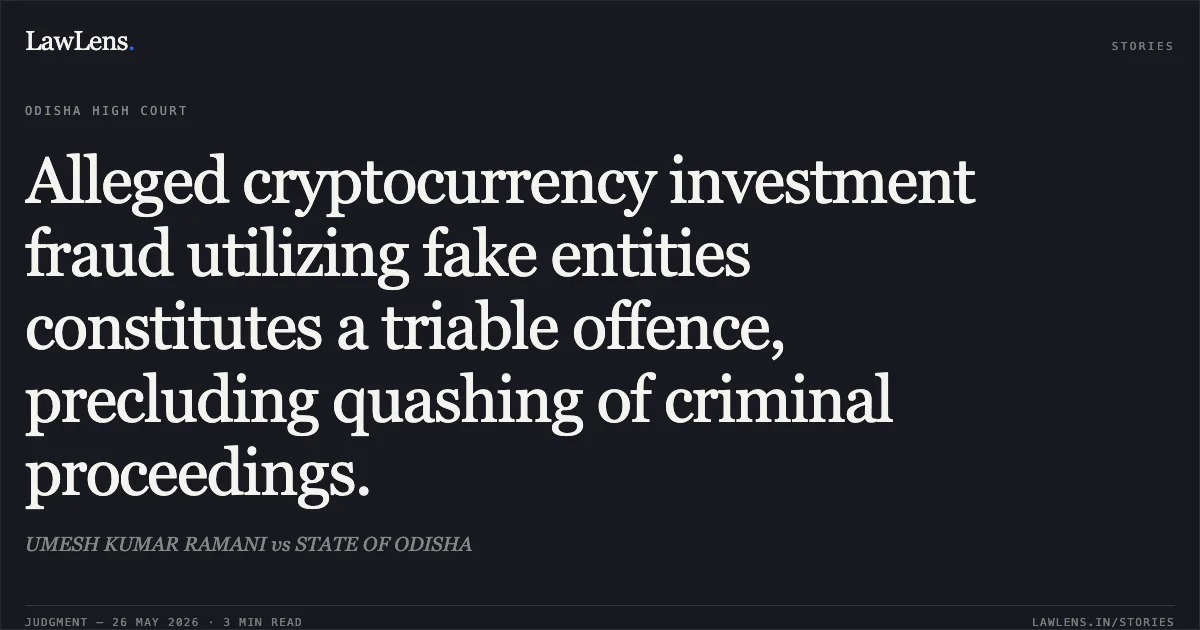
The High Court dismissed the petitions, holding that the allegations in the FIR and the materials in the charge-sheet prima facie disclosed the commission of cognizable offences.
The Court concluded that since the case involves triable issues and serious accusations of financial deception, quashing the proceeding at the threshold would amount to stifling a legitimate prosecution. The prayer for quashing the criminal proceedings in G.R. Case No. 1303 of 2024 was refused.
Source reference: p.16Acts & Sections Cited
10 provisions across 4 statutes referred to in this judgment. Each provision opens on LawLens.
Indian Penal Code, 18607
Code of Criminal Procedure, 19731
Bharatiya Nagarik Suraksha Sanhita, 20231
Bharatiya Nyaya Sanhita, 20231
Original Court PDF
UMESH KUMAR RAMANIvsSTATE OF ODISHA
Click to open original judgment
Original judgment, available to read, download and summarize on LawLens.in