Facts
The petitioner, a resident of Village Ridauli, Tehsil Ater, District Bhind, approached the High Court under Article 226 of the Constitution alleging encroachment upon Government land and obstruction of a public drainage channel.
Source reference: p.2Survey No. 1261, measuring 2.88 hectares, was stated to be recorded as Government grazing land (Charagah), while Survey No. 1263, measuring 0.44 hectare, was stated to be recorded as Government Khal-Khaddar/public drain land.
Source reference: p.2The petitioner alleged that private respondents had unlawfully cultivated or occupied the Government land and blocked the drainage channel, causing accumulation of rainwater, flooding and waterlogging in the village.
Source reference: pp.2–3He further alleged that villagers seeking protection of the land and restoration of the drain were subjected to threats and intimidation.
Source reference: pp.2–3The petitioner sought inspection and demarcation, removal of encroachments, restoration of the drainage channel, initiation of revenue and criminal proceedings, and protection from threats.
Source reference: p.1The State submitted that the allegations involved factual questions requiring verification of revenue records and, if necessary, spot inspection and demarcation by the competent authority.
Source reference: p.4Issues
Whether the alleged encroachment upon Government land bearing Survey No. 1261 and obstruction of the public drainage channel over Survey No. 1263 required factual verification, inspection and demarcation by the competent revenue authority?
Source reference: pp.4–5Whether the High Court should itself adjudicate the allegations under Article 226 or direct the competent authority to examine and decide the petitioner’s pending representation in accordance with law?
Source reference: p.5Whether any unauthorized encroachment or obstruction, if established after due inquiry, should be removed and consequential action taken after affording hearing to affected persons?
Source reference: p.5Law Applied
The Court exercised its jurisdiction under Article 226 of the Constitution of India, while recognising that disputed factual questions concerning the status of land, the extent of encroachment and obstruction, and the necessity of demarcation are ordinarily to be examined by the competent administrative or revenue authority.
Source reference: pp.4–5The Court relied on Jagpal Singh and Others v. State of Punjab and Others, (2011) 11 SCC 396, which emphasises protection of village common and public utility lands from unauthorized occupation and restoration of such lands for common use.
Source reference: pp.3–5The judgment also requires that eviction or consequential action against alleged unauthorized occupants be undertaken in accordance with law, after issuance of notice and provision of a reasonable opportunity of hearing.
Source reference: pp.3–5Reasoning
The Court held that the petitioner’s allegations raised disputed questions of fact regarding the revenue classification of Survey Nos. 1261 and 1263, the existence and extent of any encroachment, and the alleged obstruction of the drainage channel.
Source reference: p.4Since these matters required examination of revenue records and potentially a spot inspection and demarcation, the Court declined to determine the merits directly in writ proceedings.
Source reference: p.4Instead, consistent with the principle in Jagpal Singh protecting public and common lands, it directed the Collector or other competent authority to examine the petitioner’s pending representation.
Source reference: pp.4–5The authority was required to conduct such verification, inspection and demarcation as necessary and to provide a reasonable opportunity of hearing to all concerned persons before taking any consequential action.
Source reference: pp.4–5Holding
The petition was disposed of without expressing any opinion on the merits of the alleged encroachment or obstruction.
The Collector, District Bhind, or the competent authority was directed to decide the petitioner’s pending representation by a reasoned and speaking order, preferably within four weeks of receiving a certified copy of the order.
Source reference: p.5The authority was directed to verify the relevant revenue records and undertake inspection or demarcation if necessary, after hearing all concerned persons.
Source reference: p.5If unauthorized encroachment or obstruction was found, appropriate action was to be taken strictly in accordance with law.
Source reference: pp.5–6Original Court PDF
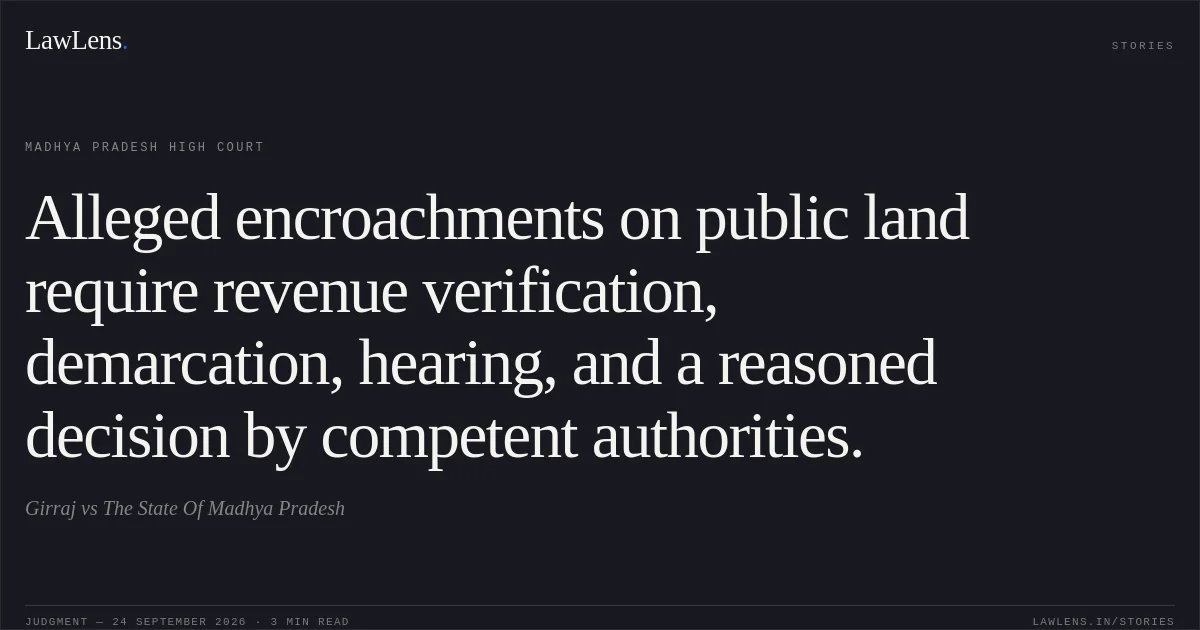
GirrajvsThe State Of Madhya Pradesh
Click to open original judgment
Original judgment, available to read, download and summarize on LawLens.in
![Land acquisition alone creates no enforceable right to public employment absent statutory or applicable policy entitlement.. MAHESH KR SINGH vs RAILWAY. CAT - ['Patna']. LawLens](/stories/thumbnails/land-acquisition-alone-creates-no-enforceable-right-to-public-employment-absent-statutory-1a15be750fd3445f9b58d68728e76006.webp)