01Facts
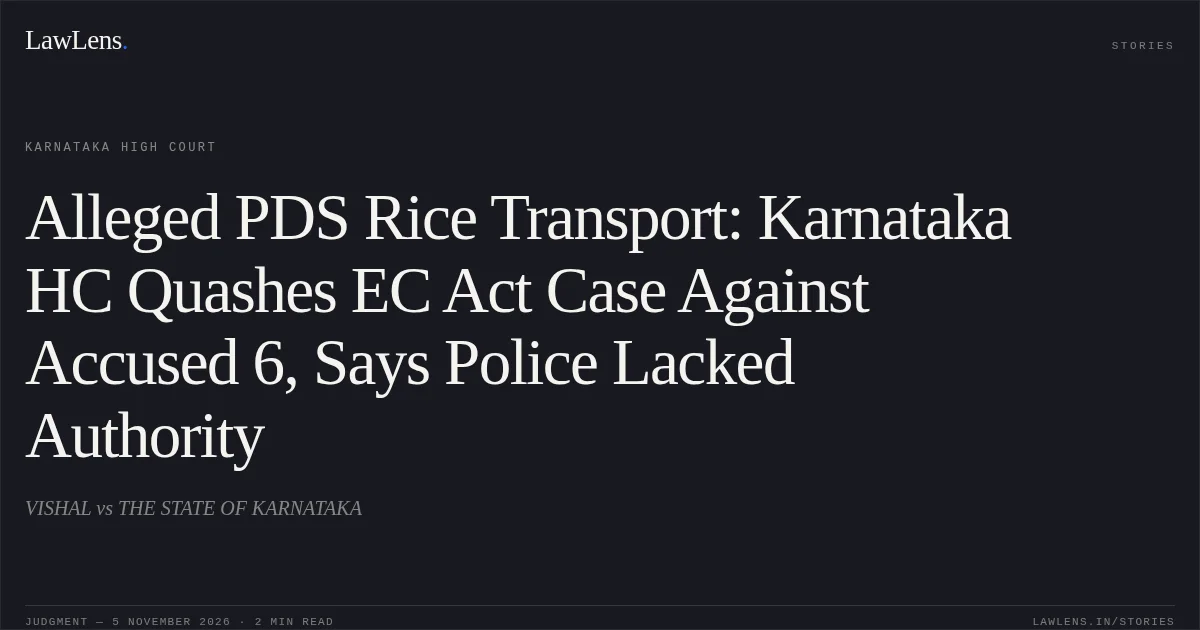
The petitioner, Accused No. 6, sought quashing of proceedings under Sections 3 and 7 of the Essential Commodities Act, 1955, arising from Crime No. 87/2021 and pending in C.C. No. 124/2022.
pp. 2–5The prosecution alleged that, following information received by a police officer, three trucks carrying rice allegedly meant for the Public Distribution System were stopped and seized while being transported from Gurumitkal towards Gujarat.
pp. 2–5The police later filed a charge sheet against the petitioner and others.
pp. 2–5The petitioner contended that there was no material against him apart from statements made by Accused Nos. 2 to 5.
pp. 2–502Issues
i.1. Whether the proceedings under Sections 3 and 7 of the Essential Commodities Act could continue against the petitioner when the material against him consisted only of statements by co-accused.
pp. 5–6ii.2. Whether the police had authority to register the case, seize the alleged commodity, and investigate the alleged offences under the Essential Commodities Act.
pp. 6–903Law Applied
The Court considered Sections 3 and 7 of the Essential Commodities Act, 1955, concerning the alleged contravention and its punishment, and Section 528 of the Bharatiya Nagarik Suraksha Sanhita, 2023, as the source of its inherent power to prevent abuse of the process of court.
p. 2, 7It applied the principle that investigation and seizure for alleged violations of the Act must be undertaken by an officer authorised under the Act; proceedings initiated by police lacking the requisite authority are unsustainable.
pp. 6–7The Court relied on three coordinate-Bench orders concerning proceedings under the Act.
p. 5Although the petitioner also invoked Section 114(b) of the Indian Evidence Act regarding the need for corroboration of an accomplice’s evidence, the order does not set out a separate determination of that argument.
p. 5Provisions in the judgment · 4 · Linked ones open on LawLens
Code of Criminal Procedure, 1973 Section 482
Bharatiya Nagarik Suraksha Sanhita, 2023 Section 528
04Reasoning
The Court found that the investigation had produced no material against the petitioner other than statements of Accused Nos. 2 to 5.
p. 6It further concluded that the police lacked jurisdiction to register the case and lacked authority to seize the commodity, because those powers lay with an authorised officer under the Essential Commodities Act.
pp. 6–7Applying the coordinate-Bench decisions and its inherent powers under Section 528 BNSS, the Court held that continuing the prosecution against the petitioner would amount to an abuse of process.
p. 705Holding
The Court allowed the petition and quashed the proceedings in C.C. No. 124/2022, arising from Crime No. 87/2021, insofar as the petitioner/Accused No. 6 was concerned.
pp. 7–8Any pending interim application was disposed of as not surviving for consideration.
p. 8Original Court PDF
VISHALvsTHE STATE OF KARNATAKA
Click to open original judgment
Original judgment, available to read, download and summarize on LawLens.in