Facts
The Petitioner, Stonex India Private Limited, claimed prior adoption, extensive use, goodwill, and registrations in the mark STONEX and formative/device marks in relation to marble, granite, slabs, natural stones, and allied goods falling in Class 19.
Source reference: pp. 2–4; paras. 2–4Respondent No. 1 obtained registration of a device mark containing the dominant expression STONEX WORLD under Trade Mark Application No. 5957794 in Class 19.
Source reference: pp. 3–4; para. 5Following a cease-and-desist notice, Respondent No. 1 relied on the registration and contended that the addition of “WORLD” and non-use of “STONEX” in isolation distinguished the marks.
Source reference: p. 4; para. 5The Petitioner sought cancellation of the registration under Section 57 of the Trade Marks Act, 1999, alleging deceptive similarity and procedural manipulation.
Source reference: pp. 5–6; paras. 7–8It contended that Respondent No. 1 had initially uploaded only a fragmented device mark, omitting the words “STONEX WORLD”, and later secured acceptance of the complete mark through Form TM-M without substantive re-examination or comparison with the Petitioner’s earlier marks.
Source reference: pp. 5–6; paras. 7–8Respondent No. 1 did not appear and was proceeded ex parte; Respondent No. 2 stated that the omission was a clerical error and that the registration had been granted in statutory compliance.
Source reference: p. 7; para. 9Issues
1. Whether the impugned registration was obtained through procedural manipulation or in violation of the examination requirements under Section 18(4) of the Trade Marks Act, 1999 read with Rule 33 of the Trade Marks Rules, 2017.
Source reference: pp. 7–10; paras. 11–132. Whether the impugned STONEX WORLD device mark was identical with or deceptively similar to the Petitioner’s prior STONEX marks, thereby attracting the prohibition under Section 11(1) of the Trade Marks Act, 1999.
Source reference: pp. 10–11; paras. 14–153. Whether the registration was liable to be cancelled and removed from the Register under Section 57 of the Trade Marks Act, 1999.
Source reference: pp. 7, 11; paras. 11, 16Law Applied
The Court applied Section 57 of the Trade Marks Act, 1999, which empowers the High Court or Registrar to cancel or vary a registration where there has been a contravention or failure to observe statutory requirements or where an incorrect entry remains on the Register.
Source reference: p. 7; para. 11Section 18(4) requires the Registrar to examine an application and either refuse it or accept it subject to appropriate amendments, conditions, or limitations, while Rule 33 of the Trade Marks Rules, 2017 mandates examination of the application and a search of earlier registered or pending marks for identical or deceptively similar marks covering identical or similar goods or services.
Source reference: p. 7; para. 11Section 11(1) prohibits registration of a mark that is identical or deceptively similar to an earlier mark in respect of identical or similar goods where such similarity is likely to cause confusion.
Source reference: pp. 9–10; para. 13Applying M/s. South India Beverages Pvt. Ltd. v. General Mills Marketing & Anr., 2014 SCC OnLine Del 1953, and Pernod Ricard India Private Limited v. Karanveer Singh Chhabra, 2025 SCC OnLine SC 1701, the Court held that although marks must ordinarily be compared as a whole, identification of a dominant feature is permissible; the anti-dissection rule and the dominant-mark principle are complementary.
Source reference: pp. 10–11; para. 14Reasoning
The Court found that the original application contained an incomplete or fragmented device mark omitting “STONEX WORLD”. The Registry’s first Examination Report expressly recognised this omission and directed Respondent No. 1 to confine the mark to the device as uploaded.
Source reference: pp. 8–9; para. 12Nevertheless, after Respondent No. 1 subsequently characterised the omission as a clerical error and sought inclusion of the complete STONEX WORLD mark, the Registry accepted and registered the amended mark without enquiring whether the omission was deliberate or conducting fresh substantive examination.
Source reference: p. 9; para. 12Since the complete mark introduced at a later stage contained the dominant expression “STONEX”, the Registry was required to conduct a fresh search and examine potential conflicts under Section 11(1); its failure to do so constituted a serious procedural violation.
Source reference: pp. 9–10; para. 13On the merits, the Petitioner possessed an earlier word-mark registration for STONEX, which was also the dominant element of its other device marks. The impugned mark likewise prominently featured “STONEX”.
Source reference: pp. 10–11; paras. 14–15Because the parties’ goods, trade channels, and consumer base were identical or overlapping, the addition of “WORLD” and other device elements did not sufficiently distinguish the marks. The Court therefore held that the impugned mark was deceptively similar and likely to cause confusion among consumers.
Source reference: pp. 10–11; paras. 14–15Holding
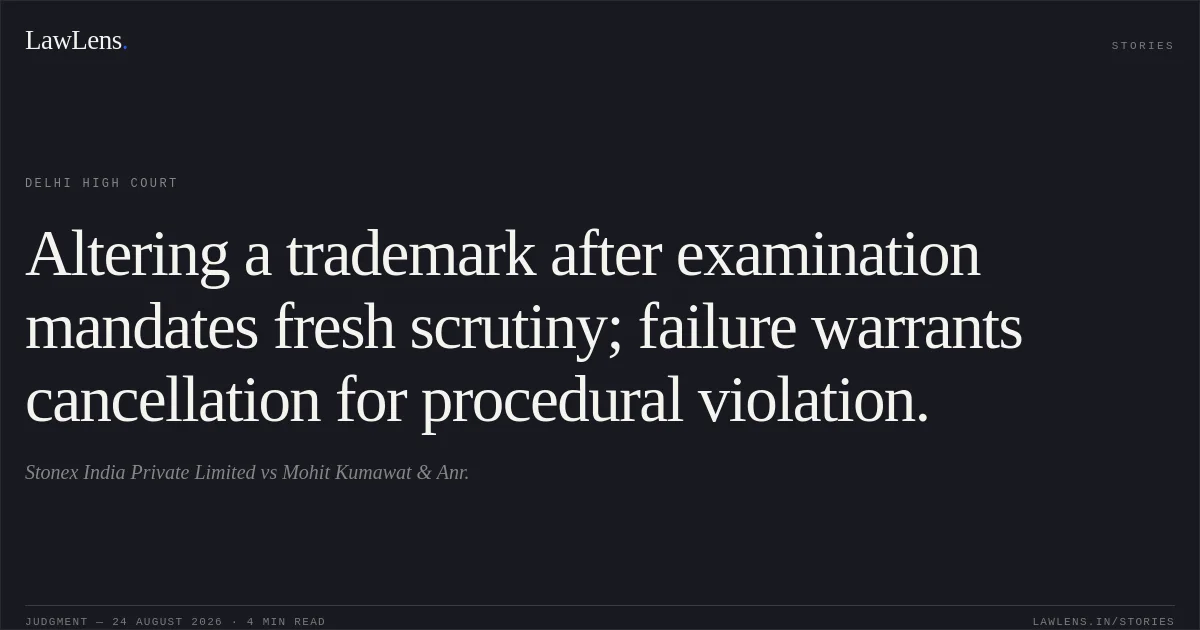
The Court answered both principal issues in favour of the Petitioner. It held that the registration had been procedurally obtained without the requisite substantive examination and that the impugned STONEX WORLD device mark was deceptively similar to the Petitioner’s earlier STONEX marks, contrary to Section 11(1) of the Trade Marks Act, 1999.
The petition was accordingly allowed under Section 57.
Source reference: p. 11; paras. 16–17Registration of the impugned mark under Trade Mark Application No. 5957794 in Class 19 was cancelled, and Respondent No. 2 was directed to remove the entry from the Register and rectify it within eight weeks.
Source reference: p. 11; paras. 16–17Acts & Sections Cited
6 provisions across 1 statute referred to in this judgment. Linked provisions open on LawLens.
Trade Marks Act, 19996
Original Court PDF
Stonex India Private LimitedvsMohit Kumawat & Anr.
Click to open original judgment
Original judgment, available to read, download and summarize on LawLens.in