Facts
Pullangode Rubber & Produce Co. Ltd. ("amalgamating company") was amalgamated with Aspinwall and Co. Ltd. ("appellant/amalgamated company") via a scheme sanctioned in November 2006, with an appointed date of January 1, 2006
Source reference: p.3, para. 4The amalgamating company had accumulated losses which the appellant sought to set off against its own agricultural income
Source reference: p.3, para. 4The appellant relied on Clause 14.2 of the amalgamation scheme, which deemed the losses of the amalgamating company to be those of the amalgamated company
Source reference: p.16, para. 10The Kerala Agricultural Income Tax and Sales Tax Appellate Tribunal and the High Court of Kerala rejected the claim, leading to this appeal
Source reference: p.2, para. 2Issues
1. Whether an amalgamated company is entitled to carry forward and set off the accumulated losses of an amalgamating company under the Kerala Agricultural Income Tax Act, 1991
Source reference: p.3, para. 52. Whether the terms of a court-sanctioned amalgamation scheme regarding tax set-offs are binding on the State when no notice of the proceedings was issued to the State Government
Source reference: p.17, para. 133. Whether Section 54 of the Kerala Agricultural Income Tax Act regarding "succession to business" encompasses the transfer of the right to set off accumulated losses
Source reference: p.11, para. 9.1Law Applied
The Court interpreted Section 12 of the Kerala Agricultural Income Tax Act, 1991, which permits a person to carry forward sustained losses for set-off against subsequent income for a maximum of eight years
Source reference: p.9, para. 12It also examined Section 54 of the same Act, which holds a successor liable for the tax demands of the predecessor but does not explicitly transfer the benefit of accumulated losses
Source reference: p.11, para. 9.1The Court distinguished Section 72A of the Income Tax Act, 1961, which contains a legal fiction deeming the losses of an amalgamating company to be the losses of the amalgamated company
Source reference: p.12, para. 9.3Finally, the Court applied the principle from Dalmia Power Ltd. v. Assistant Commissioner of Income-Tax, noting that approved schemes are binding only where the relevant tax authorities were given notice and an opportunity to object
Source reference: p.17, para. 12Reasoning
The Court held that tax benefits like carry-forward of losses are statutory and cannot be claimed unless specifically provided by the governing Act.
Source reference: p.15-16, para. 9.1-9.3It observed that the Kerala Agricultural Income Tax Act lacks an equivalent to Section 72A of the Income Tax Act, 1961, which provides for the transfer of losses in mergers; Section 54 of the Kerala Act only establishes the successor’s liability for existing tax demands and does not grant them the predecessor's loss benefits
Source reference: p.15-16, para. 9.1-9.3Regarding the Appellant’s reliance on the amalgamation scheme, the Court distinguished the Dalmia Power case, noting that in the present instance, no notice of the amalgamation was served upon the State of Kerala, meaning the State was not bound by Clause 14.2 of the scheme
Source reference: p.18, para. 13Furthermore, the Court upheld the High Court’s factual finding that the losses in question pertained to a period beyond the eight-year statutory limit prescribed in Section 12 of the Kerala Act, rendering them ineligible for set-off regardless of the merger
Source reference: p.18, para. 15Holding
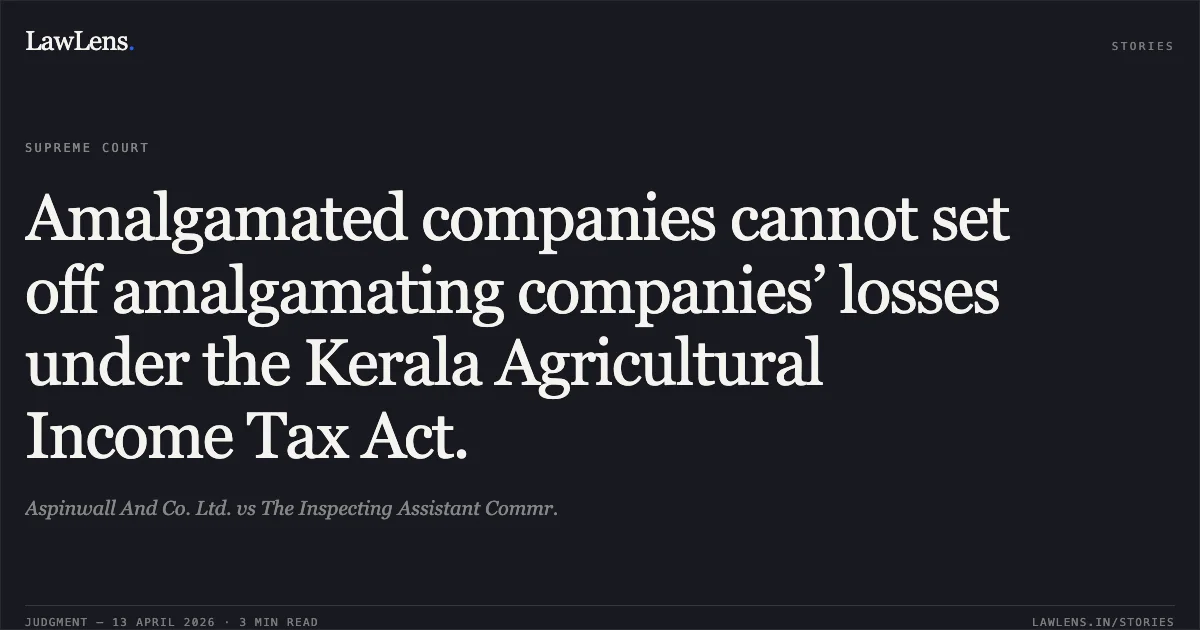
The Supreme Court dismissed the appeals, holding that the appellant was not entitled to set off the amalgamating company’s losses
The Court concluded that under the Kerala Agricultural Income Tax Act, 1991, the right to carry forward losses is restricted to the assessee who suffered them and does not automatically transfer to a successor company in the absence of a specific statutory provision or a scheme approved after notice to the State authorities
Source reference: p.18, para. 14Furthermore, losses exceeding the eight-year carry-forward limit are statutorily barred from set-off
Source reference: p.18, para. 15Acts & Sections Cited
3 provisions across 2 statutes referred to in this judgment. Each provision opens on LawLens.
Companies Act, 20132
Banking Regulation Act, 19491
Original Court PDF
Aspinwall And Co. Ltd.vsThe Inspecting Assistant Commr.
Click to open original judgment
Original judgment, available to read, download and summarize on LawLens.in


![Subsequent exoneration does not retrospectively invalidate a finalized promotion select list.. UNNIKRISHNAN M vs M/o Environment And Forests. CAT - ['Ernakulam']. LawLens](/stories/thumbnails/subsequent-exoneration-does-not-retrospectively-invalidate-a-finalized-promotion-select-li-ce80a0e84f2f4887857271e8b4341c42.webp)