Facts
The appellants, two plaintiffs in a suit for partition and separate possession of shares in the suit properties, challenged the dismissal of their suit by the Trial Court.
Source reference: p. 2–4Their first appeal was dismissed by the III Additional District Judge, Shivamogga, as not maintainable for want of pecuniary jurisdiction.
Source reference: p. 7–10The First Appellate Court relied on its valuation of the plaintiffs’ shares at approximately ₹14.28 lakh and the then-applicable ₹10 lakh threshold under Section 19 of the Karnataka Civil Courts Act, 1964.
Source reference: p. 7–10In the second appeal, the High Court noted that the First Appellate Court had not considered the appeal on its merits.
Source reference: p. 11–12Issues
1. Whether the First Appellate Court’s judgment dismissing the appeal for want of pecuniary jurisdiction could stand in light of the Karnataka High Court (Amendment) Act, 2023 and the Karnataka Civil Courts (Amendment) Act, 2023, as considered in Smt. Narayanamma v. State of Karnataka and upheld by the Supreme Court.
Source reference: p. 112. Whether the matter should be remitted to the First Appellate Court for a decision on the merits.
Source reference: p. 11–12Law Applied
Section 19 of the Karnataka Civil Courts Act, 1964, as quoted by the First Appellate Court, allocated appeals from Senior Civil Judges by reference to a ₹10 lakh pecuniary threshold.
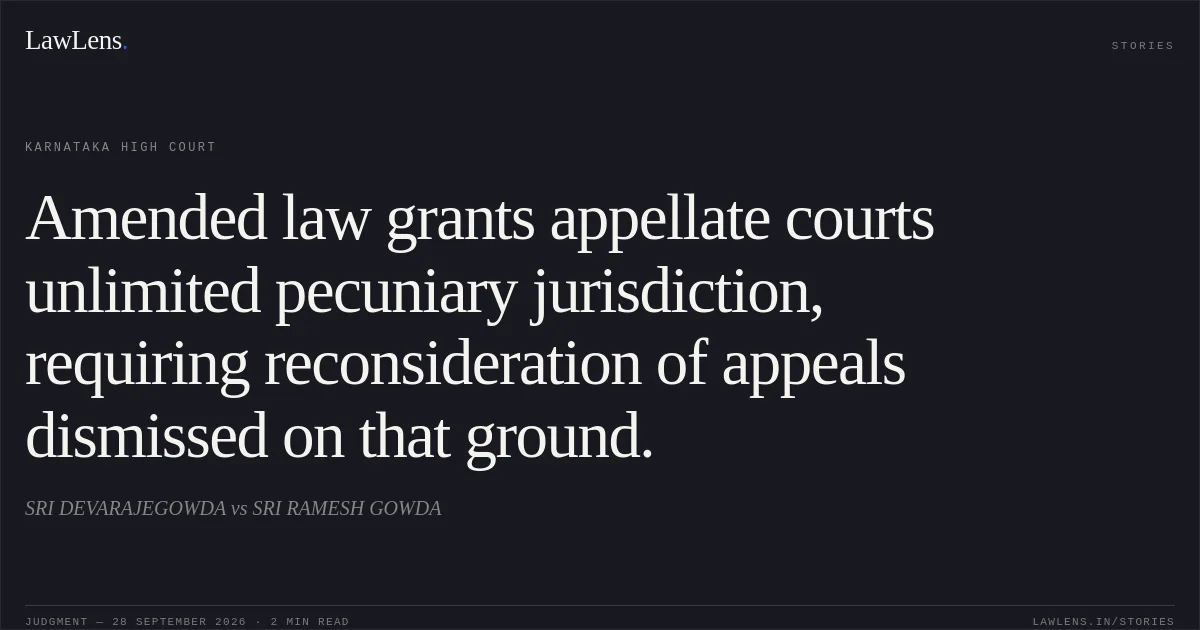
Source reference: p. 9–10The High Court relied on the Karnataka High Court (Amendment) Act, 2023 and the Karnataka Civil Courts (Amendment) Act, 2023, together with Smt. Narayanamma v. State of Karnataka, W.P. No. 17588/2024, and the Supreme Court’s subsequent decision in SLP (Civil) Diary No. 41602/206, for the position that the First Appellate Court had unlimited pecuniary jurisdiction to entertain appeals irrespective of pecuniary value.
Source reference: p. 11–12The appeal before the High Court was brought under Section 100 CPC read with Order 42 Rule 1 CPC.
Source reference: p. 2Reasoning
The First Appellate Court had dismissed the appeal solely because it considered the valuation of the plaintiffs’ shares to exceed its pecuniary limit; it had not determined the appeal on its merits.
Source reference: p. 10–12In light of the 2023 amendments and the authorities cited, the High Court held that the First Appellate Court presently had unlimited pecuniary jurisdiction.
Source reference: p. 12Its dismissal on the former jurisdictional ground therefore could not stand, and the appeal required fresh consideration on the merits.
Source reference: p. 12Holding
The High Court allowed the second appeal, set aside the First Appellate Court’s judgment and decree dated 24 September 2019, and remitted R.A. No. 28/2016 for fresh consideration on the merits and in accordance with law.
All rival contentions were left open, and the High Court expressed no opinion on the merits of the dispute.
Source reference: p. 13Acts & Sections Cited
5 provisions across 3 statutes referred to in this judgment. Each provision opens on LawLens.
Code of Civil Procedure, 19081
KARNATAKA COURT-FEE AND SUITS VALUATION ACT, 1958.3
KARNATAKA CIVIL COURTS ACT, 19641
Original Court PDF
SRI DEVARAJEGOWDAvsSRI RAMESH GOWDA
Click to open original judgment
Original judgment, available to read, download and summarize on LawLens.in