01Facts
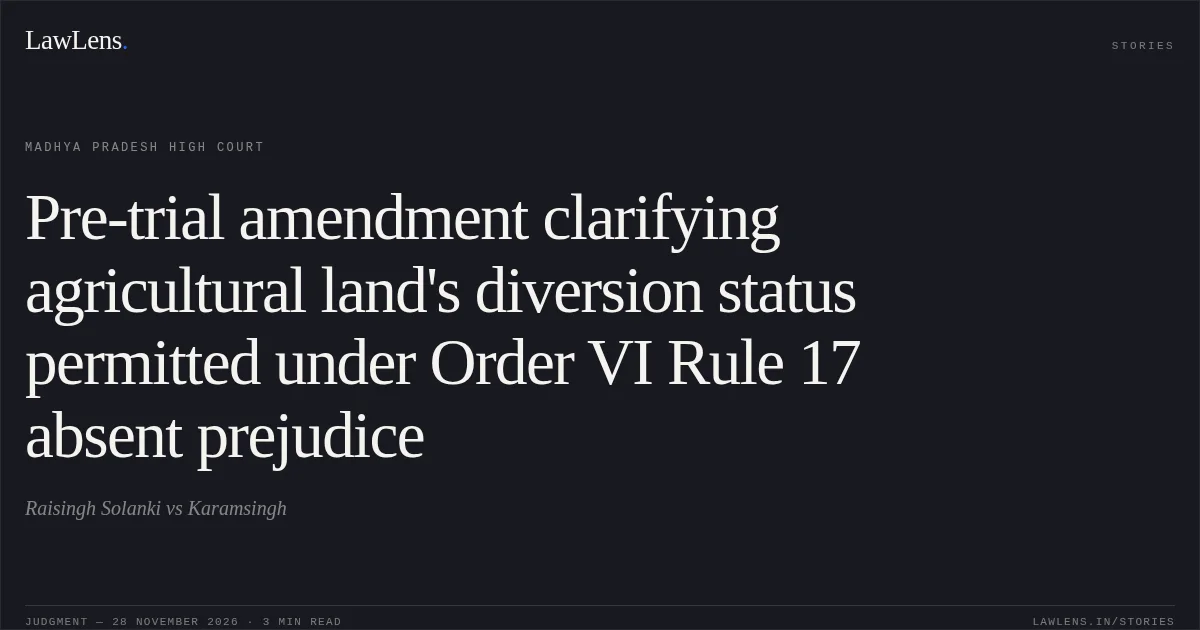
The Petitioner (Plaintiff) challenged an order dated February 20, 2026, passed by the Trial Court, which rejected an application for amendment of the plaint.
¶ 1The Trial Court’s rejection was based on the proviso to Order 6 Rule 17 of the Code of Civil Procedure (C.P.C.), noting that the amendment was sought more than one year after the settlement of issues, meaning the trial had already commenced.
¶ 1The Petitioner argued that while the trial had formally commenced, no actual evidence had been recorded, and thus the application should have been viewed with leniency.
¶ 202Issues
i.1. Whether an amendment application can be allowed after the formal commencement of trial if it is necessary in the interest of justice.
¶ 5ii.2. Whether the Trial Court erred in failing to consider established Supreme Court guidelines regarding the liberal approach toward amendments of pleadings.
¶ 5-603Law Applied
Order 6 Rule 17 of the C.P.C. and its proviso regarding amendments after the commencement of trial.
¶ 1The power to allow amendment is wide and can be exercised at any stage of proceedings if justice demands, as held in Abdul Rehman v. Mohd. Ruldu (2012) 11 SCC 341.
¶ 3All amendments necessary for determining the real question in controversy should be allowed unless they cause injustice, change the nature of the suit, or introduce time-barred claims, as per LIC v. Sanjeev Builders (P) Ltd. (2022) 16 SCC 1.
¶ 404Reasoning
The High Court found that the Trial Court adopted a hyper-technical approach by rejecting the amendment solely because it was filed after the formal commencement of the trial.
¶ 1, 5Referring to LIC v. Sanjeev Builders, the Court noted that delay alone is not a ground to disallow an amendment, and courts should be liberal where the opposite party can be compensated by costs.
¶ 4 (71.5, 71.9)The Court observed that the Trial Court failed to evaluate whether the amendment was necessary for a satisfactory decision or to pinpoint the dispute.
¶ 4, 5Since the Trial Court did not apply the standards set by the Supreme Court—which allow for amendments even after a "formal" start of trial to serve the interests of justice—the impugned order was deemed legally flawed.
¶ 5-605Holding
The High Court set aside the Trial Court's order dated February 20, 2026.
¶ 6The Court held that the Trial Court must reconsider the amendment application afresh in light of the principles established in Abdul Rehman and LIC v. Sanjeev Builders.
¶ 6The petition was disposed of with directions to the Trial Judge to decide the matter in terms of the cited judgments.
¶ 6-7Original Court PDF
Raj Jyoti AgrawalvsVaranasi Builders And Development Pvt.Ltd
Click to open original judgment
Original judgment, available to read, download and summarize on LawLens.in