Facts
The Petitioners (plaintiffs) filed a suit for perpetual injunction against the Respondent (defendant), their real brother, to restrain him from obstructing possession of suit land.
Source reference: para 3The Trial Court initially decreed the suit.
Source reference: para 4-5On appeal (RCA 10/2020), the District Court set aside the decree and remanded the matter, observing that the suit was defective and required an amendment to include a prayer for declaration of ownership per the principles in Anathula Sudhakar v. P. Buchi Reddy.
Source reference: para 4-5The District Court directed the Petitioners to file the amendment application within 30 days of their appearance before the Trial Court.
Source reference: para 7The Petitioners appeared on July 20, 2022, but filed the amendment application (Exhibit 53) on December 16, 2022—a delay of approximately four months.
Source reference: para 6-7The Trial Court rejected the application because the Petitioners failed to explain the delay and disregarded the mandatory nature of the District Court's timeline.
Source reference: para 7A subsequent application (Exhibit 63) for the same relief was also rejected.
Source reference: para 8Issues
1. Whether the Trial Court was justified in rejecting the amendment application solely due to procedural delay and the absence of a formal explanation for such delay.
Source reference: para 13, 152. Whether the directions issued by the District Court in its remand order remained binding on the parties despite the Petitioners' failure to adhere to the prescribed timeline.
Source reference: para 14Law Applied
The Court primarily applied the principles laid down by the Hon’ble Supreme Court in Anathula Sudhakar v. P. Buchi Reddy (2008) 4 SCC 594, which necessitates a prayer for declaration of title when a plaintiff’s title is under a cloud in an injunction suit.
Source reference: para 5, 13Procedural defaults should not typically defeat the crystallization of civil rights or the resolution of the "real controversy" if the litigation can be brought to its logical end through the imposition of costs.
Source reference: para 16-17Directions issued by a superior court (District Court) that go unchallenged are binding on the parties.
Source reference: para 14Reasoning
The Court observed that while the Petitioners were indeed in default for the delay and poor drafting of the application, the fundamental purpose of the remand was to allow the Civil Court to arrive at a correct conclusion regarding ownership.
Source reference: para 9, 13The High Court emphasized that the Respondent had never challenged the District Court’s order granting leave to amend; thus, the Respondent could not retrospectively protest those directions.
Source reference: para 14The Court reasoned that since the litigation involved close relatives and a significant controversy over land ownership, the interest of justice required the parties to contest the suit on declaratory grounds rather than technicalities.
Source reference: para 15-16It held that the procedural lapse could be mitigated by imposing exemplary costs to compensate the Respondent for the delay.
Source reference: para 17Holding
The High Court allowed the Writ Petition and quashed the Trial Court's orders rejecting the amendment applications.
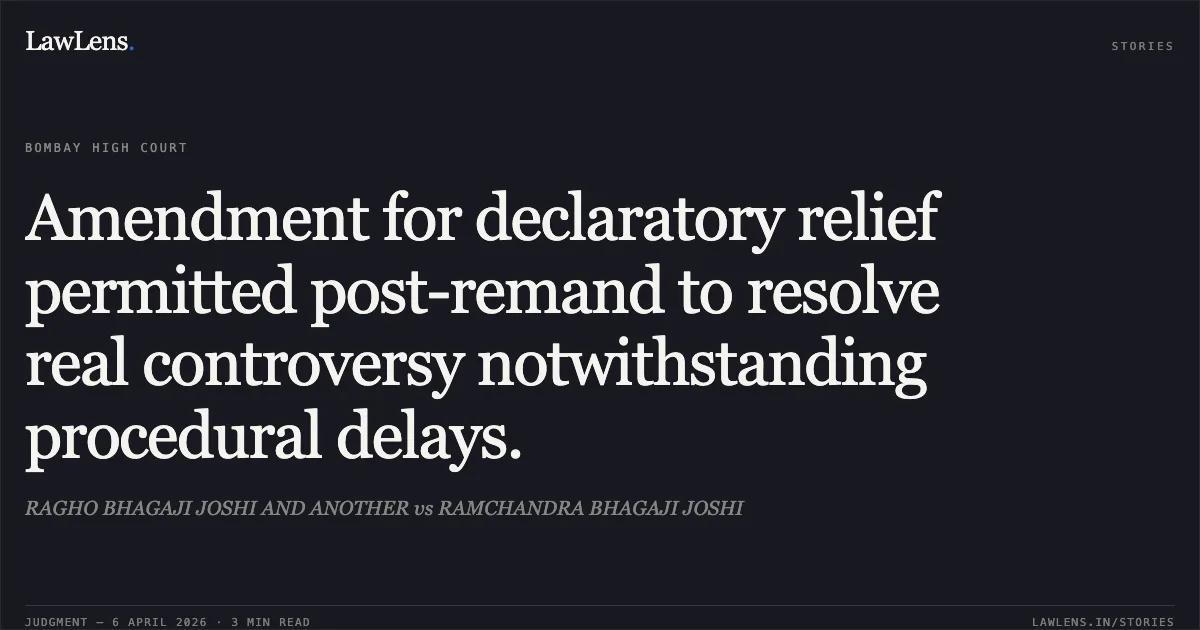
The Court held that the Petitioners deserved an opportunity to amend the pleadings to ensure the controversy reached a logical end.
Source reference: para 16The Petitioners were ordered to carry out the amendment within two weeks and pay costs of ₹15,000 to the Respondent.
Source reference: para 18(iii, vi)Failure to deposit costs or carry out the amendment would nullify the order.
Source reference: para 18(vii)The Trial Court was requested to conclude the hearing within one year.
Source reference: para 18(v)Acts & Sections Cited
6 provisions across 2 statutes referred to in this judgment. Each provision opens on LawLens.
Code of Civil Procedure, 19084
Specific Relief Act, 19632
Original Court PDF
RAGHO BHAGAJI JOSHI AND ANOTHERvsRAMCHANDRA BHAGAJI JOSHI
Click to open original judgment
Original judgment, available to read, download and summarize on LawLens.in