Facts
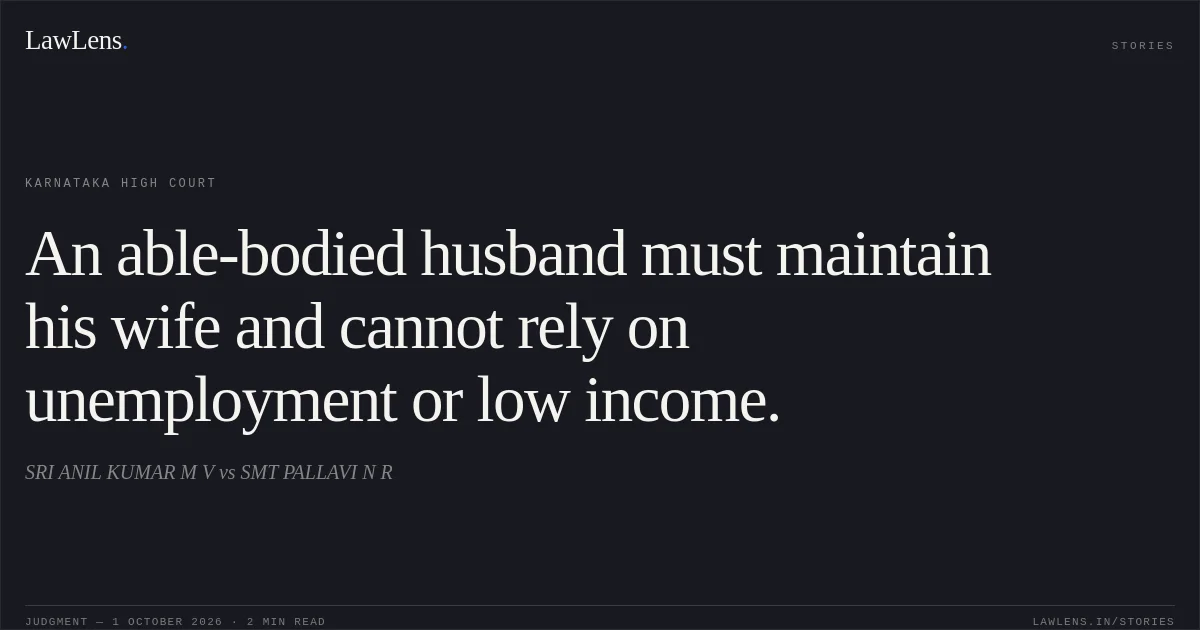
The husband challenged the revisional court’s dismissal of his revision, which had affirmed a Magistrate’s order directing him to pay his wife monthly maintenance of ₹10,000 in proceedings under Section 12 of the Protection of Women from Domestic Violence Act, 2005.
Source reference: pp. 2–3He contended that the wife worked as a nurse and was financially better off, and that the Magistrate’s order had been made ex parte.
Source reference: p. 3The Magistrate had relied on the wife’s unchallenged evidence and a payslip showing the husband earned ₹42,309 per month from South Western Railway; the husband had neither objected to the petition nor cross-examined her.
Source reference: pp. 4–6The revisional court dismissed his challenge and confirmed the maintenance order.
Source reference: pp. 7–9Issues
Whether the Magistrate’s order granting the wife maintenance of ₹10,000 per month, as affirmed by the revisional court, warranted interference by the High Court.
Source reference: p. 9Whether the husband’s claims that the wife was employed and that the Magistrate’s order was ex parte justified setting aside the maintenance order.
Source reference: pp. 3, 9Law Applied
Section 12 of the Protection of Women from Domestic Violence Act, 2005, was the provision under which the wife sought relief; the petition before the High Court invoked Sections 397 and 401 of the Code of Criminal Procedure.
Source reference: pp. 2–3Relying principally on Anju Garg v. Deepak Kumar Garg, 2022 SCC OnLine SC 1314, the Court reiterated that an able-bodied husband must provide financial support to his wife and cannot avoid that obligation on the basis of unsupported submissions; maintenance proceedings serve to prevent a deserted wife’s destitution.
Source reference: pp. 9–12The judgment also referred to Chaturbhuj v. Sita Bai for the purpose of maintenance proceedings as a speedy remedy to prevent vagrancy and destitution.
Source reference: pp. 5, 10Reasoning
The High Court found no basis to disturb the concurrent orders.
Source reference: pp. 4–6The Magistrate had evidence of the marriage and the husband’s monthly income, while the wife’s evidence remained unchallenged because the husband did not appear or cross-examine her.
Source reference: pp. 4–6The husband’s assertions about the wife’s employment and comparative financial position did not displace that record.
Source reference: pp. 3, 9Applying Anju Garg, the Court held that an able-bodied husband could not evade his maintenance obligation; if necessary, he must seek work or better-paid work to support his wife.
Source reference: pp. 9–12Holding
The Court answered the question of interference in the negative, found no merit in the husband’s petition, and dismissed it, leaving the orders awarding the wife ₹10,000 monthly maintenance undisturbed.
Pending applications, if any, were disposed of as a consequence.
Source reference: p. 13Acts & Sections Cited
6 provisions across 3 statutes referred to in this judgment. Each provision opens on LawLens.
Code of Criminal Procedure, 19733
Bharatiya Nagarik Suraksha Sanhita, 20232
Protection of Women from Domestic Violence Act, 20051
Original Court PDF
SRI ANIL KUMAR M VvsSMT PALLAVI N R
Click to open original judgment
Original judgment, available to read, download and summarize on LawLens.in