Facts
The respondents, being the widow and children of Late Soharab Khan @ Saherad Khan @ Saheb Khan, filed a claim before the Railway Claims Tribunal, Ranchi, alleging that the deceased was travelling by train from Tatanagar to Dhanbad on 23.09.2012 and accidentally fell from the running train near Nimdih Station due to overcrowding and a sudden jerk. He sustained serious injuries and was declared dead at the station.
Source reference: p.2, para.4The FIR, inquest report, post-mortem report and final police report attributed his death to injuries caused by the fall from the train.
Source reference: p.4, para.7The Railway Administration disputed liability, contending that the deceased was not proved to be a bona fide passenger and that the fall from a train had not been established.
Source reference: p.3–4, paras.7–8By judgment dated 28.02.2017 in Case No. OA (IIU)/RNC/65/2016, the Railway Claims Tribunal awarded compensation of ₹8,00,000, with interest at 9% per annum if payment was not made within 90 days.
Source reference: p.1–2, para.3The Union of India challenged that decision under Section 23(1) of the Railway Claims Tribunal Act, 1987.
Source reference: p.2–3, para.5During the appeal, ₹8,00,000 with interest calculated at 7.5%, totalling ₹10,67,958, was deposited before the Tribunal.
Source reference: p.2–3, para.5Issues
Whether the deceased’s death caused by falling from a running train constituted an “untoward incident” under Section 123(c)(2) of the Railways Act, 1989, attracting the railway’s statutory liability under Section 124-A
Source reference: p.4–6, paras.8–13Whether the Railway Administration established that the deceased was not a bona fide passenger or that his death fell within any of the exceptions contained in the proviso to Section 124-A
Source reference: p.3–6, paras.7–13Whether the compensation and interest awarded by the Railway Claims Tribunal required interference in appeal
Source reference: p.1–2, 6–8, paras.3, 13–18Law Applied
The Court applied Section 23(1) of the Railway Claims Tribunal Act, 1987, governing appeals to the High Court; Sections 123(c)(2) and 124-A of the Railways Act, 1989, under which an accidental fall of a passenger from a train is an “untoward incident” giving rise to strict statutory liability, subject only to the exceptions in the proviso to Section 124-A.
Source reference: p.2, para.2; p.4–6, paras.8–13Relying on Union of India v. Prabhakaran Vijaya Kumar and Jameela v. Union of India, the Court held that railway liability under Section 124-A is not dependent upon proof of negligence by the Railway Administration and that accidental falling from a train does not cease to attract liability merely because the passenger may have been negligent.
Source reference: p.4–6, paras.8, 12The Court also relied on Union of India v. Rina Devi, which holds that compensation is payable at the rate applicable on the date of the accident, with reasonable interest, and that interest may be awarded from the date of the accident until payment; where applicable, the claimant is entitled to the higher beneficial amount.
Source reference: p.6–7, para.13Reasoning
The Court found that the documentary evidence, including the FIR, inquest report, post-mortem report and final police report, consistently established that the deceased died from injuries sustained in a railway accident involving a fall from a train.
Source reference: p.4, paras.7, 10Although the Railway Administration relied on internal reports questioning the deceased’s bona fide passenger status and attributing the incident to his negligence, those reports did not disprove the accidental fall or establish any statutory exception under Section 124-A.
Source reference: p.3–4, paras.7–8The Court treated overcrowding and accidental falling as circumstances commonly associated with railway travel and declined to adopt a narrow interpretation that would defeat the beneficial purpose of the Railways Act.
Source reference: p.4–5, paras.10–11Since there was no evidence of suicide, self-inflicted injury, intoxication, insanity, criminal act, natural cause or disease, the deceased’s death fell within the main provision of Section 124-A and not its exceptions.
Source reference: p.5–6, paras.12–13The Tribunal’s finding that the case constituted an untoward incident was therefore upheld.
Source reference: p.5–6, paras.12–13As the awarded amount with interest had already been deposited, the Court directed release of ₹10,67,958 to the claimants and found no basis for directing any further interest.
Source reference: p.7–8, paras.15–17Holding
The appeal was dismissed.
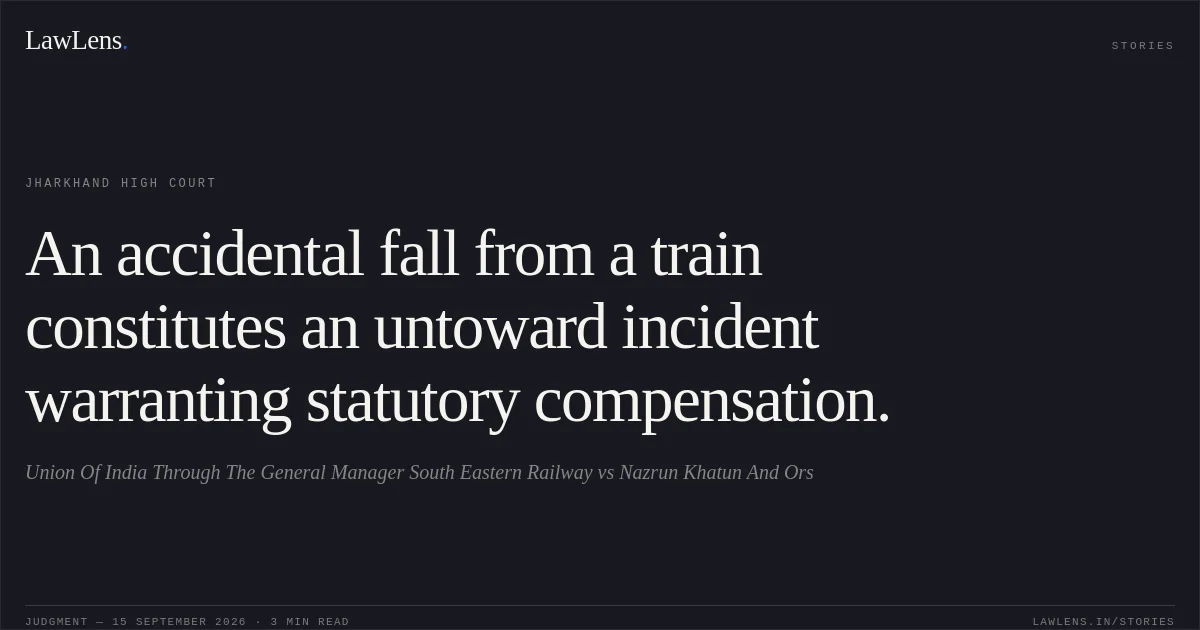
The Court held that the deceased’s accidental fall from the train constituted an untoward incident under Section 123(c)(2) and attracted the Railway Administration’s no-fault liability under Section 124-A of the Railways Act, 1989.
Source reference: p.7–8, paras.14–18The award of ₹8,00,000 was upheld.
Source reference: p.7–8, paras.14–18The Additional Registrar, Railway Claims Tribunal, Ranchi, was directed to release the deposited amount of ₹10,67,958 to the claimants after due verification, and the Railway Administration was held not liable to pay any further interest.
Source reference: p.7–8, paras.14–18Acts & Sections Cited
2 provisions across 2 statutes referred to in this judgment. Each provision opens on LawLens.
Railway Claims Tribunal Act, 19871
Railways Act, 19891
Original Court PDF
Union Of India Through The General Manager South Eastern RailwayvsNazrun Khatun And Ors
Click to open original judgment
Original judgment, available to read, download and summarize on LawLens.in