Facts
The complainant alleged that the respondent borrowed ₹6,00,000 on 10 January 2016 and later issued a cheque for that amount, which was dishonoured for insufficient funds.
Source reference: pp. 1–3, 8–10The respondent’s reply notice disputed the alleged ₹6,00,000 loan and asserted that he had borrowed ₹3,00,000 in 2014, issuing a blank cheque as security.
Source reference: pp. 1–3, 8–10The trial court convicted him under Section 138 of the Negotiable Instruments Act; the Sessions Court reversed the conviction and acquitted him.
Source reference: pp. 1–3, 8–10The complainant appealed against the acquittal under Section 372 CrPC.
Source reference: pp. 1–3, 8–10Issues
Whether the acquittal of the respondent by the appellate court was sustainable
Source reference: p. 3Law Applied
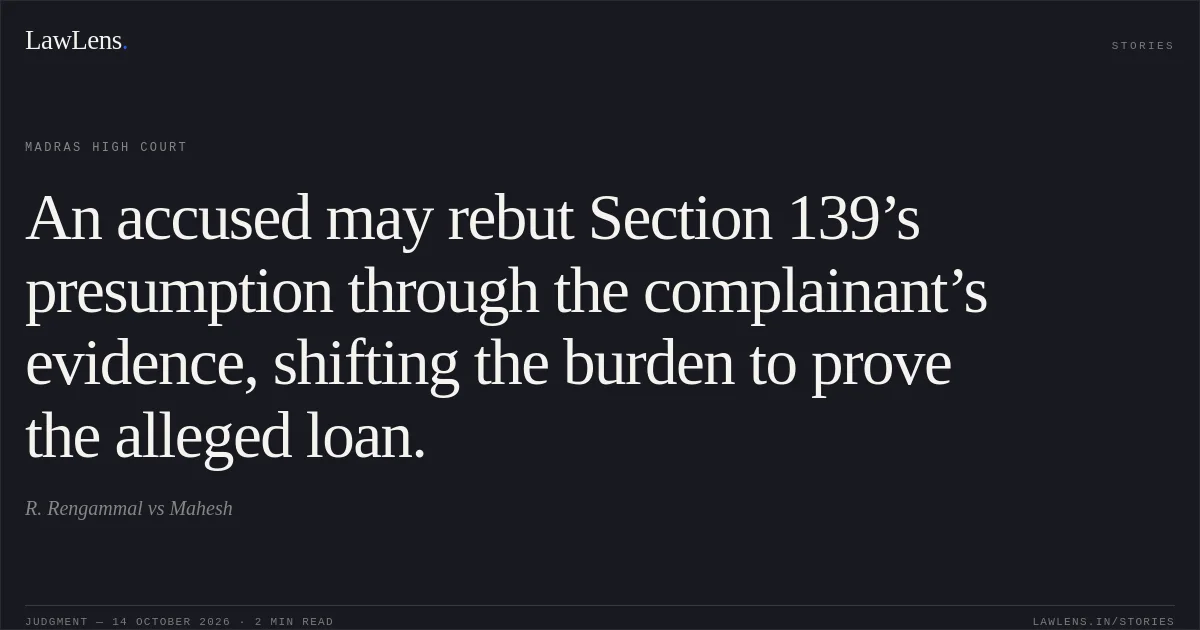
Sections 118(a) and 139 of the Negotiable Instruments Act raise presumptions, upon admission of execution of a cheque, that it was issued for consideration and towards discharge of a debt or liability; those presumptions are rebuttable.
Source reference: pp. 10–12Under Basalingappa v. Mudibasappa, (2019) 5 SCC 418, the accused may rebut them on a preponderance of probabilities by relying on the complainant’s evidence, other record materials, or surrounding circumstances, and need not testify.
Source reference: pp. 10–12Once a probable defence rebuts the presumption, the burden shifts to the complainant to establish the alleged debt.
Source reference: pp. 12, 15Reasoning
The court accepted that the admitted execution of the cheque initially attracted the statutory presumptions.
Source reference: pp. 12–16However, the respondent’s reply notice had contemporaneously denied the alleged ₹6,00,000 loan and described the cheque as security for an earlier ₹3,00,000 loan.
Source reference: pp. 12–16The complainant did not substantiate the alleged 2016 advance.
Source reference: pp. 12–16Her evidence showed pension as her only regular income, while the bank statement reflected a balance of ₹403 on 10 June 2016; the earlier account transactions relied on by the trial court were from 2011 and had no relevant connection to the alleged loan.
Source reference: pp. 12–16Her explanation that her children had given her ₹10,00,000 was absent from the complaint and unsupported by evidence.
Source reference: pp. 12–16The cross-examination and surrounding circumstances therefore raised a probable defence, rebutting the presumption; the complainant then failed to prove the alleged ₹6,00,000 debt.
Source reference: pp. 12–16Holding
The High Court held that the appellate court’s acquittal was supported by the record and warranted no interference.
It dismissed the criminal appeal and confirmed the respondent’s acquittal under Section 138 of the Negotiable Instruments Act.
Source reference: pp. 16–17Acts & Sections Cited
5 provisions across 2 statutes referred to in this judgment. Each provision opens on LawLens.
Code of Criminal Procedure, 19732
Negotiable Instruments Act, 18813
Original Court PDF
R. RengammalvsMahesh
Click to open original judgment
Original judgment, available to read, download and summarize on LawLens.in