Facts
Chinta Devi, the appellant’s wife, was found dead with fatal injuries in the couple’s matrimonial home on 4 February 2012.
Source reference: paras. 3–9, 10; pp. 2–6Her family members testified that the appellant’s brother had informed them of a quarrel between the couple; on reaching the house, they saw the appellant with an axe and the deceased’s body inside.
Source reference: paras. 3–9, 10; pp. 2–6The doctor attributed death to injuries caused by a hard and blunt substance.
Source reference: paras. 3–9, 10; pp. 2–6The axe was seized but was not produced at trial or sent for forensic examination, and the appellant’s brother was not examined.
Source reference: paras. 3–9, 10; pp. 2–6The Sessions Court convicted the appellant under Section 302 IPC and sentenced him to life imprisonment and a fine.
Source reference: paras. 3–9, 10; pp. 2–6He appealed, arguing, among other things, that the circumstantial evidence was insufficient and the prosecution had not proved motive.
Source reference: paras. 3–9, 10; pp. 2–6Issues
1. Whether the conviction and sentence under Section 302 IPC were supported by proof beyond reasonable doubt, or suffered from an error of law warranting appellate interference
Source reference: para. 19; p. 102. Whether, after the prosecution established the circumstances surrounding the death, the appellant’s failure to explain how his wife died in their home could be considered under Section 106 of the Evidence Act
Source reference: paras. 25–27; pp. 16–18Law Applied
Section 302 IPC governs the offence of murder.
Source reference: para. 14; p. 7The prosecution must prove its case beyond reasonable doubt and cannot rely on a weakness in the defence to cure deficiencies in its own case.
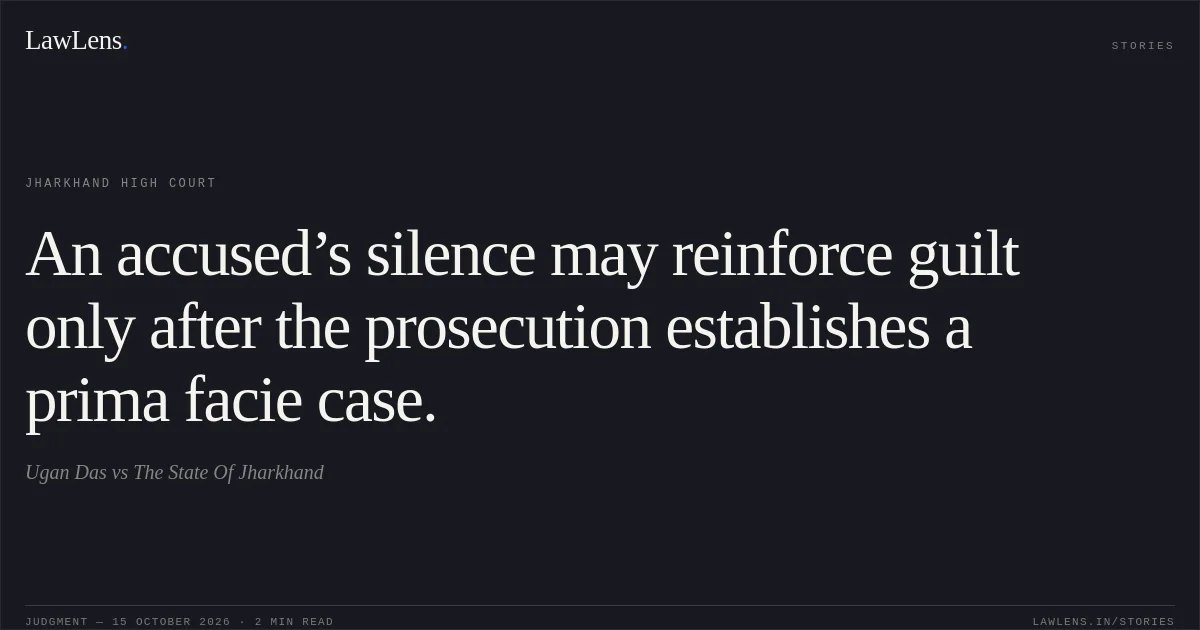
Source reference: para. 14; p. 7Under Section 106 of the Indian Evidence Act, the burden of explaining a fact especially within a person’s knowledge may arise once the prosecution has discharged its initial burden and established a prima facie case; Section 106 cannot substitute for proof of the offence by the prosecution.
Source reference: paras. 25–27; pp. 16–18The Court relied on Anees v. State Government of N.C.T., 2024 SCC OnLine SC 757, for these principles.
Source reference: para. 25; p. 16Reasoning
The Court treated the family witnesses’ consistent evidence as establishing that the appellant and deceased had been quarrelling shortly before the death, that the appellant was present at the house and was seen with an axe, and that the deceased’s body was found there with fatal injuries.
Source reference: paras. 22–28; pp. 15–18It also noted that the appellant did not dispute his presence or offer an explanation for the homicidal death in the matrimonial home.
Source reference: paras. 22–28; pp. 15–18The Court held that these circumstances established a prima facie case, permitting the absence of an explanation to be considered under Section 106—not as a substitute for the prosecution’s burden, but as an additional link in the circumstances.
Source reference: paras. 22–28; pp. 15–18It further held that proof of motive was not essential in the circumstances of this case.
Source reference: paras. 22–28; pp. 15–18Holding
The High Court held that the prosecution had proved the appellant’s guilt beyond reasonable doubt and found no error of law in the trial court’s judgment.
It dismissed the appeal, leaving the conviction under Section 302 IPC and the sentence of life imprisonment with fine undisturbed.
Source reference: paras. 28–30; p. 18Acts & Sections Cited
3 provisions across 3 statutes referred to in this judgment. Each provision opens on LawLens.
Indian Penal Code, 18601
Code of Criminal Procedure, 19731
Bharatiya Sakshya Adhiniyam, 20231
Original Court PDF
Ugan DasvsThe State Of Jharkhand
Click to open original judgment
Original judgment, available to read, download and summarize on LawLens.in


