Facts
The prosecution alleged that Mukesh Kumar Yadav had sexually assaulted the minor victim from April 2023 onwards on the promise of marriage and had thereafter taken her from her home on 4 November 2023 and kept her at his residence.
Source reference: para. 4–5The victim’s father lodged a written complaint on 6 November 2023, following which FIR No. 113/2023 was registered for offences under Sections 363, 366, 376(AB) of the IPC and Section 6 of the POCSO Act.
Source reference: para. 4–5The victim was recovered from the respondent’s house, and the investigation included recording her statement under Section 164 CrPC, seizure of age-related school records, preparation of spot maps, and arrest of the respondent.
Source reference: para. 4–5After investigation, charges were framed under Sections 363, 366, 376(2)(n), and 376(AB) of the IPC and Sections 3/4(2), 5(l)(m)/6, and 5(j)(ii)/6 of the POCSO Act.
Source reference: para. 6–7The prosecution examined 13 witnesses, including the victim and her parents; the accused did not lead defence evidence.
Source reference: para. 6–7The Additional Sessions Judge, Fast Track Special Court (POCSO Act), Ambikapur, acquitted the accused on 7 February 2025, principally finding that the prosecution evidence, including the absence of DNA/FSL evidence and the non-support of the prosecution case by material witnesses, raised reasonable doubt.
Source reference: para. 8, 22The victim’s father filed Acquittal Appeal No. 241 of 2025. The State separately filed CRMP No. 2014 of 2026 seeking leave to appeal, accompanied by an application for condonation of 442 days’ delay.
Source reference: para. 1–3Issues
Whether the Trial Court’s acquittal was perverse, manifestly erroneous, unreasonable, or unsupported by the evidence so as to justify interference in an appeal against acquittal.
Source reference: para. 16–21, 23–25Whether the testimony of the minor victim, together with the oral and documentary evidence regarding her alleged sexual assault, pregnancy, recovery, and age, established the offences beyond reasonable doubt.
Source reference: para. 22, 26–29Whether the prosecution had reliably and admissibly established the victim’s legally relevant age for purposes of the IPC and POCSO charges.
Source reference: para. 28Whether the State had sufficient grounds for condonation of the 442-day delay in filing the petition seeking leave to appeal after the victim’s father’s acquittal appeal was dismissed on merits.
Source reference: para. 34Law Applied
The Court considered the offences charged under Sections 363, 366, 376(2)(n), and 376(AB) of the IPC and Sections 3/4(2), 5(l)(m)/6, and 5(j)(ii)/6 of the POCSO Act.
Source reference: para. 3, 6It applied the settled principle that an appellate court may reappreciate evidence in an appeal against acquittal but should interfere only where the Trial Court’s view is perverse, manifestly illegal, unreasonable, or one that no reasonable court could have reached.
Source reference: para. 17–20The Court relied on C. Antony v. Raghavan Nair, which requires a definite finding of perversity before substituting the appellate court’s view.
Source reference: para. 17Ramanand Yadav v. Prabhunath Jha, which requires compelling and substantial reasons for interference.
Source reference: para. 18Tota Singh v. State of Punjab, which holds that a plausible view favouring acquittal must not be disturbed merely because another view is possible.
Source reference: para. 19State of Rajasthan v. Kistoora Ram, which reiterates that interference is permissible only where the acquittal view is impossible or perverse.
Source reference: para. 20The Court further applied the principles that a child witness’s testimony may sustain conviction if reliable and trustworthy, but cannot be accepted mechanically, and that an acquitted accused enjoys a double presumption of innocence.
Source reference: para. 26, 31Reasoning
The High Court examined the Trial Court’s reasons rather than merely undertaking a different assessment of the evidence.
Source reference: para. 22–25It found that the Trial Court had considered the testimony of the victim, her parents and other witnesses, the documentary material, the issue of age, and the absence of DNA or FSL evidence.
Source reference: para. 22–25Although the victim’s testimony could legally form the basis of conviction if found reliable, the Trial Court had scrutinised it with the other evidence and concluded that the prosecution case did not inspire the degree of confidence necessary for conviction.
Source reference: para. 26The alleged disclosure by the victim to her family, the lodging of the complaint, the FIR, and the recovery from the respondent’s house were treated as circumstances requiring corroboration through substantive and reliable evidence; they did not, by themselves, prove guilt beyond reasonable doubt.
Source reference: para. 27The Court also found no manifest illegality in the Trial Court’s treatment of the victim’s age or in its conclusion that the cumulative discrepancies and evidentiary deficiencies created a reasonable doubt.
Source reference: para. 28–30Since the acquittal represented a possible and plausible view and was not perverse or wholly unsustainable, the appellate threshold for interference was not met.
Source reference: para. 30–32Holding
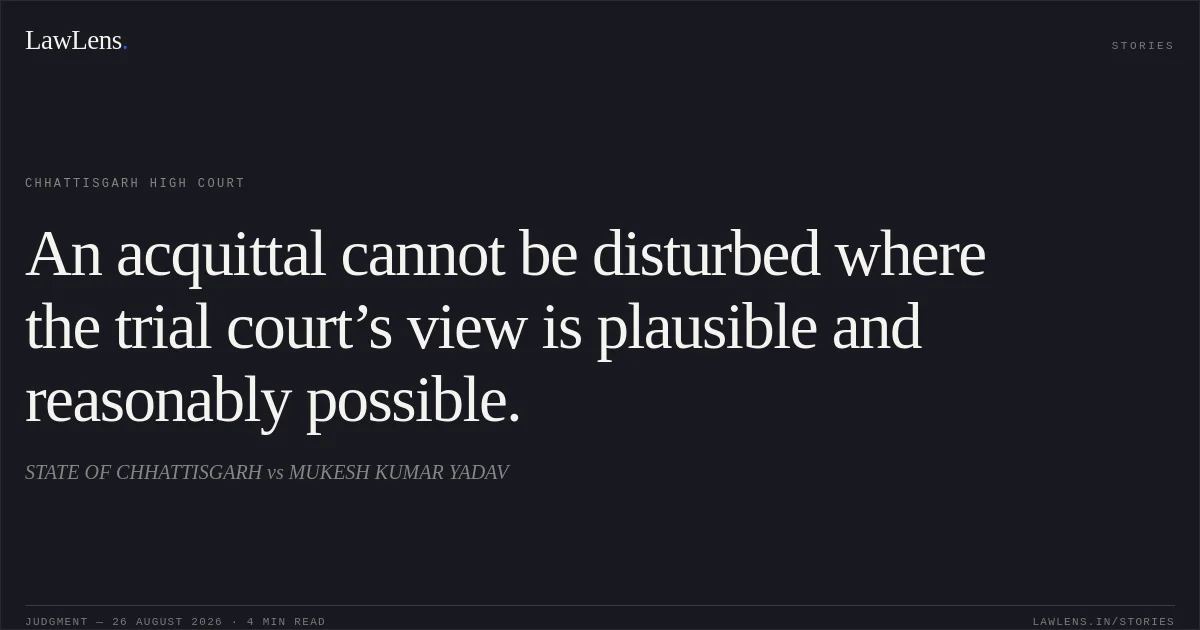
The High Court held that the Trial Court’s acquittal was based on a possible and reasonable appreciation of the evidence and did not suffer from perversity, manifest illegality, or material irregularity.
Accordingly, Acquittal Appeal No. 241 of 2025 filed by the victim’s father was dismissed, and the judgment of acquittal dated 7 February 2025 was affirmed.
Source reference: para. 32–33Since the acquittal had been affirmed on merits, the Court found no sufficient ground to condone the State’s 442-day delay; I.A. No. 1 of 2026 in CRMP No. 2014 of 2026 was rejected.
Source reference: para. 34Acts & Sections Cited
9 provisions across 3 statutes referred to in this judgment. Each provision opens on LawLens.
Indian Penal Code, 18604
Code of Criminal Procedure, 19731
Original Court PDF
STATE OF CHHATTISGARHvsMUKESH KUMAR YADAV
Click to open original judgment
Original judgment, available to read, download and summarize on LawLens.in