Facts
On 8 March 2013, a police party allegedly apprehended Rati Ram near Kali Mata Temple, Shamti, Solan, at approximately 9:30 p.m. while he was carrying a micron bag.
Source reference: paras. 3(a)–3(d)The police claimed to have recovered 1.200 kg of charas from his conscious and exclusive possession.
Source reference: paras. 3(a)–3(d)The contraband was sealed, re-sealed at the police station, deposited in the malkhana, and subsequently sent for chemical examination, where it was reported to be cannabis/charas.
Source reference: paras. 3(a)–3(d)The accused was charged under Section 20 of the Narcotic Drugs and Psychotropic Substances Act, 1985, but denied the prosecution case and alleged false implication.
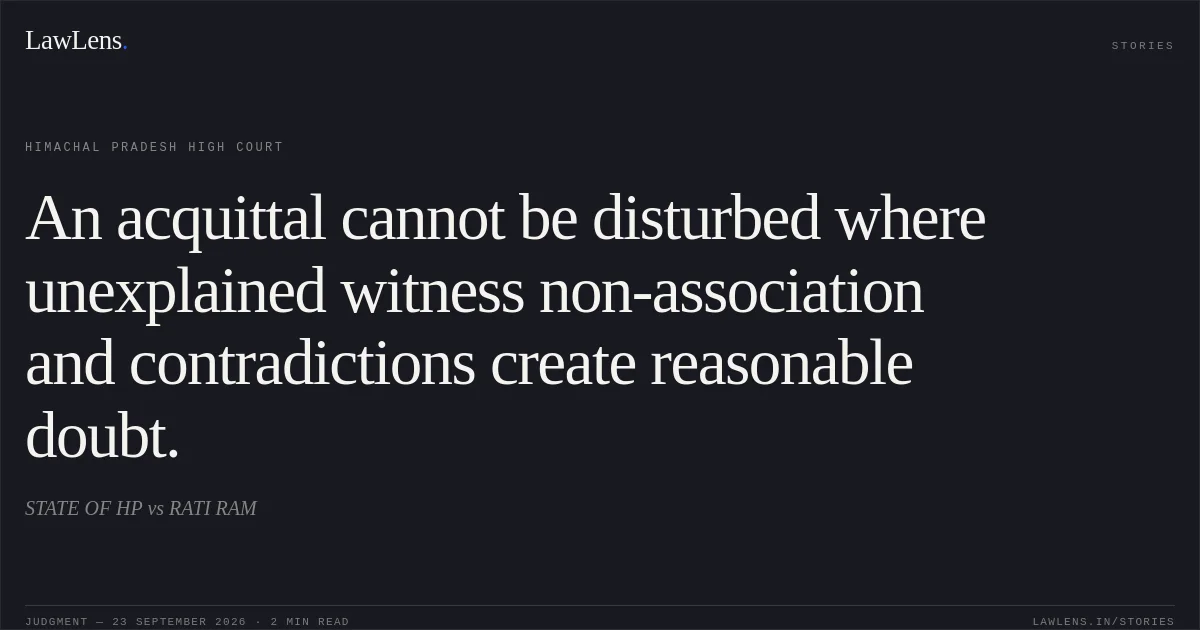
Source reference: paras. 4, 7The Special Judge, Solan, acquitted him on 23 December 2014, principally finding the prosecution evidence unreliable due to material contradictions and the unexplained non-association of independent witnesses.
Source reference: para. 8, 14The State appealed against the acquittal.
Source reference: para. 9Issues
1. Whether the prosecution proved beyond reasonable doubt that the respondent was in conscious and exclusive possession of 1.200 kg of charas, thereby committing an offence under Section 20 of the NDPS Act?
Source reference: paras. 22–23, 36–372. Whether the non-association of independent witnesses, despite their alleged availability near the place of recovery, rendered the prosecution case doubtful?
Source reference: paras. 24–333. Whether the trial court’s order of acquittal was perverse or unreasonable so as to warrant interference in an appeal against acquittal?
Source reference: paras. 15–21, 37–38Law Applied
The Court applied Section 20 of the NDPS Act, which criminalises possession of cannabis/charas, and the general criminal-law principle that the prosecution must establish guilt beyond reasonable doubt and that the burden never shifts from the prosecution.
Source reference: para. 22In an appeal against acquittal, the appellate court may reappreciate the evidence but must respect the strengthened presumption of innocence; interference is justified only where the trial court’s view is perverse, palpably wrong, based on an erroneous legal approach, or where the prosecution’s conclusion is the only possible conclusion on the evidence.
Source reference: paras. 16–21Relying on Muralidhar v. State of Karnataka, H.D. Sundara v. State of Karnataka, Jafarudheen v. State of Kerala, and Surendra Singh v. State of Uttarakhand, the Court held that a possible view favouring acquittal cannot be displaced merely because another view is also possible.
Source reference: paras. 16, 18–21Applying Raveen Kumar v. State of Himachal Pradesh, Kallu Khan v. State of Rajasthan, and related authorities, the Court held that non-association of independent witnesses is not automatically fatal, but official testimony must then be scrutinised with particular care to exclude the possibility of false implication.
Source reference: paras. 25–28Acts & Sections Cited
9 provisions across 3 statutes referred to in this judgment. Each provision opens on LawLens.
Narcotic Drugs and Psychotropic Substances Act, 19852
Code of Criminal Procedure, 19736
Bharatiya Nagarik Suraksha Sanhita, 20231
Original Court PDF
STATE OF HPvsRATI RAM
Click to open original judgment
Original judgment, available to read, download and summarize on LawLens.in