Facts
The deceased, H. Muniyappa, claimed an interest in land bearing Survey No. 280/2, measuring 1 acre 8 guntas. The property had allegedly been transferred through financial transactions and was subsequently purchased by Accused No. 1, Narayanaswamy. A civil suit concerning the property, O.S. No. 147 of 2011, was pending, and an interim order had been passed.
Source reference: pp. 5–8The prosecution alleged that on 27 July 2011, Accused Nos. 1 to 5 were ploughing the disputed land. When Muniyappa, his son PW1, his wife PW2 and other family members reached the spot, the accused allegedly formed an unlawful assembly and assaulted them. Accused No. 2 was alleged to have kicked Muniyappa on his private parts, causing him to collapse and die. PW1 lodged the complaint, and Crime No. 140 of 2011 was registered for offences under Sections 143, 147, 323 and 302 read with Section 149 of the IPC.
Source reference: pp. 5–8The prosecution examined 21 witnesses, marked Exhibits P1 to P17 and produced material objects MO1 to MO4. The accused denied the allegations in their Section 313 CrPC statements and led no defence evidence.
Source reference: p. 7The I Additional Sessions Judge, Kolar, acquitted all the accused on 22 December 2017, principally relying on contradictions in the evidence of PW1, PW2 and PW9, the absence of injuries on the alleged injured witnesses, inconsistencies concerning the FIR and investigation, and deficiencies in the medical evidence.
Source reference: pp. 8–9The deceased’s son and the State challenged the acquittal before the High Court under Sections 372 and 378 CrPC.
Source reference: pp. 1–4Issues
1. Whether the Trial Court committed an error in acquitting the accused of the offences alleged under Sections 143, 147, 323 and 302 read with Section 149 of the IPC?
Source reference: para. 27(i), p. 272. Whether the acquittal should be reversed and the accused convicted on the basis of the prosecution’s oral, documentary and medical evidence?
Source reference: para. 27(ii), p. 27Law Applied
The Court applied Sections 143, 147, 323, 302 and 149 IPC concerning unlawful assembly, rioting, voluntarily causing hurt, murder and constructive liability, together with Sections 154, 162 and 174 CrPC governing registration of FIRs, statements during investigation and inquest proceedings, and Sections 372 and 378 CrPC governing appeals against acquittal.
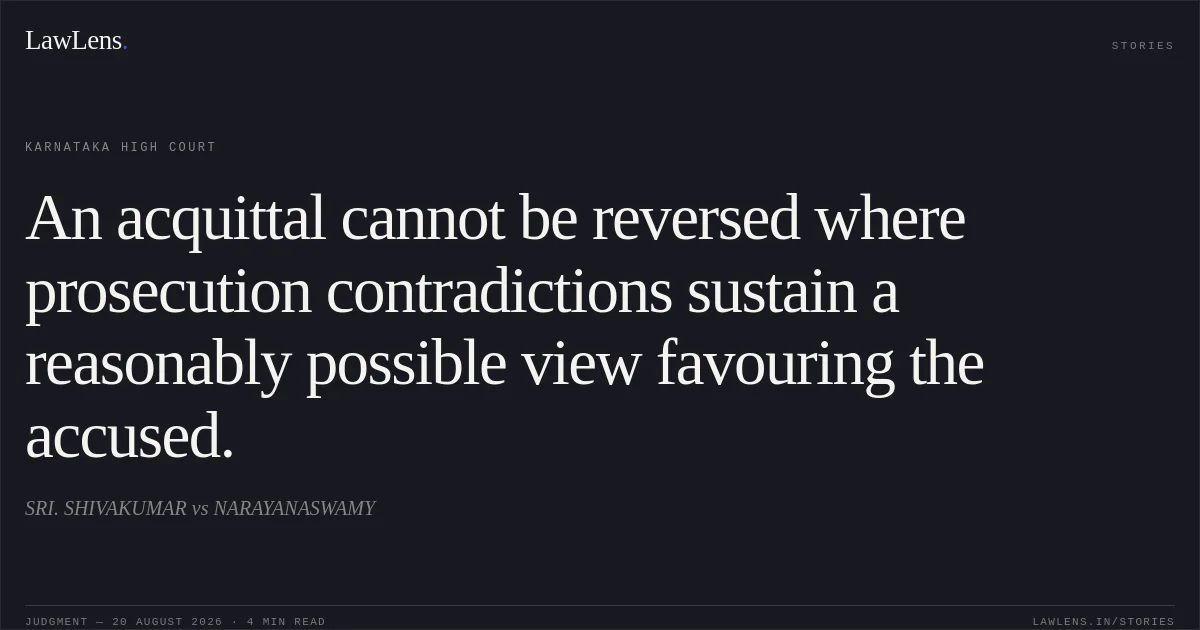
Source reference: pp. 1–4, 33–39On appeals against acquittal, the Court relied principally on Mallappa v. State of Karnataka, holding that a reversal requires demonstration of illegality, perversity or an error of law or fact; where two views are reasonably possible, the view favouring the accused should ordinarily prevail.
Source reference: para. 29, pp. 28–29It also relied on State of Rajasthan v. Islam and Muralidhar v. State of Karnataka for the principles that acquittal strengthens the presumption of innocence and that a possible and reasonable view taken by the Trial Court should not be disturbed merely because another view is possible.
Source reference: paras. 30–31, pp. 29–31With respect to the FIR, the Court applied the rule that information regarding a cognizable offence must be promptly recorded under Section 154 CrPC, and that ante-timing, unexplained delay or preparation of the FIR after investigation may substantially impair its evidentiary value, as discussed in Mohd. Muslim v. State of Uttar Pradesh, State of A.P. v. Punati Ramulu, Lalita Kumari v. State of Uttar Pradesh and Meharaj Singh v. State of U.P.
Source reference: paras. 33–36, pp. 32–36Reasoning
The High Court found that the prosecution evidence did not meet the standard required to overturn an acquittal.
Source reference: paras. 42–46, pp. 41–51PW1, PW2 and PW9, all members of the deceased’s family, gave materially inconsistent accounts regarding who accompanied the deceased to the spot, which accused inflicted the alleged kick, and whether the kick was administered by Accused No. 1 or Accused No. 2.
Source reference: paras. 42–46, pp. 41–51Although PW2 was projected as an injured eyewitness, her medical certificate recorded treatment for giddiness, anxiety and weakness, without noting assault-related injuries; the treating doctor also confirmed the absence of injuries and hospitalisation.
Source reference: paras. 44–45, pp. 46–48The post-mortem evidence did not disclose external injuries to the chest or abdomen, despite the allegation that the accused had assaulted the deceased on the chest. The medical evidence further distinguished between injury caused by kicking and injury caused by squeezing of the testicles, leaving the prosecution version uncertain.
Source reference: paras. 50–52, pp. 54–57The Court also found serious inconsistencies concerning the timing and registration of the FIR. The witnesses stated that police were present at the spot from the morning, whereas the formal complaint was recorded at 3.00 p.m. and the FIR was registered at 3.30 p.m.
Source reference: paras. 47–49, 52–54, pp. 51–60There were also inconsistencies between the timings of the inquest, post-mortem examination and spot investigation, including an apparent overlap between the inquest and autopsy.
Source reference: paras. 47–49, 52–54, pp. 51–60In the absence of reliable independent eyewitnesses—the independent witnesses having turned hostile—and considering the admitted civil dispute between the parties, the Court held that the prosecution evidence did not establish either the accused’s participation or the common object of the alleged unlawful assembly beyond reasonable doubt.
Source reference: paras. 53–55, pp. 57–61The Trial Court’s view was therefore held to be a reasonably possible view and not perverse or legally erroneous.
Source reference: paras. 29–31, 55, pp. 28–31, 60–61Holding
The High Court answered the issues against the appellants, holding that the Trial Court had not erred in acquitting the accused and that the evidence was insufficient to justify reversal of the acquittal or conviction under Sections 143, 147, 323 and 302 read with Section 149 IPC.
Both Criminal Appeal No. 568 of 2019 filed by the de facto complainant and Criminal Appeal No. 950 of 2018 filed by the State were dismissed, and the acquittal judgment dated 22 December 2017 was affirmed.
Source reference: para. 56, p. 61Acts & Sections Cited
14 provisions across 2 statutes referred to in this judgment. Each provision opens on LawLens.
Code of Criminal Procedure, 19737
Indian Penal Code, 18607
Original Court PDF
SRI. SHIVAKUMARvsNARAYANASWAMY
Click to open original judgment
Original judgment, available to read, download and summarize on LawLens.in