Facts
The prosecution alleged that on 1 July 2013, the respondent rode a motorcycle rashly and negligently on the Pakshikere–Haleyangadi Road, struck Vijay near a school bus stop, and failed to comply with his duties after the accident.
Source reference: pp. 2–5, paras. 2–6Vijay later died of his injuries.
Source reference: pp. 2–5, paras. 2–6The respondent was charged under Sections 279 and 304A of the Indian Penal Code and Sections 134(a) and 134(b), read with Section 187, of the Motor Vehicles Act.
Source reference: pp. 2–5, paras. 2–6The trial court acquitted him in C.C. No. 432 of 2013.
Source reference: pp. 2–5, paras. 2–6The State appealed against the acquittal, arguing that the trial court had not properly assessed the evidence, particularly that of PW1, the deceased’s brother and the alleged eyewitness.
Source reference: pp. 2–5, paras. 2–6Issues
Whether the State had established grounds for appellate interference with the trial court’s judgment of acquittal.
Source reference: p. 5, para. 8What order should follow.
Source reference: p. 5, para. 8Law Applied
The appeal was brought under Section 378 of the Code of Criminal Procedure.
Source reference: pp. 6–7, para. 10The Court applied the principles governing appeals against acquittal, relying on Constable 907 Surendra Singh v. State of Uttarakhand, (2025) 5 SCC 433; Babu Sahebgouda Rudrగౌదar v. State of Karnataka, (2024) 8 SCC 149; Chandrappa v. State of Karnataka, (2007) 4 SCC 415; and H.D. Sundara v. State of Karnataka, (2023) 9 SCC 581.
Source reference: pp. 6–7, para. 10An acquittal reinforces the presumption of innocence.
Source reference: pp. 6–7, para. 10Although an appellate court may reappreciate the evidence, it should not reverse an acquittal where the trial court’s view is reasonably possible; interference is warranted where the judgment is perverse, materially misreads or omits evidence, or the evidence permits only a conclusion of guilt beyond reasonable doubt.
Source reference: pp. 6–7, para. 10Reasoning
The Court found no basis to displace the trial court’s assessment.
Source reference: pp. 7–10, paras. 11–13The case on the manner of driving rested principally on PW1’s evidence, which the trial court found ambiguous and inconsistent with his earlier statement; the Court also noted that the complaint was filed two days after the incident and that the prosecution had not explained the delay.
Source reference: pp. 7–10, paras. 11–13In the absence of supportive evidence resolving the uncertainty about how the accident occurred, the trial court’s view that rash or negligent riding had not been established was a reasonably possible one.
Source reference: pp. 7–10, paras. 11–13The Court therefore found no factual or legal error warranting appellate intervention.
Source reference: pp. 7–10, paras. 11–13Holding
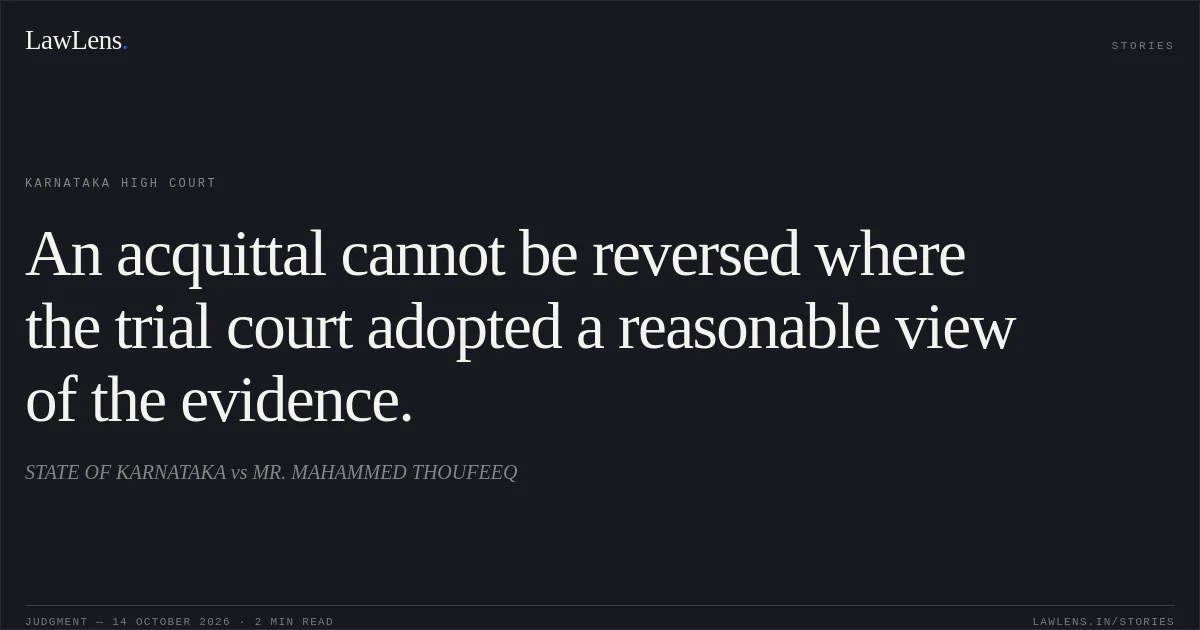
The Court answered the question of interference in the negative and dismissed the State’s appeal.
The trial court’s acquittal of the respondent was left undisturbed.
Source reference: p. 10, paras. 13–14Acts & Sections Cited
5 provisions across 3 statutes referred to in this judgment. Each provision opens on LawLens.
Code of Criminal Procedure, 19732
Indian Penal Code, 18601
Motor Vehicles Act, 19882
Original Court PDF
STATE OF KARNATAKAvsMR. MAHAMMED THOUFEEQ
Click to open original judgment
Original judgment, available to read, download and summarize on LawLens.in


