Facts
The appellant alleged that on 19 September 2017, while at his workplace at the C.C.L. Office, respondents 2–5 and two unknown persons dragged and assaulted him.
Source reference: p.2–3He alleged that respondent 2 struck the back of his head with a stone and respondent 3 hit his waist with a rod, following a demand for ₹20 lakhs concerning land said to have enabled the appellant to obtain his C.C.L. job.
Source reference: p.2–3The police registered a case under Sections 147, 323, 353, 341, 307, 385, 504, 506 and 149 IPC, and the matter proceeded to trial.
Source reference: p.3The trial court acquitted respondents 2–5 on 20 February 2024, finding that the prosecution had not proved the charges beyond reasonable doubt; the appellant challenged that acquittal.
Source reference: p.4Issues
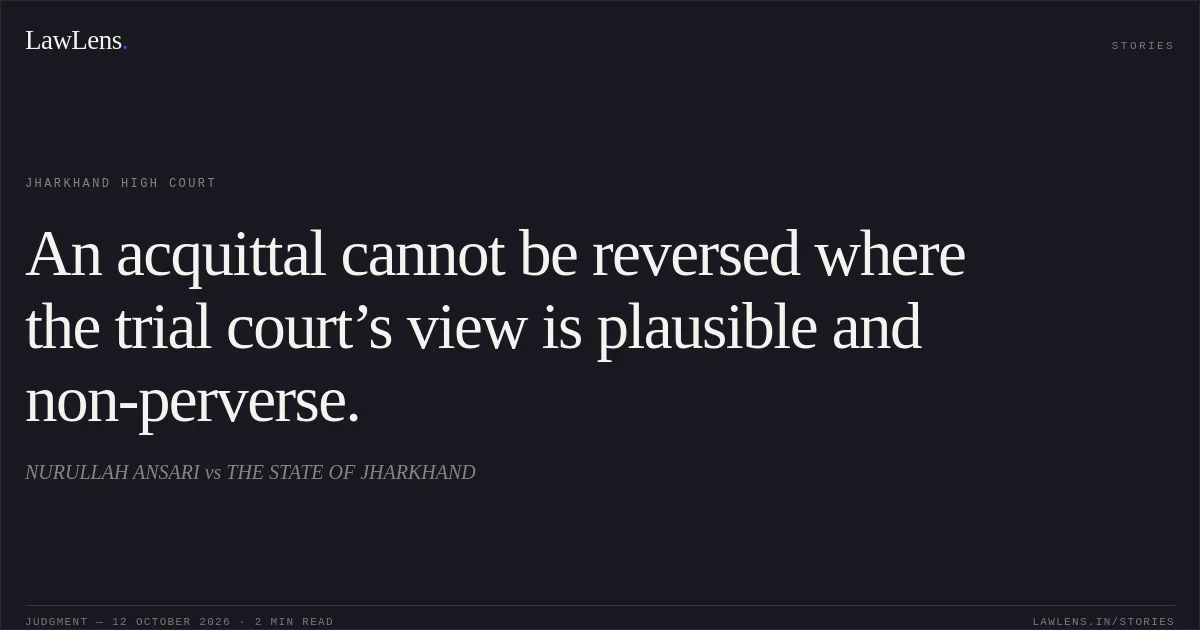
Whether the trial court’s acquittal of respondents 2–5 was liable to be reversed on appeal.
Source reference: p.4, p.8Whether the prosecution evidence established the alleged assault and other charged offences beyond reasonable doubt.
Source reference: p.4–5, p.8Law Applied
The respondents had been charged under Sections 147, 323, 353, 341, 307, 385, 504, 506 and 149 of the IPC.
Source reference: p.3In an appeal against acquittal, the appellate court may reappreciate the evidence, but interference is warranted where the trial court’s view is illegal, erroneous or perverse; acquittal should not be reversed merely because another view is possible. Where two equally plausible views arise, the view favouring the accused should prevail (Mallappa v. State of Karnataka, (2024) 3 SCC 544, paras 26–27).
Source reference: p.5–7The presumption of innocence is reinforced by acquittal, and appellate interference is justified only where the acquittal is perverse (State of Odisha v. Banabihari Mohapatra, (2021) 15 SCC 268, para 32).
Source reference: p.7Reasoning
The High Court noted that the injury report was prepared on 29 November 2017, approximately two months after the alleged incident, and recorded injuries that were superficial and simple and could have resulted from other accidents.
Source reference: p.5It also noted that the Investigating Officer had seized no material from the place of occurrence or from the respondents.
Source reference: p.5Applying the restricted standard for appellate review of acquittals, the Court found that the trial court had properly assessed the evidence and that its view was a permissible one; the evidence did not warrant disturbing the acquittal.
Source reference: p.7–8Holding
The Court held that respondents 2–5 were entitled to the benefit of doubt and found no merit in the appeal.
It affirmed the acquittal dated 20 February 2024 and dismissed the appeal; any pending interlocutory application was disposed of, and the trial court record was directed to be returned.
Source reference: p.8Acts & Sections Cited
10 provisions across 2 statutes referred to in this judgment. Each provision opens on LawLens.
Indian Penal Code, 1860
Code of Criminal Procedure, 19731
Original Court PDF
NURULLAH ANSARIvsTHE STATE OF JHARKHAND
Click to open original judgment
Original judgment, available to read, download and summarize on LawLens.in