Facts
The prosecution alleged that the accused, proprietor of Hoysala Security Services and the complainant’s employer, failed to remit provident-fund contributions totalling ₹19,512 for 2007–2011.
Source reference: paras. 1, 3–5; pp. 2–5It also alleged that, on 17 February 2012, the accused threatened and caste-abused the complainant.
Source reference: paras. 1, 3–5; pp. 2–5The accused was charged under Sections 418, 406 and 506 of the IPC and Section 3(1)(x) of the SC/ST (Prevention of Atrocities) Act, 1989. The trial court acquitted him in Special Case No. 21/2012, and the State appealed against that acquittal.
Source reference: paras. 1, 3–5; pp. 2–5Issues
Whether the State had established grounds to interfere with the trial court’s judgment of acquittal
Source reference: para. 9; pp. 5–6Whether the trial court’s assessment of the evidence concerning the alleged non-remittance of provident-fund contributions and the related offences was legally or factually erroneous
Source reference: paras. 12–14; pp. 8–12Law Applied
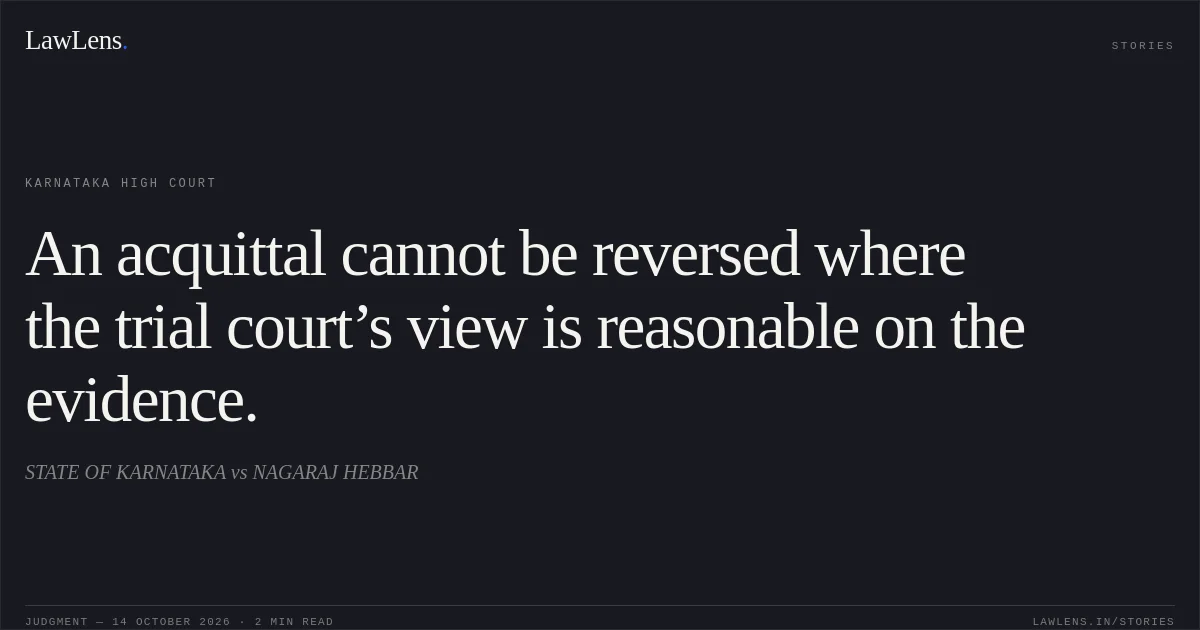
In an appeal against acquittal under Section 378 of the Code of Criminal Procedure, the appellate court may reappreciate the evidence, but the acquittal reinforces the presumption of innocence. If the trial court’s view is a reasonable one on the evidence, it must not be displaced merely because another view is possible; interference is warranted where the acquittal is perverse, material evidence has been misread or omitted, or the evidence permits only a conclusion of guilt.
Source reference: para. 10; pp. 6–8The Court relied on Constable 907 Surendra Singh v. State of Uttarakhand, Babu Sahebgouda Rudragoudar v. State of Karnataka, Chandrappa v. State of Karnataka and H.D. Sundara v. State of Karnataka.
Source reference: para. 10; pp. 6–8The charged offences included criminal breach of trust under Sections 405–406 IPC and cheating under Section 418 IPC.
Source reference: para. 13; pp. 9–12Reasoning
The Court noted inconsistencies in the evidence about the incident’s location: the complaint referred to the accused’s office at Raj Towers, while witnesses and the spot mahazar also referred to Tulu Nadu Towers, where the PF office was situated.
Source reference: para. 12; pp. 8–9More significantly, the PF records and testimony showed that supplementary contributions had been paid on 1 February 2012; the PF witnesses acknowledged the relevant challans and that no balance remained payable as of 17 February 2012, the alleged incident date.
Source reference: para. 13; pp. 9–12On reappreciating the record, the Court found no legal or factual error in the trial court’s conclusion that the prosecution had not proved the alleged offences beyond reasonable doubt, and no basis to disturb a reasonable acquittal.
Source reference: paras. 14–15; pp. 12–13Holding
The Court answered the issue of interference in the negative, holding that the State had not shown grounds to overturn the acquittal.
The appeal was dismissed, and the trial court’s acquittal was left undisturbed.
Source reference: paras. 14–15; pp. 12–13Acts & Sections Cited
7 provisions across 3 statutes referred to in this judgment. Each provision opens on LawLens.
Code of Criminal Procedure, 19732
Indian Penal Code, 18604
Scheduled Castes and the Scheduled Tribes (Prevention of Atrocities) Act, 19891
Original Court PDF
STATE OF KARNATAKAvsNAGARAJ HEBBAR
Click to open original judgment
Original judgment, available to read, download and summarize on LawLens.in


