Facts
The prosecution alleged that accused Nos. 1 and 2 trespassed into the complainant’s residence and threatened the complainant and another person, demanding money and threatening to obtain and publish personal information.
Source reference: pp. 3–4Accused No. 3 was alleged to have supplied their personal information to accused Nos. 1 and 2.
Source reference: pp. 3–4The State charged the accused under Sections 448, 506 and 114 of the Indian Penal Code (IPC), among other provisions described in the judgment.
Source reference: pp. 3–4After examining 12 prosecution witnesses and marking 17 exhibits, the trial court acquitted the accused, citing material omissions, contradictions, improvements and concerns regarding interested witnesses.
Source reference: pp. 4, 9The State appealed against the acquittal under Section 378 of the Code of Criminal Procedure (CrPC).
Source reference: pp. 2, 4Issues
1. Whether the State established grounds for appellate interference with the trial court’s acquittal.
Source reference: p. 7Law Applied
The Court considered the principles governing appeals against acquittal under Section 378 CrPC.
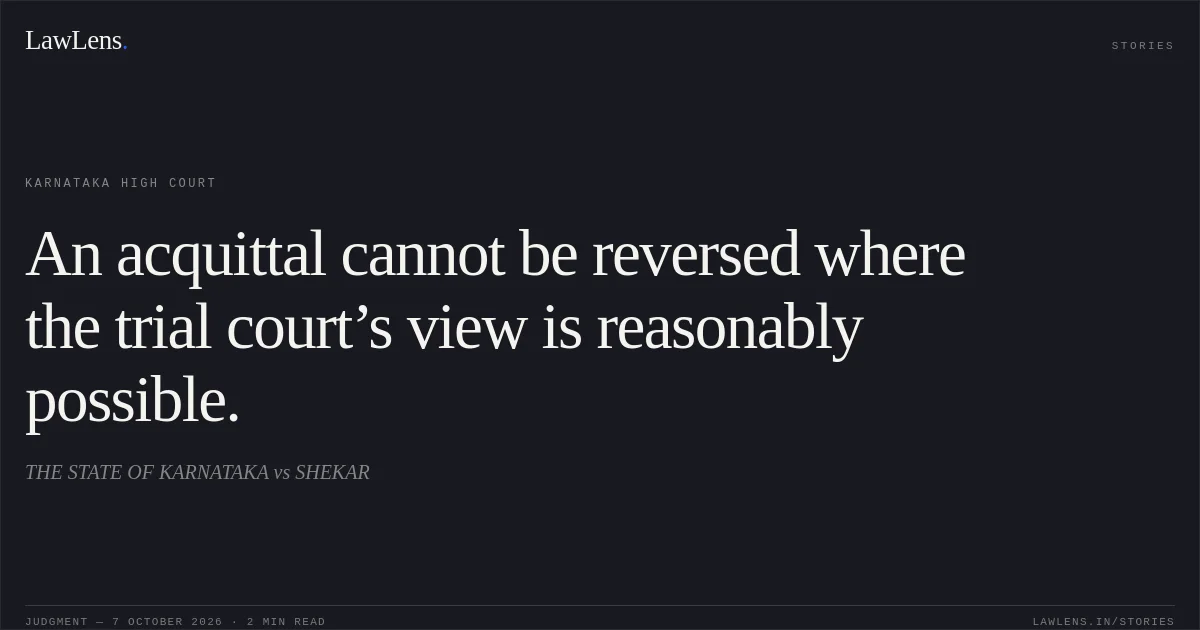
Source reference: pp. 7–9An appellate court may reappreciate the evidence, but the acquittal reinforces the presumption of innocence; if the trial court’s view is a reasonable view supported by the record, it cannot be displaced merely because another view is possible.
Source reference: pp. 7–9Interference is warranted where the acquittal is perverse, rests on a misreading or omission of material evidence, or where the only reasonable conclusion on the evidence is guilt beyond reasonable doubt.
Source reference: pp. 7–9The Court relied on Constable 907 Surendra Singh v. State of Uttarakhand, (2025) 5 SCC 433; Babu Sahebgouda Rudragaudhar v. State of Karnataka, (2024) 8 SCC 149; Chandrappa v. State of Karnataka, (2007) 4 SCC 415; and H.D. Sundara v. State of Karnataka, (2023) 9 SCC 581.
Source reference: pp. 7–9Reasoning
The High Court reviewed the trial court’s assessment of the prosecution evidence and noted that the trial court had considered the material omissions, contradictions, improvements and conduct of the interested witnesses.
Source reference: p. 9On its own reappreciation of the record, the High Court found no legal or factual error in that assessment and no basis to conclude that the acquittal was perverse or that guilt was the only reasonable view.
Source reference: pp. 9–10The State therefore failed to satisfy the standard for appellate interference with an acquittal.
Source reference: pp. 9–10Holding
The Court answered the issue in the negative, holding that the State had not made out grounds to interfere with the acquittal.
The appeal was dismissed.
Source reference: p. 10Acts & Sections Cited
6 provisions across 2 statutes referred to in this judgment. Each provision opens on LawLens.
Code of Criminal Procedure, 19731
Indian Penal Code, 18605
Original Court PDF
THE STATE OF KARNATAKAvsSHEKAR
Click to open original judgment
Original judgment, available to read, download and summarize on LawLens.in