Facts
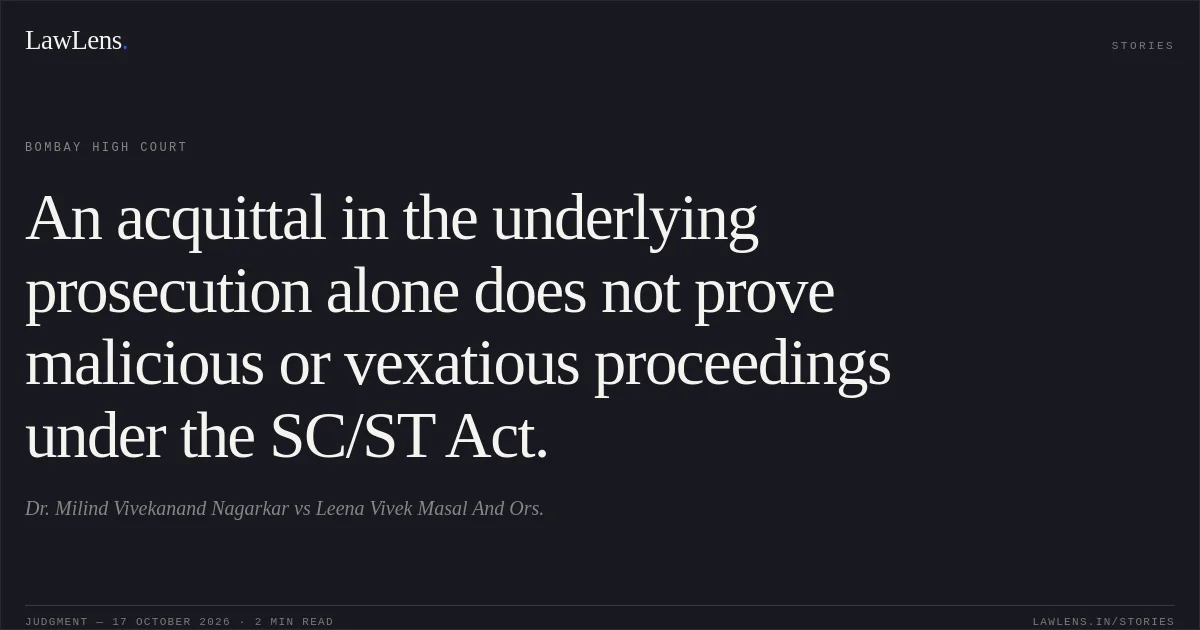
The applicant, a doctor belonging to the Hindu Chambhar community, filed a private complaint alleging that Respondents 1 and 2 had falsely implicated him in a prosecution under Section 354 IPC and thereby committed offences under Sections 3(1)(viii), 3(1)(ix) and 3(2)(ii) of the Scheduled Castes and the Scheduled Tribes (Prevention of Atrocities) Act, 1989.
Source reference: para. 2–5The applicant had been acquitted of the Section 354 IPC charge; Respondents 1 and 2 were subsequently acquitted in the private complaint by the Additional Sessions Judge, Panvel.
Source reference: para. 2–5The applicant sought leave under Section 378(4) CrPC to appeal that acquittal.
Source reference: para. 2Issues
Whether the acquittal of the applicant in the earlier Section 354 IPC prosecution established that the respondents had instituted false, malicious or vexatious proceedings, or given false or frivolous information, under Sections 3(1)(viii) or 3(1)(ix) of the Atrocities Act.
Source reference: para. 12, 15–17Whether the respondents’ alleged evidence in the Section 354 IPC prosecution could attract Section 3(2)(ii) of the Atrocities Act, given the punishment prescribed for that offence.
Source reference: para. 13–14Whether the record justified granting leave to appeal against the respondents’ acquittal, including in light of the applicant’s reliance on the presumption under Section 8(c) of the Atrocities Act.
Source reference: para. 17–22Law Applied
Section 378(4) CrPC provides the procedural basis for a complainant to seek special leave to appeal against an acquittal; leave is not warranted where the acquittal is not shown to be perverse and the trial court’s view is a probable one.
Source reference: para. 2, 17, 22Sections 3(1)(viii) and 3(1)(ix) of the Atrocities Act require proof of the specified false, malicious or vexatious proceedings, or false or frivolous information causing injury or annoyance to a member of a Scheduled Caste or Scheduled Tribe.
Source reference: para. 11–12Section 3(2)(ii) requires false evidence intended or likely to cause conviction for an offence punishable with imprisonment for seven years or upwards.
Source reference: para. 11, 13Section 8(c) creates a presumption concerning an accused’s knowledge of the victim’s caste in the circumstances specified by that provision; the Court held it inapplicable to this complaint, filed before the provision came into force.
Source reference: para. 19–21The Court considered Ashabai Machindra Adhagale v. State of Maharashtra and Shivkumar @ Baleshwar Yadav v. State of Chhattisgarh but found them unhelpful to the applicant on the facts.
Source reference: para. 18, 21Reasoning
The Court held that the applicant’s acquittal in the Section 354 IPC case did not, by itself, prove that the respondents’ complaint was false, malicious or vexatious, or that they had supplied false information or fabricated evidence.
Source reference: para. 15–16Because the Section 354 IPC offence carried a maximum sentence of five years, the Court found that the seven-year threshold in Section 3(2)(ii) was not met.
Source reference: para. 14It also found no basis to apply Section 8(c), noting that the private complaint predated that provision and that the applicant’s admissions did not establish that the respondents had personal knowledge of his caste or family.
Source reference: para. 19–20The trial court’s acquittal was therefore not perverse, and its view was a probable one.
Source reference: para. 17Holding
The Bombay High Court held that no case for special leave to appeal had been made out and rejected the leave application.
The acquittal of Respondents 1 and 2 consequently remained undisturbed.
Source reference: para. 22–23Acts & Sections Cited
4 provisions across 3 statutes referred to in this judgment. Each provision opens on LawLens.
Code of Criminal Procedure, 19731
Indian Penal Code, 18601
Original Court PDF
Dr. Milind Vivekanand NagarkarvsLeena Vivek Masal And Ors.
Click to open original judgment
Original judgment, available to read, download and summarize on LawLens.in