Facts
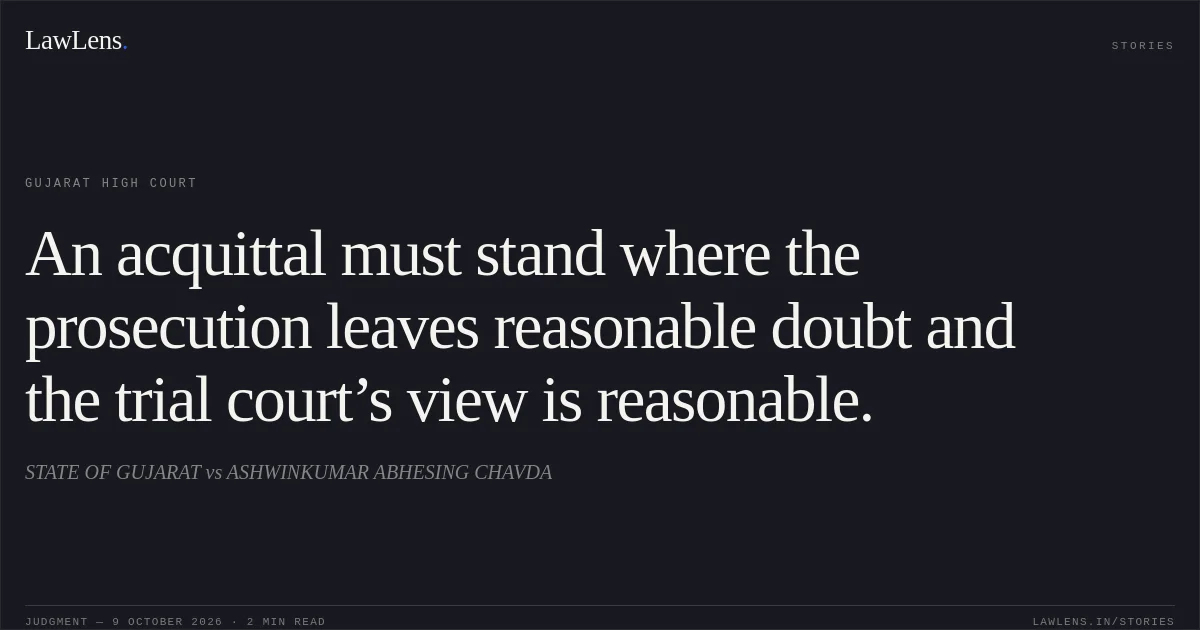
The State appealed under Section 378 of the Code of Criminal Procedure, 1973, against the respondents’ acquittal by the Sessions Court of charges under Sections 302 and 114 of the Indian Penal Code and Section 135 of the Bombay Police Act.
Source reference: para. 1–7The prosecution alleged that, following a dispute concerning family property, the accused returned to the complainant’s home armed with a knife and an iron rod; one accused allegedly restrained the complainant’s daughter, Hansa, while the other stabbed her, causing her death.
Source reference: para. 2, 15The prosecution relied principally on the complainant and family witnesses, medical evidence, and alleged weapon recoveries.
Source reference: no citationThe Sessions Court acquitted the accused, and the State challenged that decision.
Source reference: para. 5–7Issues
1. Whether the prosecution evidence established the respondents’ guilt beyond reasonable doubt for the charged offences.
Source reference: para. 24–31, 35–372. Whether the Sessions Court’s acquittal disclosed an error warranting appellate interference under Section 378 CrPC.
Source reference: para. 33–37Law Applied
Section 378 CrPC permits an appellate court to review, reappreciate, and reconsider the evidence in an appeal against acquittal; however, the accused benefit from a double presumption of innocence, and where two reasonable conclusions are available, the acquittal should not be disturbed.
Source reference: para. 33–35In assessing ocular evidence, courts consider the testimony as a whole and distinguish material contradictions from minor discrepancies.
Source reference: para. 23The prosecution must prove the charged offences beyond reasonable doubt.
Source reference: para. 31, 36The charges arose under Sections 302 and 114 IPC and Section 135 of the Bombay Police Act.
Source reference: para. 1, 4Reasoning
The doctor considered it very unlikely that the relevant injury was caused by the recovered knife, and the prosecution did not explain an additional injury recorded at post-mortem.
Source reference: para. 14, 24Despite testimony that Hansa bled profusely, no blood was found at the alleged scene or on the cot or bedsheet.
Source reference: para. 25The alleged incident occurred in darkness, and the prosecution did not examine two potentially material witnesses; the recovery witnesses turned hostile, and the investigating officer did not prove the recovery-panchnama’s contents.
Source reference: para. 26–27, 30Considering these circumstances together, the Court held that the prosecution had not established guilt beyond reasonable doubt and that the acquittal was not shown to be erroneous or perverse.
Source reference: para. 31, 36–37Holding
The Court answered the issues against the State, holding that the prosecution had failed to prove the charges beyond reasonable doubt and that no basis existed to overturn the acquittal.
The appeal was dismissed and the Sessions Court’s judgment of acquittal confirmed.
Source reference: para. 38The Court further directed that any respondent taken into custody under a non-bailable warrant be released forthwith; bail bonds, if any, were discharged.
Source reference: para. 38Acts & Sections Cited
5 provisions across 2 statutes referred to in this judgment. Each provision opens on LawLens.
Code of Criminal Procedure, 19733
Indian Penal Code, 18602
Original Court PDF
STATE OF GUJARATvsASHWINKUMAR ABHESING CHAVDA
Click to open original judgment
Original judgment, available to read, download and summarize on LawLens.in