Facts
The State challenged the acquittal of five accused by the Additional District and Sessions Judge and Special Court, Bidar, in Spl. Case (SC/ST) No. 42/2015.
Source reference: paras. 1–2, pp. 3–5The prosecution alleged that accused Nos. 1–4 conspired to murder Hanumanth Ladha and that accused No. 1 shot him near Ambedkar Circle, Bidar, on 25 March 2015; it also alleged related offences concerning destruction of evidence, illegal firearm possession, and the victim’s caste.
Source reference: paras. 1–2, pp. 3–5The trial court acquitted the accused of the charged offences under the IPC, the Arms Act, and the SC/ST (Prevention of Atrocities) Act after the prosecution examined 47 witnesses.
Source reference: paras. 3–7, pp. 5–8The State appealed, principally arguing that the trial court had wrongly assessed the evidence of the alleged eyewitnesses.
Source reference: paras. 8–10, pp. 8–9Issues
1. Whether the State established that the trial court’s acquittal was reached without proper appreciation of the evidence and therefore warranted appellate interference
Source reference: para. 10, p. 92. What order should follow from the Court’s determination of that issue
Source reference: para. 10, p. 9Law Applied
The appeal was considered under Section 378(1) and (3) of the Code of Criminal Procedure, corresponding to Sections 419(1) and (3) of the BNSS.
Source reference: para. 1, p. 3The Court applied the principle stated in Jafarudheen v. State of Kerala, 2022 SCC OnLine SC 495: an appellate court reviewing an acquittal must assess whether the trial court’s view is a possible one on the evidence; because acquittal reinforces the presumption of innocence, that view should not be reversed unless scrutiny on accepted legal principles justifies interference.
Source reference: para. 61, pp. 34–35The prosecution bore the burden of proving the charged offences—including those under Sections 118, 120-B, 179, 201, 302 read with Section 34 IPC, Sections 25, 27 and 28 of the Arms Act, and Section 3(2)(v) of the SC/ST Act—beyond reasonable doubt.
Source reference: paras. 1, 5, pp. 3, 6–8Reasoning
The Court found that the complainant, PW-12, initially described the shooter as unknown, did not name or identify accused No. 1 in the complaint, and identified him only after police showed him photographs; the prosecution did not produce those photographs, and no test identification parade was conducted.
Source reference: paras. 50–52, pp. 26–29The Court also considered PW-17’s failure to promptly inform the police or others about what he claimed to have witnessed, the uncertainty about his presence and vantage point, and PW-23’s similar failure to report the alleged identification promptly.
Source reference: paras. 54–58, pp. 29–32Other evidence, including that concerning the alleged conspiracy, firearm, and destruction of evidence, was weakened by hostile or unsupportive witnesses.
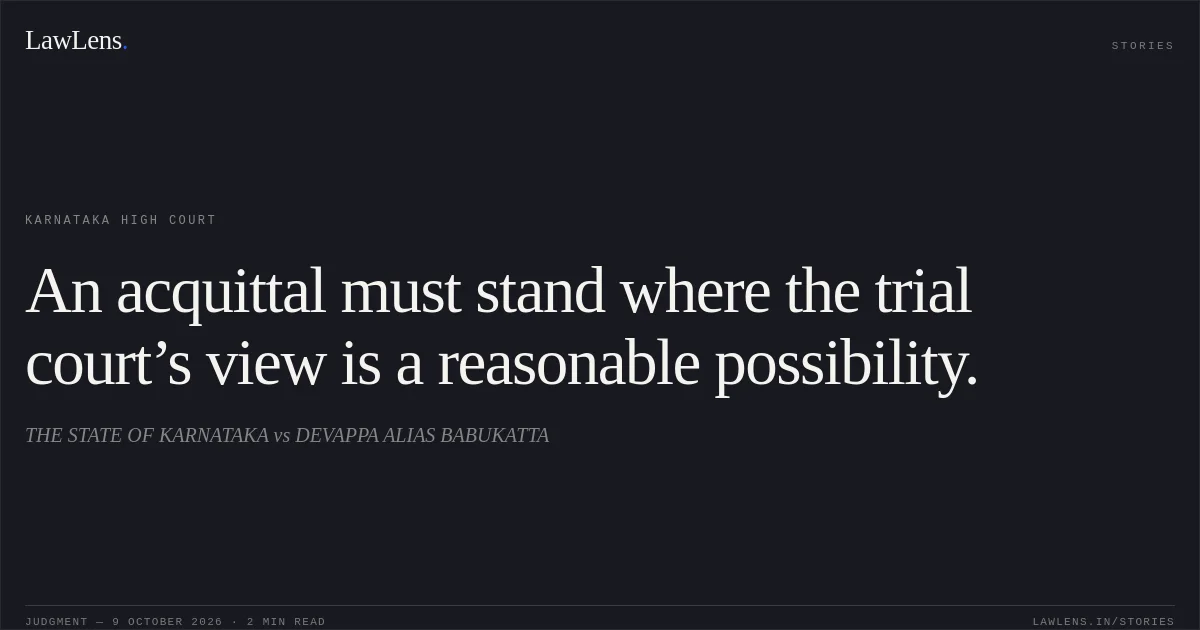
Source reference: paras. 19–22, 43–49, pp. 13–15, 23–26In light of these deficiencies, the Court held that the trial court’s assessment was a possible view of the evidence and found no basis to disturb the acquittal.
Source reference: paras. 59–62, pp. 32–35Holding
The Court answered the issue concerning appellate interference in the negative, holding that the State had not shown that the trial court failed to appreciate the evidence or otherwise committed an error warranting reversal.
The appeal was dismissed, and the trial court’s judgment and order of acquittal dated 4 September 2023 were confirmed.
Source reference: para. 63, p. 36Acts & Sections Cited
13 provisions across 5 statutes referred to in this judgment. Each provision opens on LawLens.
Bharatiya Nagarik Suraksha Sanhita, 20231
Code of Criminal Procedure, 19733
Indian Penal Code, 18605
Arms Act, 19593
Scheduled Castes and the Scheduled Tribes (Prevention of Atrocities) Act, 19891
Original Court PDF
THE STATE OF KARNATAKAvsDEVAPPA ALIAS BABUKATTA
Click to open original judgment
Original judgment, available to read, download and summarize on LawLens.in