Facts
The prosecution alleged that, following a dispute over the cutting of a tree, the accused formed an unlawful assembly and assaulted the complainant and others, used caste-based abuse, assaulted a woman, and issued threats. The accused were charged under Sections 143, 147, 148, 323, 324, 354, 504 and 506 read with Section 149 of the IPC, and Sections 3(1)(x) and 3(1)(xi) of the SC/ST (Prevention of Atrocities) Act.
Source reference: pp. 4–6The Sessions Court acquitted them on 21 May 2016. The State appealed against the acquittal; the appeal against accused No. 2 had abated.
Source reference: pp. 1, 3–4Issues
1. Whether the State established a ground for appellate interference with the acquittal, including whether the prosecution evidence proved the charged offences beyond reasonable doubt.
Source reference: para. 9, p. 92. Whether the trial court’s assessment of the evidence was legally or factually erroneous, or otherwise perverse.
Source reference: paras. 11, 19, pp. 10–11, 17Law Applied
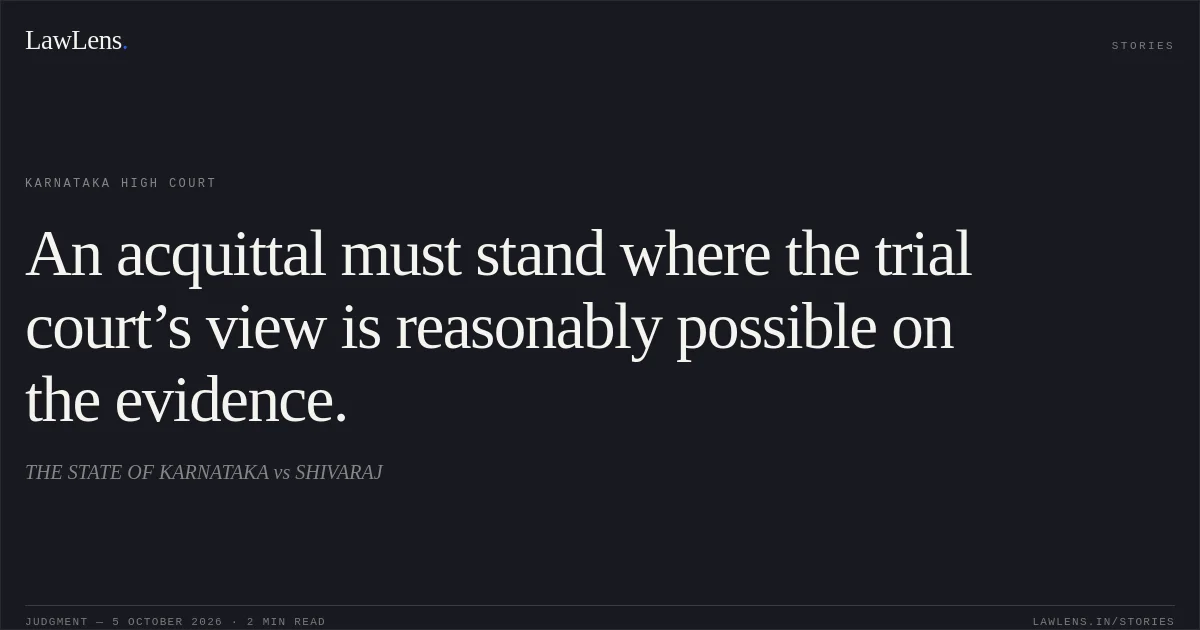
The Court applied the principles governing appeals against acquittal under Section 378 of the Code of Criminal Procedure: an acquittal reinforces the presumption of innocence; the appellate court may reappreciate the evidence but should not reverse an acquittal if the trial court’s view is a reasonable one; interference is warranted where the judgment is perverse, overlooks or misreads material evidence, or where guilt is the only conclusion reasonably available.
Source reference: para. 11, pp. 10–11The Court relied on Constable 907 Surendra Singh v. State of Uttarakhand, (2025) 5 SCC 433; Babu Sahebgouda Rudragoudar v. State of Karnataka, (2024) 8 SCC 149; Chandrappa v. State of Karnataka, (2007) 4 SCC 415; and H.D. Sundara v. State of Karnataka, (2023) 9 SCC 581.
Source reference: para. 11, p. 10The charged IPC and SC/ST Act provisions required proof of their respective elements beyond reasonable doubt.
Source reference: pp. 4, 14–15Reasoning
On reappraising the evidence, the Court found no sufficient proof of the essential ingredients of unlawful assembly and rioting under Sections 143, 147 and 148 read with Section 149 IPC.
Source reference: para. 14, p. 14Although witnesses described assaults and wound certificates recorded simple injuries, the certificates identified the alleged assailants generally as “Manjunath, Shivaraj and others,” did not name the other accused, and did not state the age of the injuries.
Source reference: paras. 15–18, pp. 14–17The Court considered the evidence inconsistent and lacking the consistency, corroboration and cogency required to establish guilt beyond reasonable doubt. It found no legal or factual error in the trial court’s assessment and no basis to conclude that the acquittal was perverse.
Source reference: para. 19, p. 17Holding
The Court answered the issue of appellate interference in the negative and held that the State had not established grounds to disturb the acquittal.
The appeal was dismissed, leaving the trial court’s judgment of acquittal in force.
Source reference: para. 20, p. 18Acts & Sections Cited
12 provisions across 3 statutes referred to in this judgment. Each provision opens on LawLens.
Code of Criminal Procedure, 19732
Indian Penal Code, 1860
Scheduled Castes and the Scheduled Tribes (Prevention of Atrocities) Act, 19891
Original Court PDF
THE STATE OF KARNATAKAvsSHIVARAJ
Click to open original judgment
Original judgment, available to read, download and summarize on LawLens.in