Facts
The prosecution alleged that, at about 2:00 a.m. on 27 April 1999, several assailants robbed the Rukshmani Temple at Dwarka and assaulted its occupants.
Source reference: para. 3.1–3.2, 8–9Four injured eyewitnesses established the occurrence, but the assailants were strangers and the incident took place at night.
Source reference: para. 3.1–3.2, 8–9The Sessions Court acquitted the six accused of offences under Sections 394, 397 and 506(2) of the Indian Penal Code (IPC) and Section 135(1) of the Bombay Police Act, giving them the benefit of doubt.
Source reference: para. 1, 3.5The State appealed under Section 378 CrPC.
Source reference: para. 1, 3.5Issues
1. Whether the prosecution proved beyond reasonable doubt that the respondents were the persons who committed the robbery and assaults, particularly through eyewitness identification and the alleged recoveries and discoveries.
Source reference: para. 7, 92. Whether the Sessions Court’s acquittal involved a view so implausible or perverse as to justify interference in an appeal against acquittal.
Source reference: para. 21Law Applied
Under Sections 394, 397 and 506(2) IPC, the prosecution had to prove the accused’s commission of the charged robbery, use of violence or weapons as alleged, and criminal intimidation; Section 135(1) of the Bombay Police Act required proof of the relevant prohibition on carrying arms.
Source reference: para. 1, 20, 23Section 27 of the Evidence Act permits proof of only that part of information from an accused in police custody which distinctly relates to a fact thereby discovered; a recovery does not establish guilt unless its evidentiary foundations are proved.
Source reference: para. 16In an appeal against acquittal, the appellate court may interfere in exceptional cases involving compelling circumstances and a perverse judgment, but should not interfere merely because another view is possible; the acquittal reinforces the presumption of innocence.
Source reference: para. 21The Court relied on Tulasareddi @ Mudakappa & Anr. v. State of Karnataka & Ors., 2026 INSC 67.
Source reference: para. 21Reasoning
The injured witnesses reliably proved the occurrence, but that evidence did not establish the identity of the assailants.
Source reference: para. 8–9Identification was doubtful because the incident occurred at night, the witnesses were asleep and covered with blankets, and no reliable source of light or prior description was established; the complainant’s claim of moonlight was an improvement.
Source reference: para. 10Dock identifications conflicted with the test-identification parade, and the parade itself was unreliable due to the circumstances in which it was conducted and the limited evidence identifying which witness picked which accused.
Source reference: para. 11–13The recovery and discovery evidence was also unreliable: the panch witnesses contradicted one another, could not reliably identify the accused or attribute articles to particular recoveries, and the alleged cupboard discovery was from an open place.
Source reference: para. 14–16No examined witness established that the recovered articles belonged to the temple, and the notification necessary to prove the charge under Section 135(1) of the Bombay Police Act was not produced.
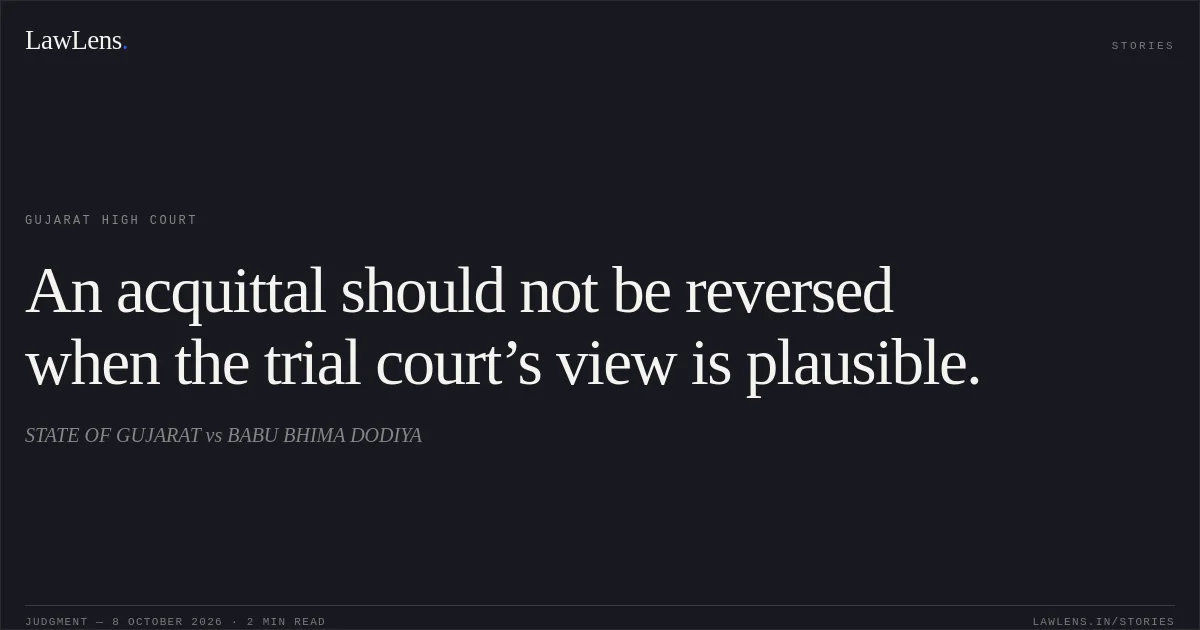
Source reference: para. 17–20Given these evidentiary gaps, the Sessions Court’s view was plausible and not a basis for appellate interference.
Source reference: para. 21–24Holding
The High Court held that the prosecution failed to prove beyond reasonable doubt that the respondents committed the charged offences, notwithstanding proof that a robbery and assaults occurred.
Finding no ground to disturb the acquittal, it dismissed the State’s appeal and confirmed the Sessions Court’s judgment dated 27 February 2002.
Source reference: para. 24–27Acts & Sections Cited
9 provisions across 2 statutes referred to in this judgment. Each provision opens on LawLens.
Code of Criminal Procedure, 19733
Indian Penal Code, 18606
Original Court PDF
STATE OF GUJARATvsBABU BHIMA DODIYA
Click to open original judgment
Original judgment, available to read, download and summarize on LawLens.in