Facts
Putta Manjula, wife of the respondent, was reported missing after leaving with him on 21 June 2011.
Source reference: paras. 2–4, pp. 2–4Her body was recovered from the Kapila River on 25 June 2011 in a highly decomposed condition.
Source reference: paras. 2–4, pp. 2–4The State alleged that the respondent had murdered her and also subjected her to dowry-related cruelty.
Source reference: paras. 2–4, pp. 2–4The Sessions Court acquitted him of offences under Sections 498A and 302 of the Indian Penal Code (IPC) and Sections 3 and 4 of the Dowry Prohibition Act, 1961.
Source reference: paras. 2–4, pp. 2–4The State appealed against the acquittal
Source reference: paras. 2–4, pp. 2–4Issues
1. Whether the trial court erred in finding that the prosecution had not proved the deceased’s death was homicidal
Source reference: para. 9(i), p. 62. Whether the prosecution established a complete chain of circumstantial evidence unerringly pointing to the respondent’s guilt
Source reference: para. 9(ii), p. 63. Whether the trial court’s findings were perverse or unreasonable, or resulted in a miscarriage of justice warranting interference with the acquittal
Source reference: para. 9(iii), p. 6Law Applied
The prosecution must prove each element of the charged offences beyond reasonable doubt.
Source reference: paras. 10, 15, pp. 6, 9–10For a conviction under Section 302 IPC, the prosecution must establish that the death was homicidal.
Source reference: paras. 10, 15, pp. 6, 9–10Where the case rests on circumstantial evidence, the circumstances must form a complete chain pointing unerringly to the accused’s guilt; the last-seen circumstance is probative only where the time gap is sufficiently small to make another person’s intervention improbable.
Source reference: paras. 10, 15, pp. 6, 9–10Under Sections 498A IPC and 3 and 4 of the Dowry Prohibition Act, the prosecution must prove the essential ingredients of cruelty and dowry demand beyond reasonable doubt.
Source reference: paras. 18–20, pp. 11–13In an appeal against acquittal, the appellate court may reappreciate the evidence, but the acquittal strengthens the presumption of innocence; where two reasonable views are possible, the trial court’s view should prevail, and interference is warranted where its findings are perverse, material evidence has been ignored, or a miscarriage of justice has occurred.
Source reference: para. 8, p. 5Reasoning
The medical evidence could not determine the cause of death or establish ante-mortem injuries, leaving the homicidal nature of the death unproved.
Source reference: para. 10, p. 6The alleged last-seen evidence was also insufficient: PW.7 turned hostile; PW.9 saw an unidentified woman and could not establish the date with certainty; and the trial court reasonably treated PW.10’s testimony with caution given her age, the delay before her evidence, and the contradictions with her earlier statement.
Source reference: paras. 12–14, pp. 7–9Moreover, the substantial time gap between the alleged departure on 21 June and PW.9’s observation the following morning weakened the last-seen circumstance, while the auto-rickshaw and pledge chit did not complete the chain.
Source reference: paras. 15–16, pp. 9–10The evidence of dowry demand and cruelty rested principally on interested family witnesses, contained inconsistencies, and lacked independent or contemporaneous corroboration; the marriage payments were not shown to constitute dowry.
Source reference: paras. 18–20, pp. 11–13The appellate court therefore found the trial court’s assessment reasonable and not perverse.
Source reference: paras. 21–22, p. 13Holding
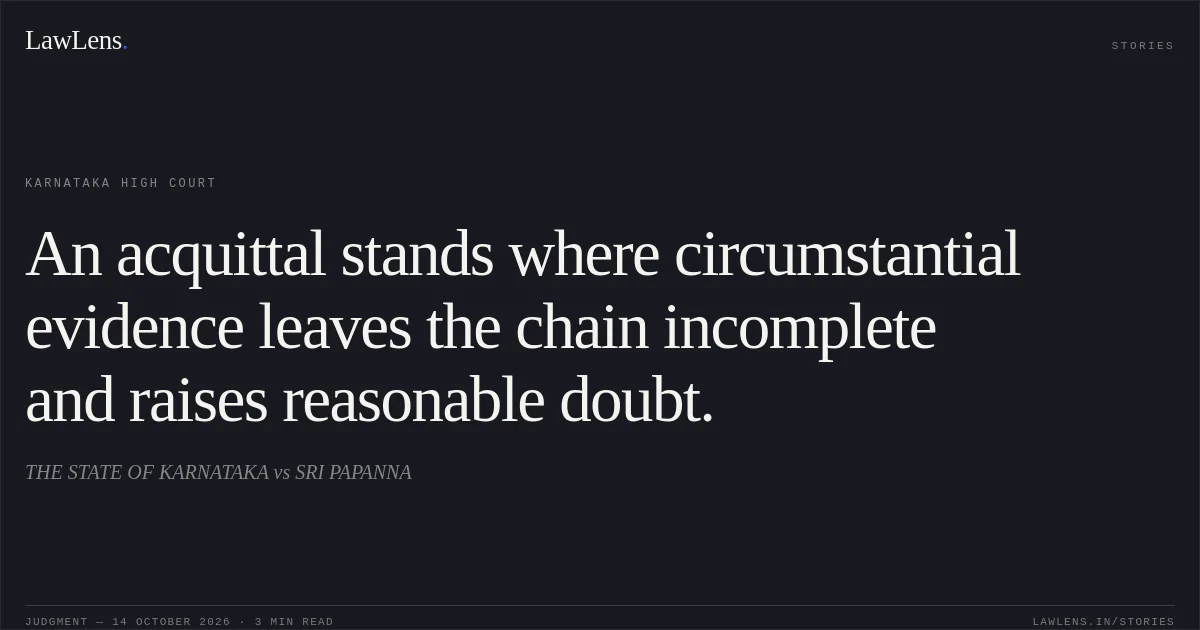
The Court answered the issues against the State, holding that the prosecution had not proved homicidal death, a complete circumstantial chain, or the offences under Section 498A and Section 302 IPC and Sections 3 and 4 of the Dowry Prohibition Act beyond reasonable doubt.
Finding no perversity or other basis to interfere with the acquittal, it dismissed the appeal and confirmed the Sessions Court’s judgment; the respondent’s bail bonds were to stand discharged after the period prescribed under Section 437-A Cr.P.C.
Source reference: paras. 22–23, pp. 13–14Acts & Sections Cited
7 provisions across 3 statutes referred to in this judgment. Each provision opens on LawLens.
Code of Criminal Procedure, 19734
Indian Penal Code, 18601
Original Court PDF
THE STATE OF KARNATAKAvsSRI PAPANNA
Click to open original judgment
Original judgment, available to read, download and summarize on LawLens.in


