Facts
The prosecution alleged that on 2 July 2013, the accused threatened the minor victim near Gopi Circle and later dragged her to an under-construction building, attempted to remove her clothes, and sexually assaulted her.
Source reference: p. 2–3The State charged him under Sections 506, 354 and 354A of the IPC and Sections 8 and 12 of the POCSO Act.
Source reference: p. 2–3The trial court acquitted the accused after the prosecution examined seven witnesses and produced six exhibits.
Source reference: p. 3–4The State appealed under Section 378(1) and (3) of the CrPC, challenging the acquittal.
Source reference: p. 1, 4–5Issues
1. Whether the trial court’s acquittal for the charged offences disclosed a legal or factual error warranting appellate interference.
Source reference: p. 4–5, 11–122. Whether the prosecution evidence proved the alleged threats, assault and attempted removal of the victim’s clothing beyond reasonable doubt.
Source reference: p. 5–11Law Applied
The prosecution allegations concerned Sections 506, 354 and 354A of the IPC and Sections 8 and 12 of the POCSO Act.
Source reference: p. 2–3The High Court considered the principles governing appellate review of acquittals under Section 378 of the CrPC and cited Constable 907 Surendra Singh v. State of Uttarakhand, Babu Sahebgouda Rudragoudar v. State of Karnataka, Chandrappa v. State of Karnataka and H.D. Sundara v. State of Karnataka.
Source reference: p. 11–12It applied those principles in deciding whether the trial court’s acquittal contained an error justifying interference; the judgment does not set out the individual propositions from those authorities.
Source reference: p. 11–12Reasoning
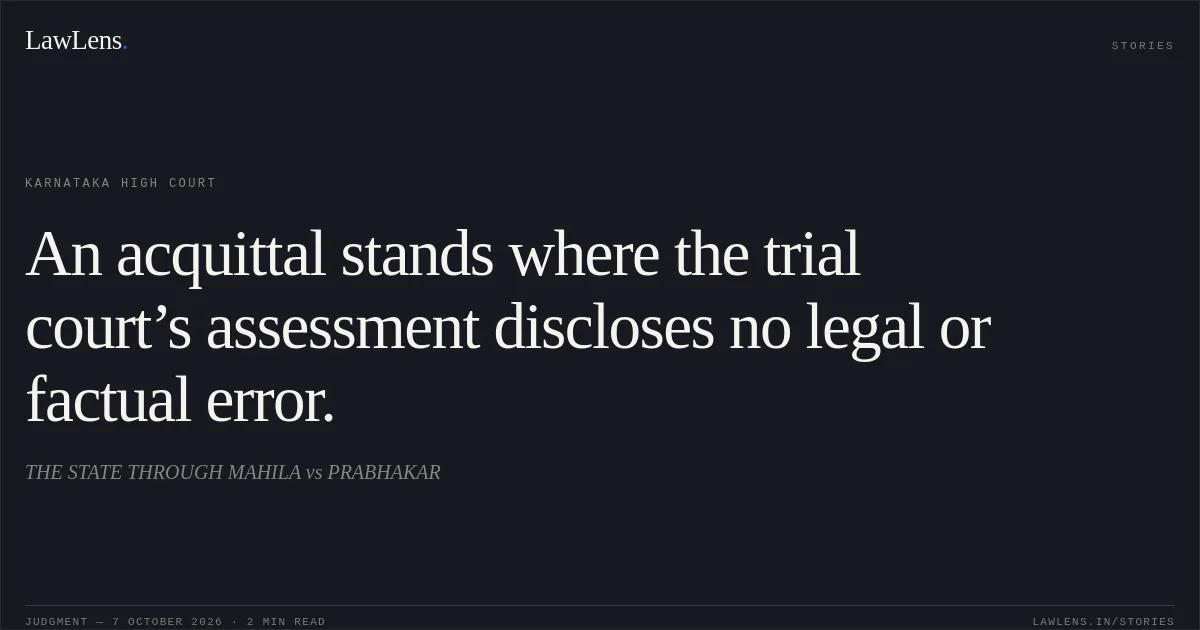
The High Court reviewed the evidence and found no legal or factual error in the trial court’s assessment.
Source reference: p. 11–12The trial court had noted that the victim’s companion did not testify to hearing a threat, while other witnesses’ accounts of the incident were hearsay; it also relied on the six-day delay in lodging the complaint.
Source reference: p. 5–7, 8–9In assessing the assault allegations, the trial court considered the victim’s evidence alongside the busy location, the absence of evidence from schoolteachers, the witnesses’ accounts, and the delay in reporting.
Source reference: p. 7–11On its reappraisal of the record, the High Court found no basis to disturb the acquittal.
Source reference: p. 11–12Holding
The High Court held that no ground had been shown to interfere with the trial court’s acquittal.
The High Court dismissed the State’s appeal.
Source reference: p. 11–12The acquittal therefore remained undisturbed.
Source reference: p. 11–12Acts & Sections Cited
6 provisions across 3 statutes referred to in this judgment. Each provision opens on LawLens.
Code of Criminal Procedure, 19732
Indian Penal Code, 18602
Protection of Children from Sexual Offences Act, 20122
Original Court PDF
THE STATE THROUGH MAHILAvsPRABHAKAR
Click to open original judgment
Original judgment, available to read, download and summarize on LawLens.in