Facts
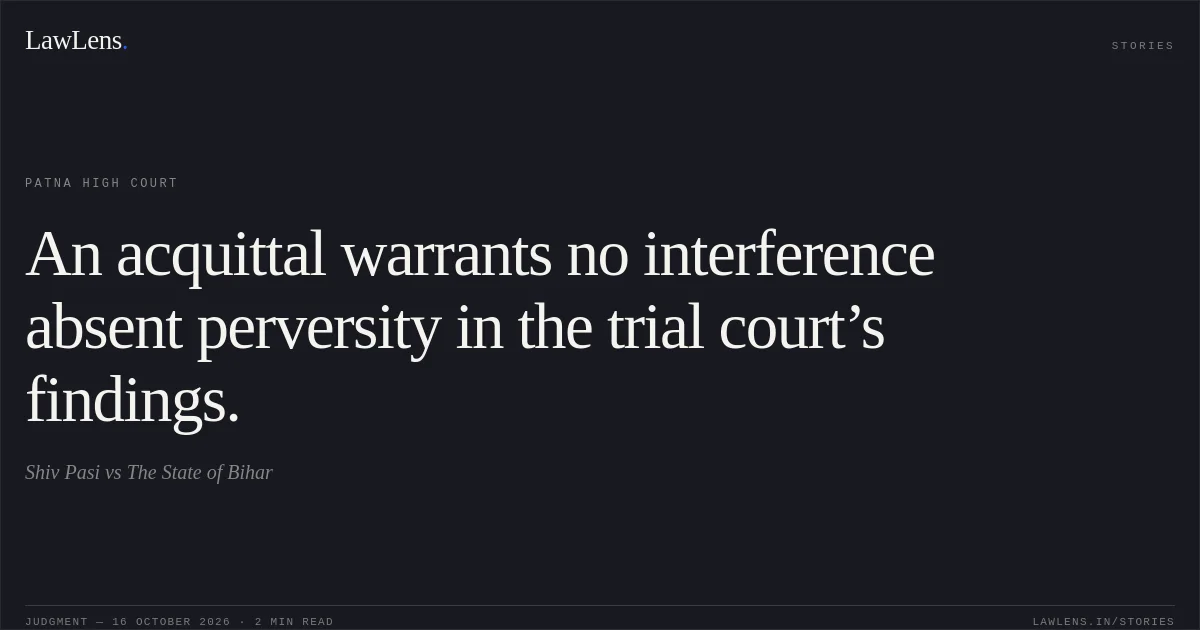
Shiv Pasi appealed the acquittal of Rakesh Pasi and Vikesh Pasi of charges under Sections 364/34 IPC.
Source reference: pp. 2–5, 8The prosecution alleged that Shiv’s son went missing on 9 September 2014 and that the accused had threatened the family; the written information was lodged three days later.
Source reference: pp. 2–5, 8The victim returned after approximately one month and seven days.
Source reference: pp. 2–5, 8At trial, the victim’s account differed materially from his statement under Section 164 CrPC, while the other family witnesses had not witnessed the alleged kidnapping.
Source reference: pp. 2–5, 8The trial court acquitted the accused, finding the victim’s testimony unreliable and the circumstantial evidence insufficient.
Source reference: pp. 2–5, 8Shiv’s appeal followed; the High Court condoned a ten-day delay in filing it.
Source reference: pp. 2–5, 8Issues
1. Whether the trial court’s acquittal was perverse or otherwise warranted appellate interference in light of the victim’s inconsistent accounts and the circumstantial evidence
Source reference: pp. 10–152. Whether the appellant should be ordered to pay costs for pursuing the appeal
Source reference: pp. 15–18Law Applied
Section 364/34 IPC was the charged offence.
Source reference: no citationUnder Section 114, Illustration (e), of the Evidence Act, the court may presume that official and judicial acts have been regularly performed; the trial court relied on this presumption in assessing the voluntariness of the victim’s Section 164 CrPC statement.
Source reference: p. 6For a case based solely on circumstantial evidence, Sharad Birdhichand Sarda v. State of Maharashtra, (1984) 4 SCC 116, requires the circumstances to be fully established, consistent only with guilt, conclusive, and sufficient to exclude every reasonable hypothesis other than guilt.
Source reference: pp. 14–15The High Court also applied the principles governing appeals against acquittal, relying on H.D. Sundara v. State of Karnataka, (2023) 9 SCC 581, and held that interference was unwarranted absent a basis to displace the acquittal.
Source reference: p. 10It referred to Charu Kishor Mehta v. Prakash Patel and Subrata Roy Sahara v. Union of India in considering costs for allegedly fictitious litigation.
Source reference: pp. 16–18Reasoning
The High Court found the victim’s trial testimony materially inconsistent with his Section 164 statement and noted that the trial account emerged about six years after the occurrence.
Source reference: pp. 11–15The other witnesses did not establish that the accused abducted or followed the victim; the victim’s brother had only seen them leave by motorcycle after the victim had departed.
Source reference: pp. 11–15The investigation disclosed no trace of the alleged vehicle or its occupants, and the evidence did not complete a chain excluding innocence.
Source reference: pp. 11–15The court therefore found no perversity in the trial court’s assessment or sufficient ground to interfere with the acquittal.
Source reference: pp. 11–15It considered the appeal fictitious and an unjustified use of court time, warranting costs.
Source reference: pp. 15–18Holding
The High Court dismissed the appeal and upheld the acquittal of Respondents 2 and 3.
It imposed costs of ₹10,000 on the appellant, payable to the Patna High Court Legal Services Committee within one month, with proof of payment to be filed.
Source reference: p. 18Acts & Sections Cited
7 provisions across 2 statutes referred to in this judgment. Each provision opens on LawLens.
Indian Penal Code, 18604
Code of Criminal Procedure, 19733
Original Court PDF
Shiv PasivsThe State of Bihar
Click to open original judgment
Original judgment, available to read, download and summarize on LawLens.in