Facts
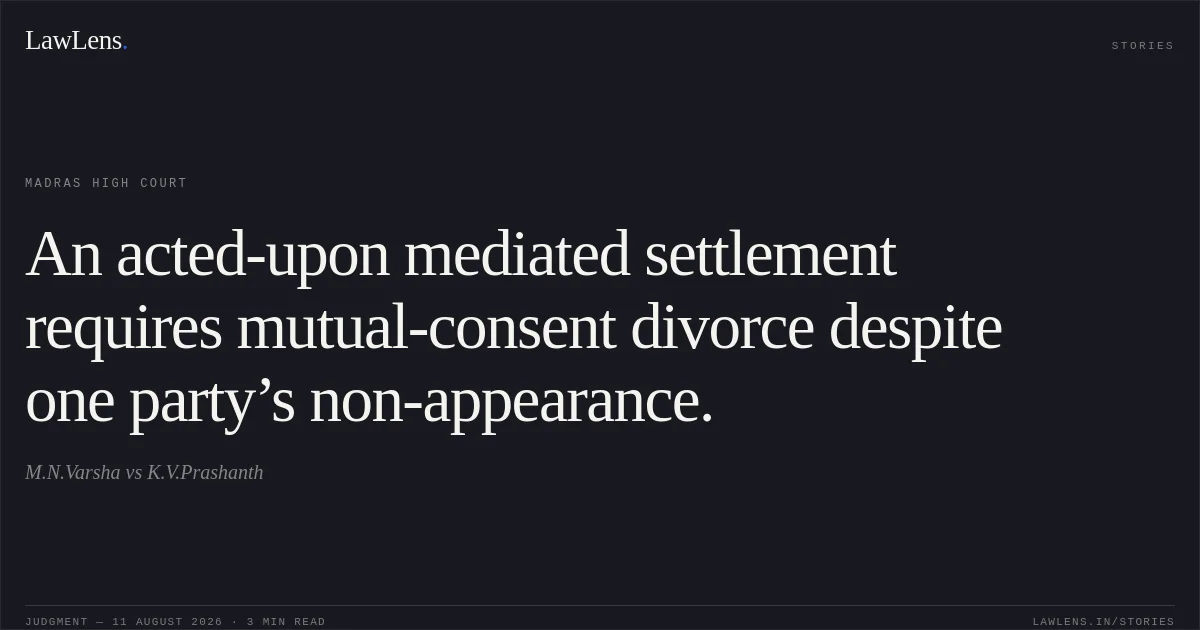
The parties, whose marriage was solemnised on 05.09.2022 and registered on 12.09.2022, had instituted matrimonial proceedings against each other, including HMOP Nos.4147 and 4640 of 2024 and a maintenance proceeding in M.C. No.683 of 2024.
Source reference: para. 3During mediation, they executed a written settlement agreement on 09.07.2025, agreeing to withdraw the pending proceedings, file a joint petition for divorce by mutual consent under Section 13-B of the Hindu Marriage Act, 1955, and regulate the minor child’s visitation.
Source reference: para. 3The husband also relinquished his claim for custody of the child.
Source reference: para. 3Pursuant to the settlement, the parties withdrew their respective proceedings and jointly filed H.M.O.P. No.3186 of 2025 under Section 13-B.
Source reference: para. 4However, the husband failed to appear before the Family Court.
Source reference: para. 4The wife initially filed a memo withdrawing her consent but subsequently withdrew that memo.
Source reference: para. 4The V Additional Family Court, Chennai, nevertheless dismissed the mutual-consent divorce petition and granted the wife liberty to restore her earlier HMOP and maintenance proceedings.
Source reference: paras. 4, 12The wife challenged that order under Article 227 of the Constitution.
Source reference: no citationIssues
Whether the Family Court was justified in dismissing the petition for divorce by mutual consent merely because the respondent-husband did not appear, despite the parties having executed and partly acted upon a mediated settlement?
Source reference: paras. 7–8, 10–12Whether the settlement agreement executed before mediation was binding and could be acted upon notwithstanding the subsequent non-appearance of the husband before the Family Court?
Source reference: paras. 11–18Whether the appearance of the wife through Senior Counsel required prior permission under Section 13 of the Family Courts Act, 1984, in the circumstances of the case?
Source reference: paras. 5–6Law Applied
The Court applied Section 13-B of the Hindu Marriage Act, 1955, governing divorce by mutual consent, and the principles concerning the binding nature of mediated settlements.
Source reference: no citationIt relied on Prakash Alumal Kalandari v. Jahnavi Prakash Kalandari, AIR 2011 Bombay 119, and Jinu Joy v. Bony Baiju, AIR Online 2024 Ker 124, for the proposition that where parties execute settlement terms and one party acts upon them, the other cannot unilaterally resile and the court may act upon the settlement.
Source reference: paras. 14–16It further relied on Trisha Singh v. Anurag Kumar, AIR 2024 SC 2939, and Dhananjay Rathi v. Ruchika Rathi, 2026 INSC 360, recognising that mediated settlements are binding unless vitiated by fraud, force or undue influence.
Source reference: paras. 14–16On legal representation, the Court noted the interaction between Section 30 of the Advocates Act, 1961, Section 13 of the Family Courts Act, 1984, and Rule 41 of the Family Court Rules, while observing that the issue did not arise for determination because the Family Court had not refused permission to the wife’s counsel.
Source reference: paras. 5–6Reasoning
The Court held that this was not a case where the parties had merely filed a mutual-consent petition without any prior consensus.
Source reference: para. 11They had resolved their disputes before a neutral mediator, reduced the settlement to writing, signed it, withdrawn their pending proceedings in accordance with its terms, and thereafter jointly filed the Section 13-B petition.
Source reference: para. 11The wife’s withdrawal of her memo revoking consent demonstrated that she continued to support the settlement, while the husband had not expressly withdrawn his consent; his conduct consisted only of non-appearance.
Source reference: para. 12Since the parties had altered their positions by withdrawing their respective proceedings, the Family Court erred in treating the settlement as ineffective and in granting liberty to revive the wife’s earlier claims.
Source reference: no citationApplying the principles in the cited authorities, the Court concluded that the mediated settlement was binding and that the husband could not defeat its implementation merely by abstaining from appearing.
Source reference: paras. 14–18The question concerning counsel’s appearance was not adjudicated on merits because no refusal of representation had occurred.
Source reference: para. 6Holding
The Civil Revision Petition was allowed.
The order dated 15.04.2026 of the V Additional Family Court, Chennai, in H.M.O.P. No.3186 of 2025 was set aside, and the mutual-consent divorce petition was allowed.
Source reference: para. 19The marriage between M.N. Varsha and K.V. Prashanth was declared dissolved.
Source reference: para. 19The Court held that the Family Court ought to have acted upon the mediated settlement despite the husband’s non-appearance.
Source reference: para. 19No order as to costs was made.
Source reference: para. 19Acts & Sections Cited
3 provisions across 3 statutes referred to in this judgment. Each provision opens on LawLens.
Hindu Marriage Act, 19551
Advocates Act, 19611
Family Courts Act, 19841
Original Court PDF
M.N.VarshavsK.V.Prashanth
Click to open original judgment
Original judgment, available to read, download and summarize on LawLens.in