Facts
The appellant alleged that he advanced the accused ₹2,50,000 in cash and ₹10,00,000 by cheque in 2015, supported by promissory notes and a loan agreement.
Source reference: p. 1–2The accused issued a cheque for ₹12,50,000 towards repayment; it was dishonoured for insufficient funds, and the appellant filed a complaint under Section 138 of the Negotiable Instruments Act, 1881 (NI Act).
Source reference: p. 1–2The Magistrate acquitted the accused, reasoning that the appellant had not produced documents establishing his financial capacity to advance the amount.
Source reference: p. 4–5The appellant appealed against the acquittal.
Source reference: no citationIssues
1. Whether the Magistrate’s acquittal was sustainable where the appellant had produced evidence of the loan, including proof that ₹10,00,000 was advanced by cheque, and the accused had not rebutted the statutory presumption under Section 139 of the NI Act.
Source reference: p. 4–62. Whether the cheque-return memo could be relied upon without a certificate under Section 65B of the Evidence Act.
Source reference: p. 5Law Applied
Section 138 of the NI Act penalises the dishonour of a cheque issued towards a legally enforceable debt or liability.
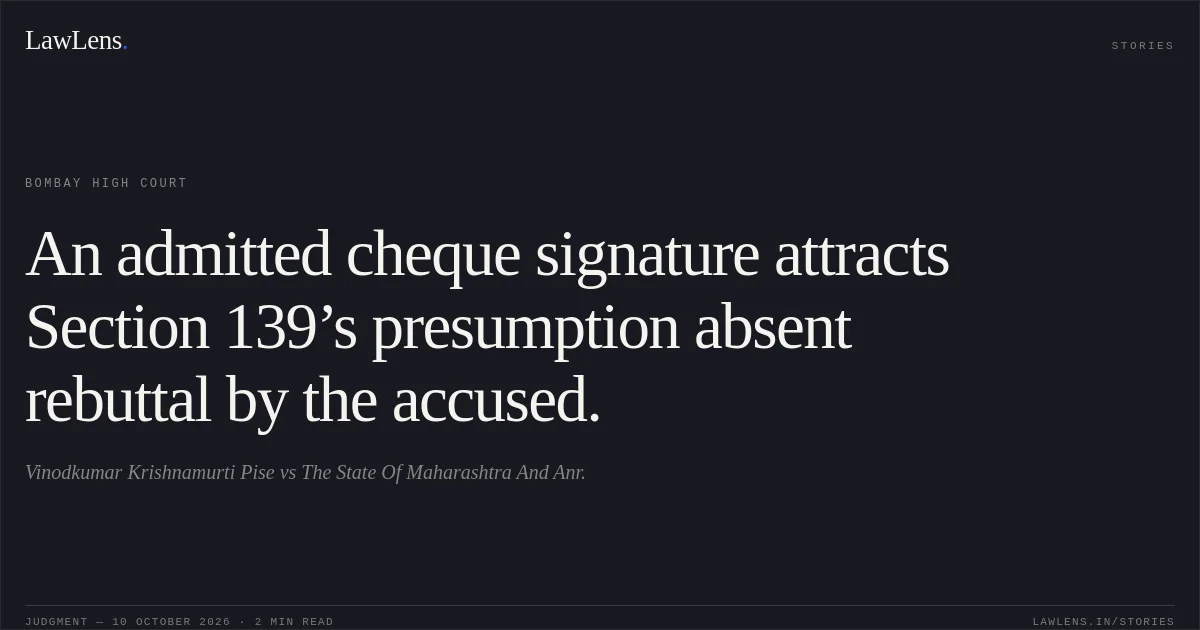
Source reference: p. 1–2Under Sections 118 and 139 of the NI Act, once execution of the cheque is admitted, presumptions arise in favour of consideration and that the cheque was issued towards discharge of a debt or liability; the accused may rebut those presumptions.
Source reference: p. 3; p. 5The Court referred to Sanjabij Tari v. Kishore Borcar (2025 SCC OnLine SC 2069) on those presumptions.
Source reference: p. 3It also considered Vandana Pandey v. Abhilasha Pande, 2018 (4) Bom. C.R. (Cri.) 774, concerning the Section 65B objection, and T.A.N. Moorthy v. C.K. Narayan, Criminal Appeal No. 561 of 2018, on appellate interference with acquittals.
Source reference: p. 4The Court held that the Section 65B objection could not be considered because it had not been raised at trial and no objection was taken when the memo was admitted.
Source reference: p. 6Reasoning
The trial court had rejected the accused’s claim that the promissory notes and loan agreement were forged, and had also not accepted his denial of the signature on the cheque.
Source reference: p. 5The High Court found that the Magistrate overlooked the evidence that ₹10,00,000 had been advanced by cheque and that the accused had not explained the receipt of that amount on any other basis.
Source reference: p. 5The admitted execution of the cheque triggered the Section 139 presumption; the accused did not testify, and the appellant’s cross-examination elicited nothing sufficient to rebut it.
Source reference: p. 5The Section 65B objection was unavailable because it had not been raised when the cheque-return memo was admitted; moreover, the cheque bore the bank’s presentation stamp.
Source reference: p. 6The acquittal was therefore perverse.
Source reference: p. 6Holding
The High Court allowed the appeal, quashed the acquittal, and convicted the accused under Section 138 of the NI Act.
It sentenced him to three months’ simple imprisonment and a fine of ₹25,00,000, with three months’ simple imprisonment in default; ₹20,00,000 of any fine deposited was directed to be paid to the appellant as compensation.
Source reference: p. 7At the accused’s request, operation of the judgment was kept in abeyance for four weeks to enable him to approach the Supreme Court.
Source reference: p. 7Acts & Sections Cited
3 provisions across 1 statute referred to in this judgment. Each provision opens on LawLens.
Negotiable Instruments Act, 18813
Original Court PDF
Vinodkumar Krishnamurti PisevsThe State Of Maharashtra And Anr.
Click to open original judgment
Original judgment, available to read, download and summarize on LawLens.in