Facts
The complainant alleged that, in the course of business transactions concerning fish cultivation and sale, Ravichandran issued a cheque for ₹14,00,000, which was dishonoured when presented.
Source reference: no citationAfter notice and a reply from the accused, the complainant filed a complaint under Section 138 of the Negotiable Instruments Act, 1881.
Source reference: no citationThe trial court convicted the accused and imposed two years’ simple imprisonment and compensation of ₹14,00,000 with interest at 9% per annum, with six months’ simple imprisonment in default; the appellate court affirmed the conviction and sentence.
Source reference: pp. 2–3In revision, the accused contended that the cheque had been issued for security and that no legally enforceable debt existed; the complainant relied on the accused’s admission of his signature, issuance of the cheque, and business dealings.
Source reference: pp. 3–5The accused also failed to comply with the High Court’s condition requiring deposit of the cheque amount for suspension of sentence, after which the Court proceeded to decide the revision on its merits.
Source reference: pp. 7–8Issues
1. Whether the accused rebutted the statutory presumption under Section 139 of the Negotiable Instruments Act that the cheque was issued towards a legally enforceable debt or liability
Source reference: pp. 8–9, 122. Whether the concurrent findings of conviction and sentence under Section 138 disclosed an error, illegality, or perversity warranting interference in revision
Source reference: pp. 12–13Law Applied
Section 138 of the Negotiable Instruments Act, 1881, criminalises the dishonour of a cheque issued towards a legally enforceable debt or liability, subject to the statutory requirements.
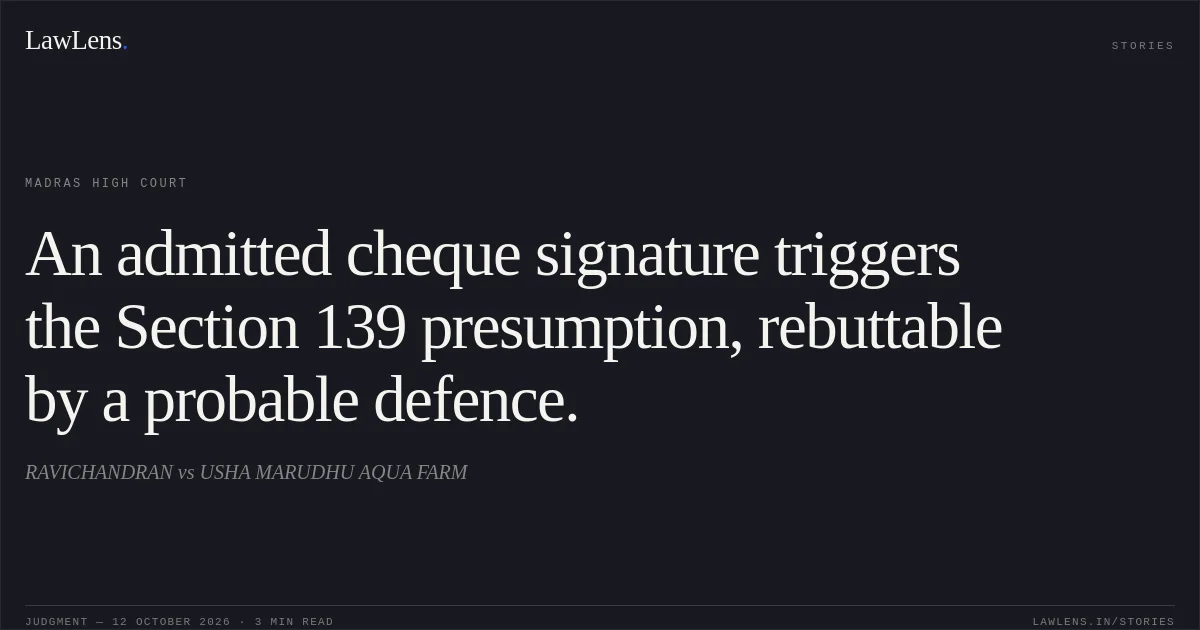
Source reference: no citationUnder Section 139, once the accused admits the cheque signature, a presumption arises that the cheque was received towards discharge of a debt or liability; the accused may rebut that presumption by raising a probable defence.
Source reference: no citationIn Rangappa v. Sri Mohan, (2010) 11 SCC 441, the Supreme Court recognised that the presumption includes the existence of a legally enforceable debt or liability.
Source reference: pp. 10–11In Bir Singh v. Mukesh Kumar, AIR 2019 SC 2446, the Court held that filling in the particulars of a voluntarily signed blank cheque does not, by itself, invalidate it, and the accused bears the onus of establishing that it was not issued towards a debt or liability.
Source reference: pp. 10–11Reasoning
The High Court noted that the accused did not dispute the business dealings, his signature on the cheque, or its issuance to the complainant.
Source reference: pp. 8–9, 12It found that he produced no persuasive evidence to support his claim that the cheque was given only as security or had been misused, and therefore had not raised a probable defence sufficient to rebut the Section 139 presumption.
Source reference: pp. 8–9, 12Applying Rangappa and Bir Singh, the Court concluded that the presumption remained unrebutted and that the courts below had properly found the cheque to have been issued towards a legally enforceable debt.
Source reference: pp. 10–12It found no error, illegality, or perversity warranting revisional interference.
Source reference: pp. 10–12The Court also recorded the accused’s failure to comply with the suspension-of-sentence deposit condition, but nevertheless decided the revision on its merits.
Source reference: pp. 7–8Holding
The High Court dismissed the criminal revision and confirmed the appellate judgment affirming the conviction and sentence under Section 138 of the Negotiable Instruments Act.
It cancelled the earlier order suspending the sentence and directed the trial court to secure the accused to serve the sentence.
Source reference: pp. 13–14Acts & Sections Cited
3 provisions across 2 statutes referred to in this judgment. Each provision opens on LawLens.
Negotiable Instruments Act, 18812
Bharatiya Nagarik Suraksha Sanhita, 20231
Original Court PDF
RAVICHANDRANvsUSHA MARUDHU AQUA FARM
Click to open original judgment
Original judgment, available to read, download and summarize on LawLens.in