Facts
Land belonging to the original allottee, Respondent No. 10, was acquired for the Veer Baji Pasalkar Dam Project.
Source reference: para. 2–3In 2016, alternate lands, including Gat No. 348/1, were allotted to him; following a conversion order dated 3 April 2017, the petitioner purchased Gat No. 348/1 on 28 April 2017.
Source reference: para. 2–3Respondent No. 9 challenged the allotment, alleging excess allotment and prior allotments to the affected co-holders.
Source reference: para. 4, 10–11By order dated 2 January 2020, the Deputy Collector (Rehabilitation) directed the Collector’s name to be recorded and ordered an inquiry into further allotment.
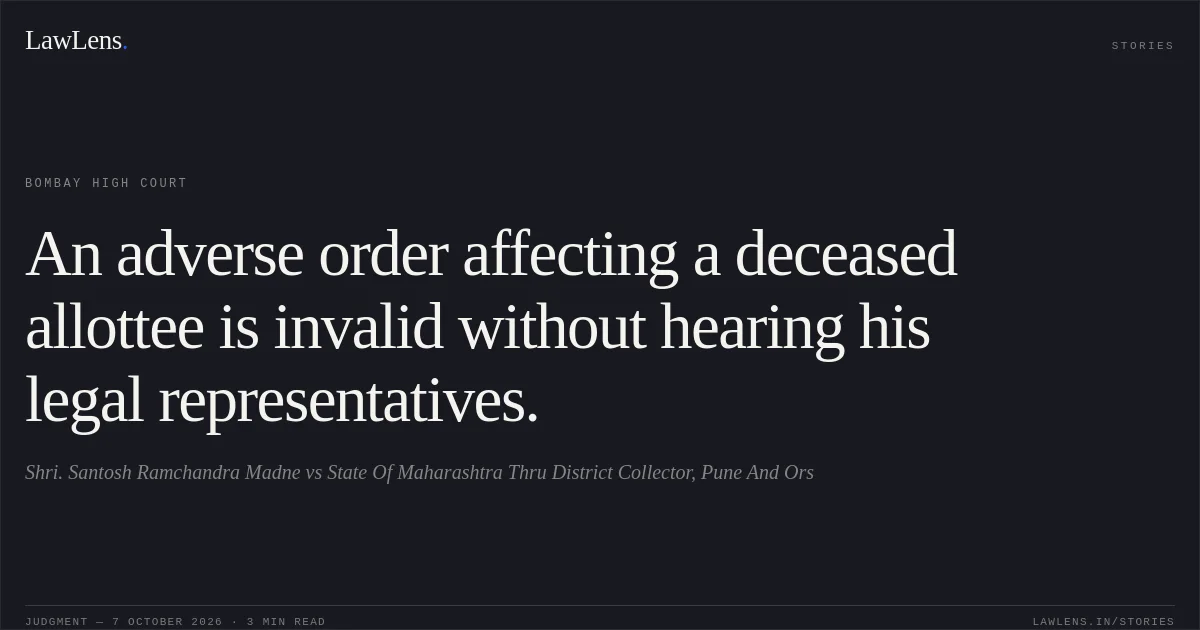
Source reference: para. 4, 10–11Respondent No. 10 had died before it was made, and his legal representatives had not been brought before the Authority.
Source reference: para. 40Issues
Whether Respondent No. 9 had standing to challenge the allotment, and whether the petitioner had standing to challenge the order affecting the land he claimed to have purchased.
Source reference: para. 20–26Whether Respondent No. 10’s entitlement to alternate land, and the legality of the petitioner’s subsequent purchase, could be determined without examining the applicable rehabilitation policy, joint holding, earlier allotments and conditions of grant.
Source reference: para. 27–39Whether the impugned order could stand when it was made after Respondent No. 10’s death without notice to his legal representatives, and without clearly establishing the Authority’s jurisdiction to reopen the earlier order.
Source reference: para. 40–44, 48–50Law Applied
Under Ravi Yashwant Bhoir v. Collector, (2012) 4 SCC 407, a person seeking to challenge an act must show injury to a legally protected right; a general or remote grievance does not confer standing.
Source reference: para. 21–23, 51–52The Government Resolution dated 9 May 1973 governed the relevant rehabilitation entitlement: allotment was subject to the prescribed formula, the nature and area of land lost, family or economic holding, and applicable maximum limits.
Source reference: para. 29–34, 47A transferee cannot obtain a better right than the original allottee, and registration of a sale deed does not by itself validate a transfer contrary to the allotment terms or applicable law.
Source reference: para. 26, 38–39Where an authority proposes to affect rights arising from an allotment after the allottee’s death, the legal representatives of the deceased must receive notice and an opportunity to be heard.
Source reference: para. 40–41The Authority must also identify the legal source of any power to reopen its earlier order and determine limitation under the provision applicable to the proceeding.
Source reference: para. 43–44, 50Sections 247 and 258 of the Maharashtra Land Revenue Code, 1966, were raised by the petitioner in argument, but the Court left the proceeding’s jurisdiction and maintainability for determination on remand.
Source reference: para. 6–7, 42–44, 55(v)Reasoning
Respondent No. 9’s assertion that his predecessor continued to possess or cultivate the acquired land did not establish a right in the alternate land allotted to Respondent No. 10; the petitioner, however, had sufficient standing because the impugned order affected land recorded in his name.
Source reference: para. 24–26The petitioner’s standing did not establish title: his claim derived from the original allottee, and the entitlement and transfer had to be assessed against the 1973 Government Resolution, the joint holding, prior allotments, and the conditions of the 2016 grant.
Source reference: para. 27–39, 47The Court found the impugned order procedurally defective because it affected the deceased allottee’s rights without bringing his legal representatives on record. It also lacked a clear determination of the power to reopen the 2017 order and of the extent of any excess allotment.
Source reference: para. 40–50These matters required fresh consideration by the competent Authority; the Court made no finding that the sale deed was valid or that the petitioner held title.
Source reference: para. 48–54Holding
The Court allowed the writ petitions and quashed the order dated 2 January 2020, remanding the proceedings to Respondent No. 2 for fresh decision after notice and hearing to the legal representatives of Respondent No. 10 and all other affected persons.
The Authority must examine the entitlement under the 9 May 1973 Government Resolution, earlier allotments, the 2016 allotment, the 2017 conversion, the sale deed, and the jurisdiction and maintainability of the proceedings, including the effect of the earlier order dated 14 December 2017.
Source reference: para. 55(iv)–(v)The Court left the validity of the sale deed and the petitioner’s title open, directed the Authority to decide preferably within four months, and ordered status quo regarding the nature and possession of the lands until the fresh decision.
Source reference: para. 55(vi)–(viii)Acts & Sections Cited
2 provisions across 1 statute referred to in this judgment. Each provision opens on LawLens.
Maharashtra Land Revenue Code, 19662
Original Court PDF
Shri. Santosh Ramchandra MadnevsState Of Maharashtra Thru District Collector, Pune And Ors
Click to open original judgment
Original judgment, available to read, download and summarize on LawLens.in