Facts
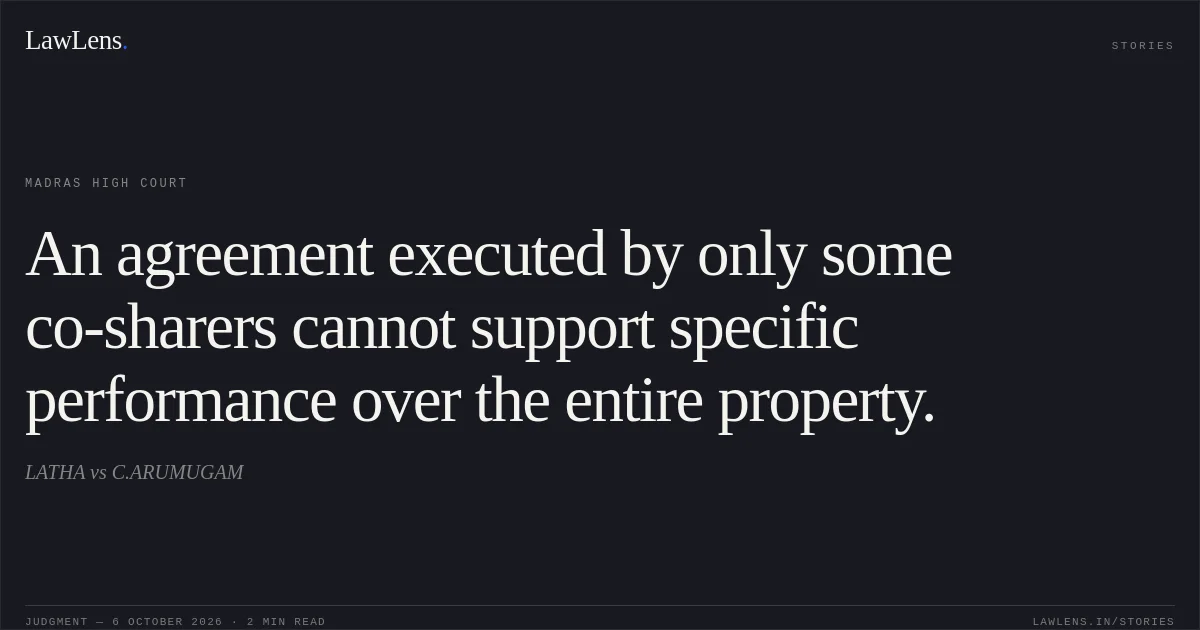
The plaintiff sued for specific performance of an agreement dated 7 December 2009, alleging that the defendants agreed to sell the property for ₹5,00,000, received ₹1,00,000 as advance on the agreement date and a further ₹1,00,000 on 12 December 2009, and failed to execute the sale deed within the agreed one-year period.
Source reference: p. 2–3, 9The defendants maintained that the agreement was executed as security for a loan, and that other co-sharers—including the defendants’ mother—had not joined it.
Source reference: p. 3, 6, 9The trial court dismissed the suit; the first appellate court reversed that decree and granted specific performance. The defendants appealed to the High Court.
Source reference: p. 2, 4, 6Issues
Whether the first appellate court could decree specific performance when the agreement was not executed by all co-sharers, having regard to Section 17 of the Specific Relief Act, 1963 and Pemmada Prabhakar v. Youngmen’s Vysya Association.
Source reference: p. 5Whether the first appellate court could decree specific performance when the plaintiff had not proved readiness and willingness to perform his part of the contract.
Source reference: p. 5Law Applied
The Court considered Sections 12 and 17 of the Specific Relief Act, 1963, stating that an agreement may be enforceable to the extent of a valid contractual interest, but that a person who contracts to sell property without title cannot obtain specific performance in respect of that property.
Source reference: p. 10It also applied the principle that a plaintiff seeking specific performance must plead and prove continuous readiness and willingness to perform the contract.
Source reference: p. 10, 12The Court relied on Pemmada Prabhakar v. Youngmen’s Vysya Association and other authorities concerning agreements made without the participation of all co-sharers and their enforceability.
Source reference: p. 11–12It also referred to Section 8 of the Hindu Succession Act in addressing the rights of the deceased owner’s legal heirs.
Source reference: p. 12Reasoning
The Court found that the agreement did not include all persons with interests in the property, including the defendants’ mother, and that the plaintiff sought specific performance over the entire property despite that omission.
Source reference: p. 9–10, 12It considered the failure to examine the agreement’s attesting witnesses, the defendants’ evidence that the document secured a loan, and the plaintiff’s lack of sufficient evidence of readiness and willingness.
Source reference: p. 10, 12–13It concluded that the first appellate court had not properly considered this evidence and had erred in granting a decree for the entire property without all co-sharers being parties to the agreement and appeal.
Source reference: p. 13Holding
The High Court answered the substantial questions of law in favour of the defendants and against the plaintiff.
It allowed the second appeal, set aside the first appellate court’s decree for specific performance, and restored the trial court’s dismissal of the suit; no costs were awarded.
Source reference: p. 15Acts & Sections Cited
4 provisions across 3 statutes referred to in this judgment. Each provision opens on LawLens.
Code of Civil Procedure, 19081
Specific Relief Act, 19632
Hindu Succession Act, 19561
Original Court PDF
LATHAvsC.ARUMUGAM
Click to open original judgment
Original judgment, available to read, download and summarize on LawLens.in