Facts
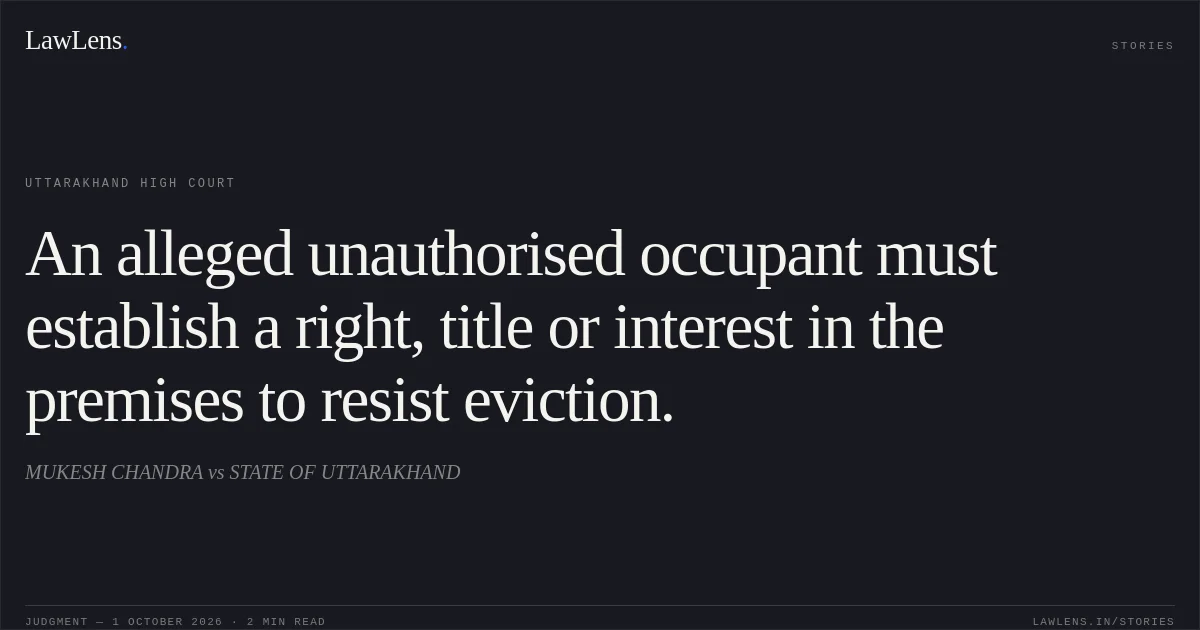
Proceedings under Section 4(1) of the Public Premises (Eviction of Unauthorised Occupants) Act, 1972, culminated in an eviction order against the petitioner on 18 December 2025.
Source reference: para. 2The District Judge dismissed his appeal under Section 9 on 5 September 2026.
Source reference: para. 2The petitioner challenged those orders under Article 227, contending that he had no connection with the land and that his applications for local investigation and additional evidence had not been allowed.
Source reference: para. 4The earlier ex parte eviction order had been set aside on appeal, and the matter remanded for fresh consideration; on remand, the petitioner gave differing accounts of who owned or occupied the house on the land.
Source reference: paras. 2–4, 10–11Issues
Whether the eviction order, as affirmed on appeal, disclosed an error warranting interference under Article 227 of the Constitution
Source reference: paras. 12, 15Whether the petitioner’s complaints concerning the refusal to issue a commission for local investigation and to permit additional evidence warranted interference with the orders below
Source reference: paras. 4, 6–8Law Applied
Section 4(1) of the Public Premises (Eviction of Unauthorised Occupants) Act, 1972 provides for notice to a person alleged to be in unauthorised occupation, and Section 9 provides for an appeal against the prescribed authority’s order.
Source reference: paras. 2, 5The Court’s stated basis for declining relief was that supervisory jurisdiction under Article 227 did not warrant interference absent a jurisdictional error, particularly where the petitioner had an opportunity to defend his possession and the statutory procedure had been followed.
Source reference: para. 15The State submitted that the recipient of a Section 4(1) notice bears the burden of establishing title to the land and that additional evidence at the appellate stage is not available as of right; it also argued that the authorities’ powers under the Act and Rule 10 of the U.P. Public Premises (Eviction of Unauthorised Occupants) Rules, 1973 are limited.
Source reference: paras. 5–8Reasoning
The Court relied on the petitioner’s inconsistent positions: he claimed the house belonged to him, but also stated that it belonged to his brother and nephew, whom he identified in cross-examination as the occupants; he also stated that he would have no objection to removal of his unauthorised occupation.
Source reference: paras. 9–10The Court found that he had not established any right, title, or interest in the land and noted that he had actively contested the proceedings, including challenging the earlier eviction order.
Source reference: paras. 11, 13–14It concluded that the authorities had considered the relevant circumstances, the petitioner had received a reasonable opportunity to defend his possession, and no jurisdictional error had been shown.
Source reference: para. 15The Court did not separately determine the legal merits of the petitioner’s objections concerning the commission or additional evidence.
Source reference: no citationHolding
The Court held that there was no basis to interfere under Article 227
dismissed the writ petition, leaving the eviction order as affirmed by the District Judge undisturbed
Source reference: paras. 15–16Acts & Sections Cited
2 provisions across 1 statute referred to in this judgment. Linked provisions open on LawLens.
Public Premises (Eviction of Unauthorised Occupants) Act, 19722
Original Court PDF
MUKESH CHANDRAvsSTATE OF UTTARAKHAND
Click to open original judgment
Original judgment, available to read, download and summarize on LawLens.in