Facts
The petitioner, an employee of Punjab and Sind Bank since December 1976, had availed loans from various Credit and Thrift Societies and defaulted in repayment.
Source reference: p.1–2; paras. 2–3She was earlier warned in 2001 and cautioned against incurring debts without prior permission.
Source reference: p.1–2; paras. 2–3Subsequently, she allegedly obtained loans from Standard Chartered Bank and Bank of Maharashtra without the requisite permission, represented herself as a Grade-I Officer, and used a purportedly false or fabricated No Objection Certificate.
Source reference: p.2; para. 3A charge-sheet was issued on 12 May 2004, and the petitioner admitted the charges during the departmental enquiry.
Source reference: p.2; para. 4The Enquiry Officer found the charges proved, following which the Disciplinary Authority imposed compulsory retirement with retirement benefits on 2 June 2005.
Source reference: p.2; para. 5The Industrial Tribunal upheld the punishment by award dated 22 February 2011.
Source reference: p.3; paras. 6–7In the writ petition under Articles 226 and 227, the petitioner principally challenged the competence of the authorities that imposed the penalty and decided her appeal.
Source reference: p.1; para. 1Issues
Whether the disciplinary and appellate proceedings were vitiated because the Zonal Manager imposed the penalty despite the applicable staff circular designating the Chief Manager as the Disciplinary Authority and the Zonal Manager as the Appellate Authority.
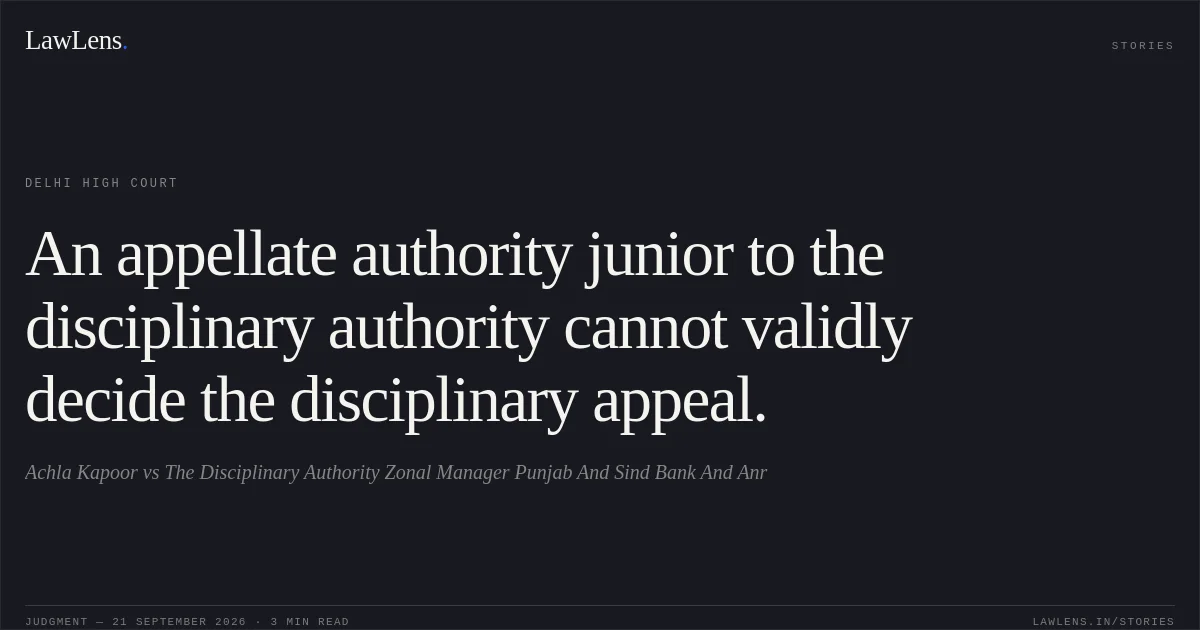
Source reference: p.5; para. 16Whether the appeal was invalidly decided by a Deputy General Manager who was junior in rank to the Zonal Manager/General Manager who had imposed the penalty.
Source reference: p.5–6; paras. 17–19Whether, in view of the defect in the appellate proceedings and the prolonged passage of time, the matter should be remanded for fresh appellate consideration or an alternative relief should be granted.
Source reference: p.6–7; paras. 21–25Law Applied
The Court exercised its jurisdiction under Articles 226 and 227 of the Constitution of India.
Source reference: p.1; para. 1It applied Staff Circular No. 2569 dated 31 January 2000, which designated the Chief Manager of the concerned zone as the Disciplinary Authority and the Zonal Manager as the Appellate Authority.
Source reference: p.5; para. 16The Court further applied the administrative-law principle that an appeal against a disciplinary order must be considered by an authority superior in rank to the authority that passed the original order; permitting a junior or equivalent officer to decide the appeal undermines the purpose of the appellate remedy and violates principles of natural justice and administrative hierarchy.
Source reference: p.6; paras. 18–19The Court also distinguished the validity of the misconduct findings from the procedural defect in the appellate proceedings.
Source reference: p.6; para. 22Reasoning
The Court found that the Zonal Manager, who was designated under the circular as the Appellate Authority, had acted as the Disciplinary Authority, while the Deputy General Manager acted as the Appellate Authority, contrary to the circular.
Source reference: p.5; para. 16Even assuming that the Zonal Manager/General Manager, being senior to the designated Chief Manager, could validly impose the penalty, the appeal was decided by a Deputy General Manager who was junior to the authority that imposed the punishment.
Source reference: p.5–6; para. 17This denied the petitioner a meaningful and fair appellate remedy, thereby compromising the appellate proceedings.
Source reference: p.6; paras. 18–19However, the Court held that this procedural defect did not erase the petitioner’s proved misconduct or require reopening the disciplinary findings.
Source reference: p.6; para. 22Although remand would ordinarily have followed, the penalty had been imposed in 2005 and the dispute had already remained pending for approximately two decades.
Source reference: p.6–7; paras. 21–24A remand would therefore cause further litigation and would not serve the ends of justice.
Source reference: p.6–7; paras. 21–24Holding
The Court held that the appellate proceedings were invalid because the appeal had been decided by an authority junior to the authority that imposed the penalty, thereby denying the petitioner a fair substantive right of appeal.
Nevertheless, the findings that the petitioner had committed the charged misconduct were left undisturbed.
Source reference: p.6; para. 22The Court declined to remand the matter and, in lieu of reopening the disciplinary proceedings, awarded lump-sum compensation of ₹3,00,000 to the petitioner, payable by Respondent No. 1 within eight weeks.
Source reference: p.7; para. 25The impugned Tribunal award was set aside and the order of penalty was modified accordingly.
Source reference: p.7; para. 26Original Court PDF
Achla KapoorvsThe Disciplinary Authority Zonal Manager Punjab And Sind Bank And Anr
Click to open original judgment
Original judgment, available to read, download and summarize on LawLens.in