Facts
The complainant alleged that the accused had taken away his wife, children, and his younger brother’s wife and daughter, and lodged a complaint under Section 498 of the Indian Penal Code (IPC) read with Section 3(1)(12) of the Scheduled Castes and Scheduled Tribes (Prevention of Atrocities) Act, 1989
Source reference: paras. 1–2, pp. 1–2After trial, the Special Judge acquitted the accused on 17 March 2018.
Source reference: paras. 1, 4–5, pp. 1, 3The complainant appealed against the acquittal under Section 378 of the Code of Criminal Procedure, 1973
Source reference: paras. 1, 4–5, pp. 1, 3Issues
Whether the trial court was justified in acquitting the accused
Source reference: para. 8, p. 5Whether the trial court correctly appreciated the prosecution evidence, and whether its acquittal judgment disclosed any illegality, irregularity, or perversity warranting appellate interference
Source reference: para. 8, p. 5Law Applied
Section 498 IPC and Section 3(1)(12) of the Atrocities Act were the provisions under which the accused had been charged
Source reference: paras. 1, 2.2, pp. 1–2In an appeal against acquittal, the appellate court may review and reappreciate the evidence, but must account for the reinforced presumption of innocence following acquittal; where two reasonable views are possible, it should not disturb the acquittal. Interference is warranted where the trial court’s conclusion is perverse or rests on manifest error
Source reference: paras. 13–14, pp. 7–8The court relied on Chandrappa v. State of Karnataka, (2007) 4 SCC 415; Rajesh Prasad v. State of Bihar, (2022) 3 SCC 471; Babu Sahebagouda Rudragoudar v. State of Karnataka, (2024) 8 SCC 149; and Ramesh v. State of Karnataka, (2024) 9 SCC 169, for these principles
Source reference: paras. 15–16, pp. 8–10Reasoning
The High Court found that the complainant’s allegations were not supported by the testimony of his daughter, his brother’s daughter, the two alleged victims, or the police witnesses
Source reference: paras. 10, 12, pp. 5–7The complainant’s cross-examination also raised doubts about his credibility, including evidence that he had previously made similar allegations against village residents and settled those complaints after receiving money.
Source reference: paras. 10–12, pp. 5–7The evidence further indicated that the present complaint may have been lodged to protect himself from proceedings initiated by his wife
Source reference: paras. 10–12, pp. 5–7The prosecution therefore failed to prove the alleged conduct or the basic ingredients of the Atrocities Act offence beyond reasonable doubt.
Source reference: paras. 12, 17–18, pp. 6–10Applying the heightened restraint applicable to an appeal against acquittal, the High Court found no perversity or other basis to interfere
Source reference: paras. 12, 17–18, pp. 6–10Holding
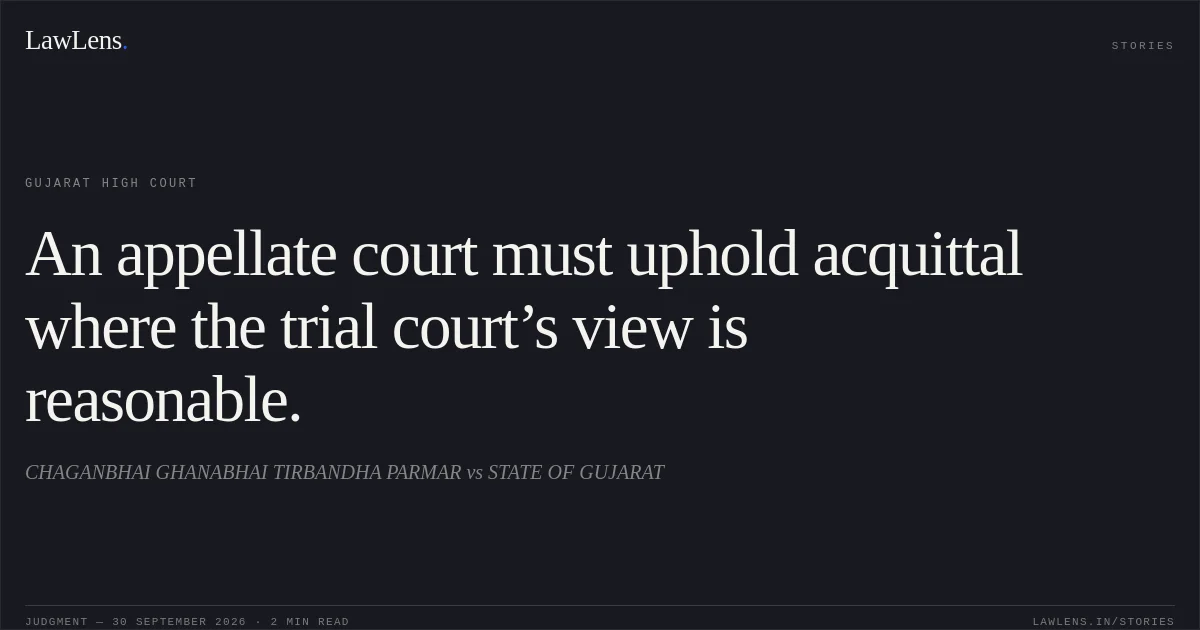
The High Court answered the issues in favour of upholding the acquittal.
It held that the prosecution had not proved the charges beyond reasonable doubt and that the trial court had committed no reviewable error
Source reference: paras. 17–18, p. 10The appeal was dismissed, the acquittal confirmed, the bail bond cancelled, and the record and proceedings ordered returned to the trial court
Source reference: para. 19, p. 11Acts & Sections Cited
5 provisions across 3 statutes referred to in this judgment. Each provision opens on LawLens.
Code of Criminal Procedure, 19733
Indian Penal Code, 18601
Scheduled Castes and the Scheduled Tribes (Prevention of Atrocities) Act, 19891
Original Court PDF
CHAGANBHAI GHANABHAI TIRBANDHA PARMARvsSTATE OF GUJARAT
Click to open original judgment
Original judgment, available to read, download and summarize on LawLens.in