01Facts
The petitioner, as plaintiff, obtained a decree for declaration of title and permanent injunction on 22 February 2022.
¶ 1–4Respondent No. 1 appealed under Section 96 of the Code of Civil Procedure on 24 November 2022 and sought condonation of delay under Section 5 of the Limitation Act.
¶ 1–4It attributed the delay to its officers’ involvement in local elections and their lack of knowledge of the decree. The appellate court allowed the application, finding sufficient cause. The petitioner challenged that order under Article 227 of the Constitution, arguing that the explanation was inadequate.
¶ 1–4, 6–802Issues
i.1. Whether the appellate court erred in finding sufficient cause under Section 5 of the Limitation Act and condoning the delay in filing respondent No. 1’s appeal.
¶ 3–4, 7–9ii.2. Whether the appellate court’s order warranted interference under Article 227 of the Constitution.
¶ 1, 9, 1103Law Applied
Section 5 of the Limitation Act permits a delayed appeal to be admitted where sufficient cause for the delay is shown.
¶ 3, 6–7In considering condonation, courts should adopt a liberal approach to advance substantial justice; the exercise of discretion will not ordinarily be disturbed merely because another view is possible, absent illegality or material irregularity.
¶ 9The High Court’s supervisory jurisdiction under Article 227 does not justify interference with a discretionary order unless the requisite grounds for intervention are established.
¶ 1, 9The appeal was brought under Section 96 of the CPC.
¶ 3Provisions in the judgment · 2 · Linked ones open on LawLens
Limitation Act, 1963 Section 5
Code of Civil Procedure, 1908 Section 96
04Reasoning
The High Court found that the appeal had been filed on 24 November 2022, making the delay approximately eight months—not four years as the petitioner contended.
¶ 6Respondent No. 1’s explanation that its officers were occupied with local elections and had not learned of the decree until later was considered probable, given the administrative responsibilities of the State and its Collector.
¶ 7–9Although the application did not give precise details of the elections, the appellate court was entitled to accept the explanation as sufficient; its discretionary decision disclosed no illegality or material irregularity warranting Article 227 intervention.
¶ 7–9The cited decision in Sh. Satish Yadav and Others v. Sh. Vijay Pal and Others was held inapplicable.
¶ 1005Holding
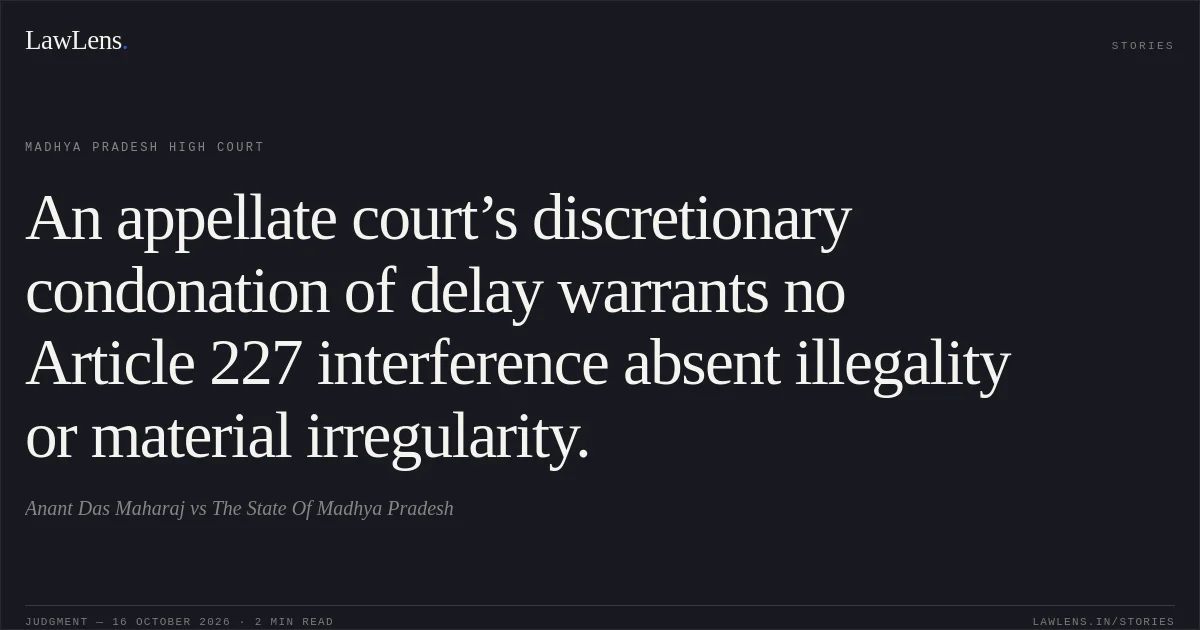
The Court held that the appellate court had acted within its discretion in condoning the delay and that no ground for supervisory interference was made out.
¶ 9, 11It affirmed the impugned order and dismissed the petition; the appeal remains pending for decision on its merits.
¶ 9, 11Original Court PDF
Anant Das MaharajvsThe State Of Madhya Pradesh
Click to open original judgment
Original judgment, available to read, download and summarize on LawLens.in