Facts
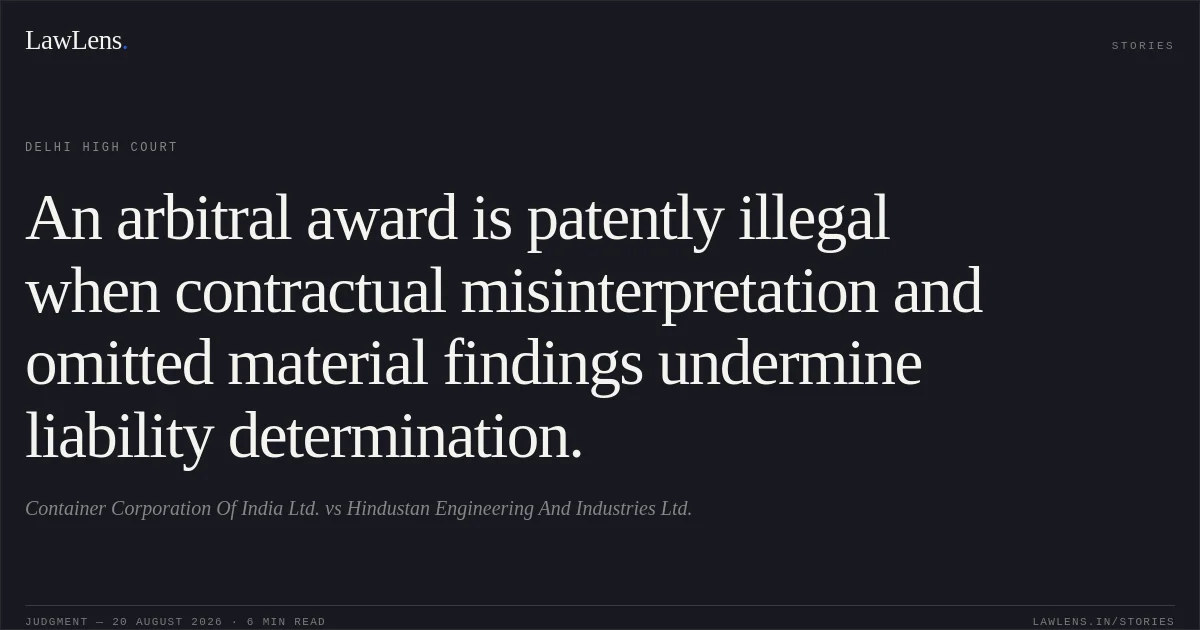
CONCOR awarded HEIL a contract for the design, manufacture and supply of 345 sets of five-wagon container flat units under a World Bank-assisted project.
Source reference: paras. 2.1–2.11The contract required HEIL to develop the design, submit drawings, manufacture and obtain approval of a prototype, and thereafter supply the wagons within stipulated timelines.
Source reference: paras. 2.1–2.11During execution, disputes arose regarding incomplete drawings, design modifications, prototype approval, supply delays, industrial unrest and difficulties in transporting axles from Romania.
Source reference: paras. 4.1–5.10The contract was ultimately completed on 16 September 2001, allegedly 1,326 days late.
Source reference: paras. 4.1–5.10CONCOR recovered Rs.18,88,43,273/- as liquidated damages.
Source reference: paras. 6.1–7.7HEIL commenced arbitration seeking refund of the liquidated damages, escalation and other amounts, while CONCOR raised substantial counterclaims for loss of traffic revenue and other consequential losses.
Source reference: paras. 6.1–7.7By Award dated 13 October 2015, the Sole Arbitrator held that time was not of the essence, found that the delay was not attributable to HEIL, directed refund of the liquidated damages, awarded Rs.47,39,893/- towards first-rake escalation and Rs.1,72,50,000/- towards restoration of a conditional price reduction, rejected CONCOR’s counterclaims, and awarded interest and costs.
Source reference: paras. 9.1–9.23Both parties challenged different portions of the Award under Section 34 of the Arbitration and Conciliation Act, 1996.
Source reference: para. 9.24Issues
Whether the petitions were governed by the amended Section 34 of the Arbitration and Conciliation Act, 1996, including the ground of patent illegality under Section 34(2A), since they were filed after 23 October 2015?
Source reference: paras. 13.1(a), 14.1–14.9Whether the Arbitral Tribunal’s interpretation of amended Clause 2.1 of the Technical Specifications as permitting an entirely new and untested design was legally sustainable?
Source reference: paras. 13.1(b), 16.1–16.10Whether the Tribunal correctly determined responsibility for delay, including the issues concerning completeness of drawings, design changes and regular supplies after prototype approval?
Source reference: paras. 13.1(c), 17.1–18.3Whether the extensions of time granted by CONCOR, despite express reservations of contractual rights, waived or extinguished its right to claim liquidated damages?
Source reference: paras. 13.1(d), 19.1–19.18Whether the Award of refund of liquidated damages and rejection of CONCOR’s counterclaims were sustainable without determining the periods and causes of delay attributable to HEIL?
Source reference: paras. 19.14–19.25, 22.1–22.5Whether the Award of escalation for the first rake and restoration of the conditional price reduction warranted interference under Section 34?
Source reference: paras. 13.1(e), 23.1–24.12Whether HEIL was entitled to escalation claims for Serial Nos. 2 to 12 of Annexure-F despite failure to furnish the contractual particulars and adjustment dates?
Source reference: paras. 13.1(f), 25.1–25.7Whether the Court should remit the Award under Section 34(4), or preserve severable portions while setting aside the legally unsustainable portions?
Source reference: paras. 13.1(g), 27.1–28.20Law Applied
The Court applied Sections 34(2), 34(2A) and 34(4) of the Arbitration and Conciliation Act, 1996, holding that the amended Section 34 applies to Section 34 petitions filed on or after 23 October 2015, irrespective of when the arbitration commenced, as explained in BCCI v. Kochi Cricket (P) Ltd., Ssangyong Engineering & Construction Co. Ltd. v. NHAI, Shree Vishnu Constructions v. Military Engineering Service and Hindustan Construction Co. Ltd. v. Union of India.
Source reference: paras. 14.2–14.6Patent illegality permits interference where the award is contrary to the contract, based on no evidence, ignores material evidence, adopts an impossible interpretation or contains a decision-making defect going to the root; however, Section 34 does not permit appellate reappreciation of evidence or substitution of a merely more plausible interpretation, as stated in McDermott International Inc. v. Burn Standard Co. Ltd., DMRC Ltd. v. Delhi Airport Metro Express (P) Ltd., PSA Sical Terminals (P) Ltd. v. V.O. Chidambaranar Port Trust and State of Chhattisgarh v. Sal Udyog Pvt. Ltd.
Source reference: paras. 15.1–15.10Under Sections 55, 73 and 74 of the Indian Contract Act, 1872, a finding that time is not of the essence does not eliminate compensation for delay; contractual liquidated damages remain subject to proof of breach and reasonable compensation.
Source reference: paras. 19.4–19.18Extensions granted with an express reservation of rights do not by themselves waive the right to claim damages.
Source reference: paras. 19.4–19.18Section 34(4) is discretionary and may cure inadequate reasons supporting an existing finding, but cannot be used to remit an award requiring fresh adjudication of contentious issues on which no findings were recorded, as explained in Kinnari Mullick v. Ghanshyam Das Damani, I-Pay Clearing Services (P) Ltd. v. ICICI Bank Ltd. and Gayatri Balasamy v. ISG Novasoft Technologies Ltd.
Source reference: paras. 27.1–27.7Reasoning
The Court held that the Tribunal had misread amended Clause 2.1. The amendment replaced the requirement that the complete wagon design be “proven” with a requirement that its design features have been successfully used on an advanced railway system for at least two years; it did not authorise an entirely new or untested design.
Source reference: paras. 16.1–16.10This interpretation also disregarded Clauses 1.2.1, 1.3, 1.6, 1.7 and 1.13.1, which placed responsibility for design, compliance, modifications and performance on HEIL notwithstanding CONCOR’s approval of drawings or prototype.
Source reference: paras. 16.11–16.17The Tribunal consequently attributed the entire delay to CONCOR without determining whether particular drawing deficiencies and design changes were contractual obligations of HEIL or purchaser-directed variations.
Source reference: paras. 17.1–18.3Its findings on Issues Nos. 15, 16 and 26 merely adopted the conclusion under Issue No. 14 and did not address the material factual questions concerning timely drawings, responsibility for design changes and post-prototype supply delays.
Source reference: paras. 17.1–18.3Although the finding that time was not of the essence was a plausible interpretation of the contract and the parties’ conduct, that finding did not preclude compensation for delay.
Source reference: paras. 19.1–19.13CONCOR’s extension letters expressly reserved its right to levy liquidated damages, and HEIL accepted the extensions; therefore, no waiver was established.
Source reference: paras. 19.1–19.13Nevertheless, CONCOR’s entitlement to retain the entire liquidated-damages amount could not be decided without determining HEIL’s responsibility for particular periods of delay, the effect of force majeure and the reasonable compensation payable under Sections 73 and 74 of the Contract Act.
Source reference: paras. 19.14–19.24The Tribunal’s force majeure findings regarding the occurrence of industrial unrest and shipping difficulties were not disturbed, but those events could excuse only the periods actually affected and could not retrospectively eliminate responsibility for earlier delays.
Source reference: paras. 20.1–20.11The first-rake escalation award was upheld because the Tribunal applied a possible contractual interpretation, considered the supporting material and confined escalation to the original delivery period.
Source reference: paras. 23.1–23.12The restoration of the conditional price reduction was also upheld because the Tribunal reasonably found that the July 1999 correspondence did not validly amend the contract under Clause 19.
Source reference: paras. 24.1–24.12HEIL’s escalation claims for Serial Nos. 2 to 12 were rightly rejected because the necessary indices, shipment dates, adjustment dates and supporting particulars were not established; the Court could not supply those missing facts or recalculate the claims under Section 34.
Source reference: paras. 25.1–25.7Since the defects required fresh adjudication rather than merely additional reasons, the Court declined remission under Section 34(4) and severed the unsustainable portions from the independently sustainable portions of the Award.
Source reference: paras. 27.3–28.20Holding
CONCOR’s petition, O.M.P. (COMM) No. 11/2016, was partly allowed.
The direction to refund Rs.18,88,43,273/- towards liquidated damages, together with interest on that amount, was set aside; however, the Court did not hold that CONCOR was automatically entitled to retain the entire amount, leaving the parties to pursue an appropriate remedy in accordance with law.
Source reference: paras. 28.1, 28.21The rejection of CONCOR’s counterclaims was set aside to the limited extent that it rested solely on the unsustainable finding that HEIL was not responsible for delay; no counterclaim was adjudicated or awarded on merits.
Source reference: paras. 28.10, 28.22The award of Rs.47,39,893/- towards first-rake escalation, with 9% simple interest, and Rs.1,72,50,000/- towards restoration of the conditional price reduction, with 9% simple interest, was upheld.
Source reference: paras. 28.23–28.24HEIL’s petition, O.M.P. (COMM) No. 50/2016, challenging rejection of escalation claims for Serial Nos. 2 to 12, was dismissed.
Source reference: para. 28.25No remission under Section 34(4) was ordered, and the award of costs in favour of HEIL was maintained.
Source reference: paras. 27.9, 28.17, 28.26Acts & Sections Cited
9 provisions across 2 statutes referred to in this judgment. Each provision opens on LawLens.
Arbitration and Conciliation Act, 19966
Indian Contract Act, 18723
Original Court PDF
Container Corporation Of India Ltd.vsHindustan Engineering And Industries Ltd.
Click to open original judgment
Original judgment, available to read, download and summarize on LawLens.in